Bellingcat proves the Russians didn’t do it.

http://turcopolier.typepad.com/sic_semper_tyrannis/2016/09/bellingcat-proves-the-russians-didnt-do-it.html

The Bellingcat site has a piece entitled “Confirmed : Russian Bomb Remains Recovered from Syrian Red Crescent Aid Convoy Attack” which includes this picture as well as several others. You may look at the others, but this one picture is apodictic proof 1) that the Russians (or Syrians) didn’t do it and 2) that Bellingcat is a loyal servant of the Borg.

syria-aid-convoy-bomb

He spends a lot of efforts to establish that the metal piece is the tail piece of a Russian-made OFAB 250-270 Fragmentation High Explosive Bomb. No argument there, I’m sure it is. Said bomb has 92kg of explosive. Which is quite a lot.

  • If said bomb had exploded in this not very large room, all those cardboard boxes would be torn to pieces and burned. To say nothing of a lot more damage to the room itself. Therefore it did not explode in that room.
  • If said bomb was a dud and did not explode, where is the rest of it? Therefore the bomb was not a dud.
  • Therefore the bomb piece was put there to make it look as if the Russians had done it. (And not very competently either: note that it is supposed to have come through the ceiling and neatly placed itself underneath some undamaged cardboard boxes.)
  • If it is necessary to produce a fake picture, then the Russians didn’t do it.
  • QED

And, as a bonus, by perpetrating this fraud, Bellingcat has also proved that he is a stooge of the war party.

A lot to deduce from one photo, isn’t it? It used to be that it took more effort to disprove Bellingcat’s fakes. He’s losing his touch.

First You Ride the Meme and Then the Meme Rides You

What follows was put into my head by a piece claiming that in Syria “Russia [was] using advanced weapons system developed through a secret agreement with extraterrestrial visitors“. I’m not suggesting that anyone take this seriously but notice the assumption that Putin is in the superhuman category. Its creators are losing control of Putin Derangement Syndrome.

At first Putin was a figure to be mocked. He overcompensated for being short by taking his shirt off on all possible occasions, by catching large fish, finding amphoras and wrestling tigers. The high point of the mocking period was the Olympics: he’d squandered billions building a site where the water was brown and the doorknobs fell off.

But then the quick little regime change in Ukraine went sour and Putin became evil. As one of Canada’s professional Ukrainians put it “My Ukraine: A personal reflection on a nation’s dream of independence and the nightmare Vladimir Putin has visited upon it.” Ukrainians just wanna have fun but Putin turned the dream into a nightmare. Remember Olga Znachkova who didn’t want the Eurasian Union but wanted frilly undies instead? Evil Putin stole them too. “Smart but truly evil man” says Madeleine Albright (of all people). Too evil for derision but still limited in his effect: a “regional power” acting out of weakness.

But PDS has evolved far past any localised evil, let alone mockery. In my Putin Derangement Syndrome collection in August there were two principal themes. The first was that Putin had the very same uncanny influence over Donald Trump and Jill Stein that he had had over Bernie Sanders; in other words, he has such a grip on the American election that Hillary Clinton is the only truly American candidate left. The second theme was the extraordinary ability of RT and other Russian media outlets to shape people’s thoughts; far exceeding the effects of the much (much) better funded Western outlets. Putin has the power to cloud minds at a distance: he operates at a more than merely human status and he’s using that power to reshape the world.

This is an illuminating case study because it shows that propaganda can take off on its own and exceed the intentions of its originators. The US establishment is fond of demonising its enemies – in recent times we have seen it happen to Milosevic, Saddam Hussein, bin Laden and many others – but those hate campaigns, once they had whipped up war support, ceased and were forgotten (anyone remember Aidid?). Washington’s current trouble is that it has never tried the technique against someone whom it can’t get at, against someone who is not cowed and, worst of all, against someone who outwits it at every stage. The propagandists have no idea of what to do except turn the volume up higher and higher. So the rhetoric builds and builds, more and more extreme, larger and larger until it bursts into full-blown psychosis and panic.

Putin is already the Moriarty, the Voldemort of the US propaganda machine: the hidden power behind everything bad. Will we see Putin the extraterrestrial agent or Putin the Antichrist, already out there in the crazy fringe, start to appear in the NYT or WaPo as they are compelled to account for the next ratcheting up of hysteria?

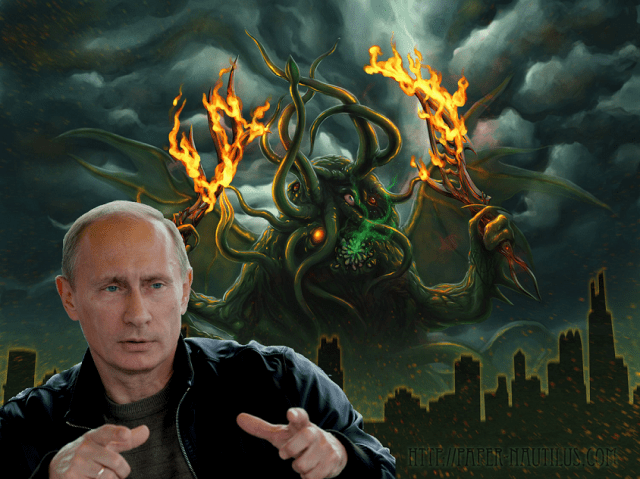
Economist cover sometime next year: Cthulhu Returns!

cthulu-putin


Putin Derangement Syndrome August 2016

In which I collect all the examples of this strange mental defect that have caught my attention in the month of August in the seventeenth year of The New American Century.

A NEW MEME?

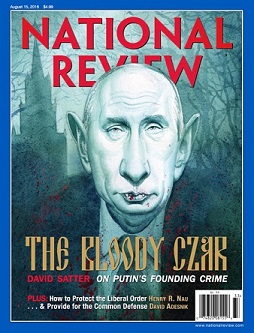
Vladimir Nosferatuvich Putin

cover_overlay_20160815

PUTIN IS WINNING THE US ELECTION

Hillary Clinton says “We know that Russian intelligence services, which is part of the Russian government which is under the firm control of Vladimir Putin, hacked into the DNC. And we know that he arranged for a lot of those e-mails to be released.” (Director of National Intelligence James Clapper would call this “hyperventilating” but what’s he know?).

Anne Applebaum informs us: “This time the goal is to disrupt the American election, discredit the process and, if possible, elect Donald Trump as President of the United States. All available evidence now points to Russian involvement in a thorough hack of the Democratic National Committee.”

Speaking of “all available evidence”, the WaPo tells us the lack of “fingerprints” is the evidence; CBS says the presence of “fingerprints” is the evidence. One or the other, I guess: but it’s all “evidence”, isn’t it?

A “scholar of Russian espionage and political subversion” informs us “For the first time since the 1950s, Russian subversion of the American political process has become a presidential campaign issue.

Jill Stein of the Green Party has been contaminated by Putin.

They’re everywhere: “Putin’s Pawns: Beware the Hillary Clinton-Loathing, Donald Trump-Loving Useful Idiots of the Left .”

And then there’s Donald Trump himself: “an unwitting agent of the Russian Federation.” A Clinton campaign video lays out the evidence of “Donald Trump’s connection to Vladimir Putin“. “So, you can say Trump and his friend Putin are the founder of ISIS, which probably would be more accurate than calling out the commander-in-chief in that way.” McFaul explains “Why Putin wants a Trump victory (so much he might even be trying to help him)”. Clinton says Putin, Farage and Trump are all together; her campaign chief details the links between Putin and Trump.

But maybe none of this matters, as the WaPo explains; Putin might use Russia’s tremendous hacking power to disrupt the entire election. He’s already sniffing around: “Russians Hacked Two U.S. Voter Databases, Officials Say” and he’s gnawing away at the “newspaper of record“. Maybe it’s already too late: “Vladimir Putin Has Already Won Our Election: It’s time to face the facts: Kremlin spies and hackers are undermining American politics“.

(A small request – can we have a pronunciation closer to vla-DEE-mir than VLAD-i-mir? Americans ought to be able to pronounce the name of their soon-to-be Commander-in-Chief.)

PUTIN’S MIND CONTROL

Just watching RT for a short time can so twist people’s thinking that they have to be put on a remedial course of BBC watching.

Are Putin’s beauties on a secret mission to break up the UK?

Then there’s the Nooscope. Whatever that is. But it’s frightening and sinister. A sort of mental Dracula, I suppose. Fortunately we have Masha Gessen to guide us through the forest “A final fact about Vayno is that the letters of his last name can spell voyna, the Russian word for war. Is this the message that Putin is sending?Вайновойна, you decide. Maybe Putin’s “gunslinger walk” or Asperger’s affects his ability to spell. (But he could probably find, or create, someone actually named Антон Эдуардович Война if he really tried, don’t you think?) But, as Gessen is a homonym for guessin’, who knows what message is being sent by whom?

The NYT suggests that in Sweden, where actually two thirds don’t want to join NATO, all expressed opposition to joining can only be the work of A Powerful Russian Weapon: The Spread of False Stories. (Amusing to consider the three “false stories” the NYT mentions and think: 1) nukes in İncirlik 2) renditions and other things we only learn about later and 3) SOFA – see Okinawa. The NYT should put more effort into its propaganda: this is an insult to its readers.)

MISCELLANEOUS

Time for another Olympics, time for another invasion says Luke Harding. (Bit stale-dated that, but the Para-Olympics aren’t over so there’s still time for Putin to invade somebody. But Harding can recycle the piece in two years.)

Why is Russia in Syria? Don’t waste your time listening to what the Kremlin says: the current Porcelain Cup holder knows it’s because “Russia wants to erase the humiliation of the Soviet Union’s defeat in Afghanistan in the 1980s.

But there’s hope: despite all that Putin has done “Twenty-five years after the great revolution that toppled the Soviet regime, the spirit of dignity and freedom still burns.

Next month, new collection. The PDS epidemic is very contagious.

NATO, Back in Business at the Old Stand

http://turcopolier.typepad.com/sic_semper_tyrannis/2016/07/nato-back-in-business-at-the-old-stand.html

JRL 2016/132/16

http://nato.trendolizer.com/2016/07/nato-back-in-business-at-the-old-stand-by-patrick-armstrong.html

http://timberexec.co.uk/nato-back-in-business-at-the-old-stand-patrick-armstrong/

https://www.reddit.com/r/russia/comments/4stb0d/nato_back_in_business_at_the_old_stand_by_patrick/

http://uk.makemefeed.com/2016/07/17/nato-back-in-business-at-the-old-stand-patrick-armstrong-1788953.html

http://snapzu.com/AdelleChattre/nato-back-in-business-at-the-old-stand

http://russia-insider.com/en/politics/nato-back-business-old-stand/ri15629

https://off-guardian.org/2016/07/21/nato-back-in-business-at-the-old-stand/

https://theflippintruth.wordpress.com/2016/07/21/nato-back-in-business-at-the-old-stand/

Spare a thought for the travails of NATO drones over the past couple of decades. About 25 years ago I was in competition for a job on the International Staff at NATO. I’ve forgotten most of the details but it would have paid about US$100,000. Tax free. Plus benefits. What would have been the equivalent salary, in the real world, to that, do you suppose? In return, NATO started work sometime Monday afternoon and knocked off early on Friday and essentially took meetings the rest of the time. And Brussels is a convenient base for travelling around Europe. But I didn’t get the job.

The Warsaw Pact imploded, followed by the USSR and NATO’s raison d’être disappeared. A colleague who finally got a position on the Canadian delegation (no big IS salaries for them!) seriously wondered whether NATO would last through his time there.

Well, it did. Expansion (soon officially changed to the more anodyne “enlargement”) gave employment. NATO, it piously said, cannot stop people from freely applying to join, can it? Of course, given that most of these countries wanted to be neutral originally – the Declaration of State Sovereignty of Ukraine in 1990 has these words: “The Ukrainian SSR solemnly declares its intention of becoming a permanently neutral state that does not participate in military blocs…” – it took time and money to persuade people to “freely” apply. In the case of Ukraine two decades, two colour revolutions and five billion USD and 500 thousand Euros. We see similar efforts today with the campaigns in Sweden and Finland. Nothing spontaneous at all, actually.

Kosovo was a problem for the NATO drones. Not in the initial execution that is; that narrative was smoothly crafted – walking blood banks, rape camps, genocide, the monster Milosevic – the MSM obediently fell into line. No, the problem was the terrifying realisation that it wasn’t working and that a land invasion might have to be fumbled together. But Chernomyrdin persuaded Milosevic to give up, the worst did not come to pass and everybody could congratulate themselves on writing a new page of military history: “virtual war“, air power alone can win wars and similar certainties that are not so certain today.

Then came 911 and NATO was required in Afghanistan. Expansion and Kosovo had been fun for NATO drones: visiting European centres as honoured guests treated to the best of everything, making speeches about stability and the necessity to make a stand against evil but not much in the way of hard or unpleasant work. Afghanistan, on the other hand, was a nasty dangerous place where the locals all hated you but concealed their hatred until you stopped paying them. Like most of the regime-change wars with which we have grown so familiar, Afghanistan started with a bang and the Taliban government was overthrown in weeks. But the war goes on and on. Obama will leave 8400 US troops there for his successor; he had promised to end it in 2014. John McCain thinks the US needs a “permanent presence” there. Complete, of course, with NATO allies.

In short, NATO membership is not attractive if all it involves is interminable rotations through Afghanistan. A dreary prospect indeed.

Besides the multitude of unpleasant locations with few hotels and bars, another problem with the “War on Terror” is that the enemy is small and feeble – IEDs, suicide vests, small arms. Small money weapons that don’t require big money weapons systems to counter.

A third problem, of course, is that NATO & Co is not exactly winning these wars. So either it must stop talking about them (the word “Afghanistan” appears only 8 times in the Warsaw Summit communiqué) or start uttering complete nonsense as in “These efforts mark an important step to strengthen Libya’s democratic transition” (§30).

NATO must remain and expand – it’s a necessary control mechanism for Washington (and so is the EU, as we have just learned with the EU-NATO amalgamation). Let a former American official explain Why NATO is vital for American interests: “Vladimir Putin’s aggression”, “weakening and potentially fractured European Union” and “tsunami of violence spreading from the Levant and North Africa into Europe itself”. In short: Russia’s resistance to NATO expansion; the EU’s failure; instability resulting from NATO attacks in the Middle East. Compelling reasons indeed. To paraphrase that great American Statesman, Homer Simpson, NATO is the solution to the problems it creates. But it badly needs a new raison d’être in order to keep the members in, attract new ones and to allow bigger profits. Jihadists in Afghanistan don’t serve the purpose any more.

So, our drones need something more attractive to retain their enthusiasm, pay and perqs. The communiqué from the Warsaw NATO summit is their answer. This 16,489 word panegyric to itself modestly states that NATO is “an unparalleled community of freedom, peace, security, and shared values, including individual liberty, human rights, democracy, and the rule of law” (§2). The Warsaw Summit brings us back to the tried and true – Russia. The communiqué uses the word “Russia” 57 times and “Ukraine” 32 times for a total of 89. By contrast, “terrorism” and “ISIL” only 27 times, “jihad”, “Islam” and “Ebola” not at all. It’s clear where the emphasis now is.

Section 10 will serve as a summary of it all:

Russia’s destabilising actions and policies include: the ongoing illegal and illegitimate annexation of Crimea, which we do not and will not recognise and which we call on Russia to reverse; the violation of sovereign borders by force; the deliberate destabilisation of eastern Ukraine; large-scale snap exercises contrary to the spirit of the Vienna Document, and provocative military activities near NATO borders, including in the Baltic and Black Sea regions and the Eastern Mediterranean; its irresponsible and aggressive nuclear rhetoric, military concept and underlying posture; and its repeated violations of NATO Allied airspace. In addition, Russia’s military intervention, significant military presence and support for the regime in Syria, and its use of its military presence in the Black Sea to project power into the Eastern Mediterranean have posed further risks and challenges for the security of Allies and others.

Nevertheless, NATO, ever patient and ever virtuous, says “We remain open to a periodic, focused and meaningful dialogue” (§2) with Russia.

NATO’s relentless expansion, its untrustworthiness (see Libya), military exercises in and around Russia, overthrow of governments in Ukraine and other neighbours, fall in this screed somewhere between unremarkable and non-existent: Russia is to blame for everything. The “serious deterioration of the human rights situation on the Crimean peninsula” is its fault (§7), the non-fulfilment of the Minsk Agreement is its fault (§9), Russia’s reaction to BMD is “unacceptable and counterproductive” (§59), as are its provocations “in the periphery of NATO territory” (§5).

NATO-Land is like Laputa – it floats in some imaginary place where Crimea is a hellish nightmare for the inhabitants, Libya ever “transitions” towards democracy and scholars, looking for sunbeams in cucumbers, find Russians hiding under the cucumber beds. What “deterioration of human rights” in Crimea? The Minsk Agreement requires nothing from Russia: the word “Russia”does not appear in it; has any of these people read it? Is it Russia’s fault that this clause still awaits fulfilment “On the first day after the pullout a dialogue is to start on modalities of conducting local elections“? Is it really so outrageous that the Russians don’t believe that NATO has “no intention to redesign this [BMD] system”? (§59) There was “no intention” to expand NATO or to blow up Libya either; no wonder Moscow won’t trust NATO’s word. (Oh, and it would be wrong to suggest that NATO promised not to permanently station troops in its new territories – that promise only held until enough accusations could be manufactured. In any case, these new troops NATO promises (§40) won’t be permanent; they’ll just be permanently rotating.) Yes, Russia does have military exercises on the edge of NATO now that NATO has expanded to the edge of Russia; is it supposed to only have exercises in central Siberia now, or would they be provocatively close to American troops in Japan, South Korea, Afghanistan, Iraq or Syria?

Always difficult out of this catalogue of nonsense to pick a favourite but I think this one is the standout: “[Russia’s] long-standing non-implementation of the Conventional Armed Forces in Europe Treaty” (§69) Russia actually ratified the amended treaty: no one in NATO did!

And, lest we forget weapons sales: “We welcome Allied efforts to address, as appropriate, existing dependencies on Russian-sourced legacy military equipment.” (§78)

So, after dreary years of trudging through the inhospitable mountains of Afghanistan or the deserts of Iraq, years of defeat, years of trivial profits, NATO drones have entered the sunny uplands. Russia is again the enemy, NATO has a big enemy that needs big money projects like the F-35, the Littoral Combat Ship, trillion dollar nuclear weapons programs, Crusader SPGs and decades-long deployments in places with good restaurants where the people don’t hate you.

Europe will again be united against the Russian Threat© under Washington’s leadership even more tightly now that the EU and NATO are openly under the same management. Promotions and prosperity all round!

All is well.

Apart for the niggling facts that NATO & Co are still losing their wars, haven’t got the money they used to have, are actually under attack from different enemies, have populations that are growing restive, are in a demographic decline, have militaries that are rusting out and fading away, have stagnant economies and populations that don’t actually want to go to war for Estonia. Oh, and European banks need a bailout. And NATO’s pressure brings Russia and China (0 mentions) ever closer. Repeating lies, nonsense and fantasies at twice the volume is not actually a sign of strength.

So, it’s not really a bright new future, it’s just Miss Havisham reliving the happiness of her engagement day.
Russia the Eternal Enemy Quotations

Will a neo imperialist Russia (aided and abetted by Iran) dominate the development of Eurasian oil and its exports, or will Russia be an equal and fair player in the region…the West has a paramount interest in assuring that the Caucasian and Central Asian states maintain their independence and remain open to the West. Otherwise, Moscow will capture almost monopolistic control over this vital energy resource, thus increasing Western dependence upon Russian dominated oil reserves and export routes.

Ariel Cohen, Senior Policy Analyst, The Heritage Foundation “The New ‘Great Game’: Oil Politics in the Caucasus and Central Asia”; 25 Jan 1996.

Russia the Eternal Enemy Quotations

Still, a big worry is that, even under Mr Primakov’s relatively sophisticated tutelage, Russia seems unable to break free of its view of the world as a sort of zero sum game in which countries become strong only by making other countries weak. In the near abroad, where it counts for something, Russia pursues that logic with hard cynicism. Presumably, it would do the same in the more distant abroad if it only had the chance. Mr Primakov is calm, he is calculating, he can be amusing. But there is something chilling in his Lubyanka tinted eyes.

The Economist 23 Nov 1996

Russia the Eternal Enemy Quotations

Headline from the Daily Stupidity Mail

NATO shows Putin who’s boss: 31,000 troops, tanks and jets from 24 countries begin the largest war game exercise in eastern Europe since the Cold War in response to Russian aggression

Well, apart from the fact that 80-some-odd percent of these 31K troops are from the USA and Poland, and the others are from here and there (in short, another typical NATO – some-NATO – others-NATO – whoever-shows-up NATO, all-NATO-all-the-time, operation) we can compare this with the somewhat larger FTXs Russia does (as, for example VOSTOK-2014 155K troops) and be properly gobsmacked.
But I prefer to look at the comments on the Daily Idiocy Mail website; regarding them as giving us, as Agent K might say, a better bead on reality.
Highest rated (467 upvotes):
So we organize a huge premeditated military show of Force with thousands of troops on Russias doorstep because of what???
Second highest rated (403 upvotes):
These fools are barking up the wrong tree! They should worry about ISIS and migrants crisis NOT Vlad.
Third highest rated (371 upvotes):
So this is what NATO is doing when they are not too busy training ISIS troops in Turkey?
I say it ain’t selling, Daily Dorkface Mail. Better go back to Hot-Babe-of-the-Moment’s-Beach-Body.\
Top comment: “Hunga Munga!!!!!” (92 billion upvotes)
 That gets upvotes.

Russia the Eternal Enemy Quotations

Russia wants everything: special recognition as a great power; aid from the West; free access to the world’s markets; a veto over the expansion of NATO; and the right to do what it pleases in its own backyard. Eventually the West will have to tell Russia, forcibly, that it cannot have everything. The tantrum that will follow will be much worse than the one over Bosnia.

The Economist, 16 April 1994

Hybrid War for Dummies

https://gianalytics.org/986-hybrid-war-for-dummies

Hybrid war” is an expression that is much used of late. It has two opposing meanings which must carefully be distinguished.

The first is the way the term is commonly used; that use is imaginary;

the second is the way it is not used; that use is factual.

To take the first use: “hybrid war”, they tell us, is what Russia is doing and NATO has to create a response. And here’s a whole paper about it. (Although I must confess I can’t figure out whether the author thinks that asserting that Russia is cunningly practising “hybrid warfare” is true or or whether he thinks saying so is just plain nonsense.) In the paper we find this:

In sum, Russian hybrid warfare as widely understood in the West represents a method of operating that relies on proxies and surrogates to prevent attribution and intent, and to maximize confusion and uncertainty.

The author also tells us it is sometimes called the “Gerasimov doctrine” after an article written in 2013 by the Chief of the Russian General Staff.

According to Gerasimov, the lessons of the Arab Spring are that if the ‘rules of war’ have changed, the consequences have not – the results of the ‘colored revolutions’ are that a ‘thriving state can, in a matter of months and even days, be transformed into an arena of fierce armed conflict, become a victim of foreign intervention and sink into a web of chaos, humanitarian catastrophe and civil war.’

In short, the theoretical foundation of this supposedly amazing, tricky, sinister and almost invisible Russian way of waging war originates in a paper written about Western-inspired “colour revolutions”. But I’ll return to that point later.

We started to hear a lot about “hybrid war” after the referendum in Crimea. And still more after the fighting started in eastern Ukraine. And this is where we see the term used in an imaginary sense. “Russia invaded Crimea“. Well, it didn’t: it already had 20-25 thousand troops in Crimea (by treaty – the Russian Black Sea Fleet has been based at Sevastopol since before the US Constitution was drafted) and those were the troops used. What were they used for? To make sure that a referendum was peaceful. Which it was and the overwhelming majority of the inhabitants voted to re-join Russia. No evidence of invasion? all the more proof that it’s… “hybrid war“!

Then Russia “invaded” Ukraine. Again, no serious evidence was presented – I covered the laughable “evidence” that NATO was handing out at the time and there is no need to go over it again: blurry satellite photos of something or other, “social media and common sense”, reporters who saw but – !! – forgot the means to record it. But, the lack of evidence makes us all the more certain that it must have been… “hybrid war”!

Then they read comments on their flacks’ articles that show their audience doesn’t believe it any more. Trust in the MSM continues to drop. RT appears on TV screens and attracts an audience. People catching on to the lying? No way, it must be… “hybrid war”!

Disagreement… “hybrid war”! Vote against it… “hybrid war”! Doubt it… “hybrid war”! Criticise it… “hybrid war”! Question it… “hybrid war”!

So, if you want to assert something, but you don’t have any evidence, call it “hybrid war”! If somebody catches you in a whopper, it must be “hybrid war”! No US Navy base in Sevastopol, it must be “hybrid war“!

“Hybrid” is used here in the sense of “invisible”.

And you hope that no one noticed that when Moscow actually did intervene with military force – as in Syria – reporters remembered their cameras, satellite photos became so sharp you could almost read the serial numbers and there was evidence of Russian military activity all over the place. Nothing “hybrid” about that.

So, that is the term “hybrid war” in its common, but imaginary, sense.

We now turn to the rarely used, but non-imaginary sense of the term. Remember that Gerasimov wrote his piece while discussing “colour revolutions”. A colour revolution is the nickname given to a regime change operation. As, for example, the Rose Revolution in Georgia that overthrew Shevardnadze and brought in Saakashvili. Or the Orange Revolution in Ukraine that overthrew Yanukovych (the first time) and brought in Yushchenko. Or the Libyan Arab Spring that killed Qaddafia and blew up the country. Or the Tulip Revolution in Kyrgyzstan that everyone has forgotten. Or the abortive White Ribbon Revolution in Russia. Or the abortive Umbrella (a colour is a giveaway these days, but there has to be a catchy slogan) Revolution in Hong Kong. Now that’s real “hybrid war”. And, as we have seen in course of the Revolution of Dignity in Ukraine, sometimes it becomes a real shooting war, with real dead bodies and entrails. Used to be that to get rid of a ruler you didn’t like, you invaded and eventually fished him out of a hidey hole and hanged him. Now, you invest the money ($5 billion in Ukraine we are told) to organise protests against corruption and overthrow him. But, different methods in different places: sometimes the one thing, sometimes the other; but it’s all war, and it’s all “hybrid”.

It’s “hybrid” because it uses many methods to bring about the desired regime change: propaganda, manipulation, protest and, occasionally, a little judicious bombing. So how ironic – how “hybrid”, in fact – that Gerasimov’s so-called textbook of Russian “hybrid war” should actually be written about the real “hybrid war” that Washington practises. A neat illustration that the common use of the term “hybrid war” is imaginary and that the hidden use is real.

For any objective observer, the evidence of who actually practises “hybrid war” is all around. Look at what we have learned just in the last month or so. The Guardian informs us that “The British government is waging information warfare in Syria by funding media operations for some rebel fighting groups…“. In the USA “15 years ago, there were two PR people for every reporter in the country. Now there are 4.8 PR people for every reporter.” “One of President Obama’s top national security advisers led journalists to believe a misleading timeline of U.S. negotiations with Iran over a nuclear agreement and relied on inexperienced reporters to create an ‘echo chamber’…”. Even respected organisations like MSF are suspect: “It seems that current MSF actions and statements on Syria are biased and effectively serving the coalition of governments waging war on Syria in violation of international law.The US funds “White Helmets” – an allegedly independent neutral organisation in Syria – but won’t allow its leader into the USA.Millions of pounds of British humanitarian aid sent to Syria may have fallen into the hands of jihadists, it has been claimed“. “The problems of the Middle East and North Africa are being compounded by a lack of ‘Western involvement,’ former Tory Foreign Secretary William Hague has claimed.” “Referenda are becoming a huge problem for the EU. The latest result in the Netherlands on the Association Agreement with Ukraine is probably the worst possible outcome.” “Croats, Bosnians, Serbs, you have been manipulated, war was staged – Former CIA officer.” “And as life has shown during these two years, Ukraine today is not a successful project. That is, America has not coped with this task.

A recent sample; and none of it from Russia or from any Putin “hybrid war” troll. What have we learned? Let us translate:

  1. Most of what you hear about Syria actually comes from London;

  2. Most reporters these days are full time PR flacks;

  3. Your government manipulates what you think you know;

  4. NGOs – well forget the NG part, only the O part is true;

  5. Different “NG”O, same story;

  6. Either we’re not as smart as we told you we were or we always intended to give the so-called enemy all that stuff. You’ll never know;

  7. More wars and more wars after that; eventually we’ll get to the Last War of All;

  8. Democracy is for losers; which is what Dutch voters are;

  9. Manipulation, ditto;

  10. Oops! Ukraine is a disaster, but the next intervention is guaranteed to be a winner. Trust us.

Definitely warfare – if you’re in Syria, Iran, Middle East, North Africa, Netherlands, former Yugoslavia, Ukraine. Warfare and pretty “hybrid” too. “Hybrid” here means sometimes bombs, sometimes “democracy promotion”, but always lies and manipulation.

By the way, this sort of thing began some time ago – “It’s recently [ February 2011] been revealed that the U.S. government contracted HBGary Federal for the development of software which could create multiple fake social media profiles to manipulate and sway public opinion.”

Which makes it all the more “hybrid” to assert that Gerasimov dreamed it all up three years ago.

Why Does the American Establishment Hate Russia So Much?

https://gianalytics.org/869-why-does-the-american-establishment-hate-russia-so-much

JRL/2016/83/5

First of all, let me start by saying I don’t know why the American Establishment is so obsessed about Russia. I can’t think of any good reason why it should be. All Russia wants is a quiet life so that it can rebuild things – as Putin himself said, back before he was President:

The current dramatic economic and social situation in the country is the price, which we have to pay for the economy we inherited from the Soviet Union.

That was not said by someone whose principal purpose is to re-create the USSR or the Russian Empire; it’s someone who wants to re-construct the defective “economic and social situation” of his country. And that requires peace and quiet. In the real world, Russia isn’t any kind of threat whatsoever to the USA. And, one would think, when the “Terror threat looms across the world” it’s a useful and necessary ally.

I do know, and my quotations collection shows, that hostility to Russia never stopped – or even moderated – after the USSR collapsed. Even in 1990 there were people insisting that nothing was real was happening because Russia, in its very essence, was expansionist, dictatorial and hostile to “our values”. Any so-called changes were only illusions calculated to gull the simple-minded. The only possible Russia was an Enemy Russia: all Russians qua Russians – never mind the absence of the temporary Soviet carapace – imagined, thought about, dreamed of, was enmity to Us and to Our Values. Russophobes – not Russia-fearers really, but Russia-haters – had little audience as long as it seemed that Russia was sinking into insignificance. With the revival of Russia’s prospects this century the Russia-haters have come to dominate the discussion.

We hear that Russia is an “existential threat” to the USA. That charge, at least, is true: Russia’s nuclear weaponry could obliterate the USA and render it uninhabitable for decades or centuries. (At the same cost to itself, of course). But the UK, France or China could cause unacceptable damage, if not outright obliteration, too. But Washington doesn’t worry about the first two and is not obsessed about the third. And one would think that Russia’s nuclear might should have been a reason to treat it with circumspection. Apparently not.

To any objective viewer Russia is not the aggressor. Those who believe that “Putin wants a new Russian empire” should – but never do – explain why it missed the chance to put Georgia into the bag in 2008. Those who believe Russia has invaded Ukraine, never explain why why the invader still hasn’t managed to get past the Donetsk Airport. A strange reluctance to take the full mouthful: a reluctance that cries out for an explanation. But no explanation is ever presented: in their vision Russia is forever reaching but never grasping, powerful but impotent, determined but indecisive.

It’s not Russia that expanded its military alliance up to the “doorstep” of the USA. It’s not Russia that has fomented, or tried to foment, “colour revolutions” in Canada, Mexico, Bermuda, Guatemala or the USA itself. Russian military bases do not surround the USA. Its media is not full of stories about Obama’s mistresses, offshore accounts, “information war“, “hybrid war“, troll factories, thuggish propensities, hatred of homosexuals, determination to conquer neighbours, bare chested macho posing, persecution of rock groups, murder of opponents.

So, why this bizarre fixation with Russia? As I said, I don’t know: there remains something deeply irrational about it; something buried deep in the dark that can’t quite be seen.

But, forthwith, I put forth a list of possible reasons.

  1. American lefties dislike Russia because it rejected socialism; indeed the Soviet experience stands as an indictment against the whole scheme.

  2. Righties dislike Russia because, communist or not (and how many think it still is?) it’s still Russia.

  3. Americans have to have a rival, an opponent, a counter, an enemy even. It’s geopolitical chiaroscuro: the City on The Hill must shine in the Darkness.

  4. Russia is the right size of opponent. To be obsessed with Venezuela (“national security threat” though it is declared) would be unworthy for such a “great” and “winning” country. China is too big and, because it owns so much of the US economy, too dangerous, to provoke. Russia is of sufficient size to be a worthy target.

  5. Russia is a safe target (or so Obama thought a year ago). US-Russia trade is small and there is little cost to being sanctimonious against Russia: bashing Russia gives a pleasing sense of moral superiority without uncomfortable consequences.

  6. Maybe Russia is an ungrateful child? In the 1990s there was much talk about US aid and advice reforming Russia, the “end of history” and all that. Russia was, evidently, on the edge of becoming “just like us”. But it didn’t and such back-sliding cannot be forgiven.

  7. Russia is a convenient palimpsest on which to write the presumptions you brought. Martin Malia wrote a fascinating book showing how Westerners from Voltaire onwards found Russia to be the perfect exemplar of whatever it was that they wished it to be. So, in Russia you can find whatever you’re looking for: a “geostrategic foe”, for example.

  8. Given that today “human rights” have been reduced to little more than applauding sexual preferences, (Watch this Ukrainian video on why the Dutch should have voted Yes, if you think I’m overstating things) Russia is so old-fashioned that all can hate it.

  9. They’re just trapped in it – they’ve been crying wolf so long and so loudly, they can’t stop.

  10. The people who actually run the USA (the White-House-and-Congress/the-Deep-State: your choice) know that the USA is losing the industrial production capacity that made it Number One. Their solution, so the theory goes (Pepe Escobar’s Empire of Chaos theory), is that the only way to keep the USA (relatively) on the top is to depress the others. Chaos and instability on its borders will bog Russia down. Europe can be bogged down by using the Russian threat – in this respect, the sanctions against and by Russia are hurting Europe more than anyone. At the end, the USA will still be king of the hill even if the hill is smaller.

  11. For some reason – it’s observable, even if it’s not explicable – Americans personalise everything. And, out there, visible everywhere, is Vladimir Vladimirovich. On Wednesday the Panama Papers are about him, on Thursday they are by him. Putin Derangement Syndrome sells papers and animates talk shows. Just in the month of April, for example, we have been told that Putin is going out with Murdoch’s ex-wife; we have seen both versions of the Panama Papers story; told that Dutch voters were thought-controlled by him, that he has a secret army in Europe and an army of “spy dolphins“. Putin Derangement Syndrome is getting crazier and crazier.

  12. We cannot forget sheer profitability. Billions spent on an F-35 fighter, a Littoral Combat Ship, unending tank production, trillion-dollar nuclear weapons program and billions and billions more cannot be substantiated by fighting a handful of “terrorists” equipped with small arms, road-side bombs and suicide vests. Without a serious enemy, justifying big contracts, how can generals hope to get a second high-paid job in retirement? The enormous US military sector needs a capable and convincing enemy. And, other than Russia (or China – remember the pivot to Asia?), what is there?

  13. There is the argument that NATO is one of the principal ways that Washington maintains its dominance over Europe and the EU. The easiest and simplest justification for NATO is a return to its earliest purpose, as Lord Ismay wittily put it, “To keep the Russians out, the Americans in and the Germans down”. The director of Stratfor has opined that the “primordial interest” of the USA has been preventing any sort of condominium between Germany and Russia. The Russia-the-eternal-enemy position provides both a justification for the continuation of NATO and a prophylactic against a Berlin-Moscow axis. It ensures a Europe that cannot stand on its own.

  14. Sheer laziness. The 24/7 news cycle needs material and it’s always easiest to stick with what you have. Because Russia filled some time yesterday, it should do so again today. There’s always someone available to tell you that Putin is corrupt, or Russia is about to invade some country, or Russia is about to collapse, or Russians are hungry or some other click-bait headline. Better than celebrities and their drug or marital problems because it gives that soupçon of gravity that makes the audience feel it’s not wasting its time. The steady diet has its effect and so Russia-the-eternal-enemy comes to be casually accepted.

  15. It’s clear that Putin’s team is serious and so many Western leaders are not. Also, and this cannot be denied, the team is successful. This minor country that makes nothing, where no one wants to live and which is dying is setting the course. Meanwhile, in the West…… This must infuriate the Western Establishment and that is a motive for the unceasing attempts to demean Putin & Co. It is “magical thinking“: if they repeat the charm loudly and often, maybe Russia will go away and no Western population will have to contemplate the possibility that national governments might actually do what they are paid to do.

  16. The state of mind in the Obama Administration is not made better by million-view YouTube videos comparing his work-out style with Putin’s. Nor pages of sneering cartoons contrasting a macho image with a feeb. Nor pages of “Putin beats Obama”. It has been some time since people gushed over Obama’s “glistening pecs“. It would also go some distance to explain outbursts like “White House criticizes Vladimir Putin’s posture” or flippant – and self-deceiving – dismissals like “regional power acting out of weakness” or “Russia is the outlier“.

  17. A subset of the above is the realisation that the Putin team has out-manoeuvred Washington at every step in the past few years. Washington was not able to overthrow Assad in Syria. The US Navy will not have a base in Sevastopol. Ukraine is a failing nightmare and its chances of joining NATO are probably lower than they were ten years ago. The sanctions regime against Russia has backfired. Russia survives low oil prices. The Moscow-Beijing axis is stronger than ever. Russia is not “isolated”. The Western Alliance is surely weaker than before. And this returns us to the “magical thinking” that we see manifested in Washington’s confused and contradictory utterances.

So abusing Russia satisfies many needs for the American Establishment: a safe opponent to swagger over; a contrast that can be painted as dark as you like; an object of feel-good moral righteousness; a sullen teenager who won’t listen to Daddy; a blank slate on which to write; a pretend enemy we can make a fortune out of; a useful bogeyman to frighten allies into obedience; gossip for pseudo-intellectuals. Many things at once.

But, the cost is rising.

What has changed is the conviction that Russia is a low-cost opponent. It’s very interesting to read things like this “If Russia Started a War in the Baltics, NATO Would Lose — Quickly” and “I am very concerned about the increasing risk of loss of U.S. military technological superiority” from the US defence establishment. Perhaps it’s just an attempt to screw more money out of Congress but these are certainly not things that could have been said in 2000.

It’s amazing the effect that a few insignificant boats in the Caspian Sea had, isn’t it?