1996 ELECTION – THE AMERICANS DIDN’T ELECT YELTSIN

(First published Strategic Culture Foundation

(This is the first of a two-part series on the 1996 Russian presidential election. They are based on notes I made at the time in the Canadian Embassy in Moscow. I was an accredited observer in both rounds in Moscow Oblast. A reporter accompanied me on the first round and a program appeared on CBC Newsworld, but I haven’t been able to find it on YouTube.)

When, four years ago, the losers concocted the story that the Russians had got Trump elected and beginning the unending series of stories, investigations and allegations, many people said that that was fair enough because Americans had got Yeltsin elected president of Russia in 1996. There was even a Time magazine story to that effect “Yanks to the Rescue“. You can see the argument made on this video.

I was there and I don’t believe it. I watched the polls carefully and a month before the first vote reported:

So the fundamental facts are these: Yeltsin is the only man who can stop the communists and Zyuganov is doing nothing effective to broaden his base from those who supported him in December… This election will be about the lesser of two evils and, at the moment, and with the dynamic of the situation, Yeltsin appears to enjoy that status.

Most Russians didn’t want the communists back and understood, that, like him or like him not – and he wasn’t popular – voting for Yeltsin was the only way to avoid them coming back.

I earlier published an anecdote of a conversation I had with a villager during the election who said that, while life in the village had been pretty dismal, he hoped it could be better for his children and that was why he was voting for Yeltsin. And he was correct: the route to the future did run through Yeltsin. Yeltsin gave way to Putin and the Putin team has achieved much. Russia in 2021 would look very different indeed had Zyuganov, still alive, won in 1996.

Therefore, 1996 was a tremendously important inflection point.

The first key to rationally analysing probabilities was to consider the election realities of Gennadiy Zyuganov, the head of the Communist Party of the Russian Federation (KPRF). Any observer knew that the communists had a solid and dependable base that would certainly turn out. There was good data from the December 1995 Duma elections when all “communist” parties (not only Zyuganov’s KPRF) received about a third of the votes. It was a reasonable assumption that Zyuganov would retain most of this support six months later. “Brownshirts” took about another 20 percent with Zhirinovskiy’s party (LDPR) taking about half of that. It could also be assumed that he would stay in the race and keep most of his votes. But some of the “brownshirt” vote would go to Zyuganov who campaigned pretty hard for derzhava (Great Power State). Therefore, in January, before any polling was done, we could assume a theoretical maximum for Zyuganov of 35-40%. Zyuganov’s problem was how to attract the other 10-15%. He could get it by persuading people that he wasn’t really a hard communist; that would lose him some of his core but, because they had no other place to go, he could expect to keep most of them. The rules required a run-off between the top two if no one won over fifty percent on the first round. It was highly probable that Zyuganov would get to the second round; the question was who the other finisher would be.

And this is what the video referred to above doesn’t understand: Zyuganov had got the largest vote in December but he hadn’t got more than half; to win the presidency he had to get more than half. Zyuganov’s situation, not Yeltsin and Clinton, was the fixed background against which any analysis had to take place. None of this had anything to do with American whiz kids or money squandered on American-style pizazz: the fundamental reality of Russian politics in the 1990s was there was a strong core of communists – about a third of the population – who would certainly turn out and vote. And that was the situation that opinion polls showed in January: Zyuganov was well in front of Yavlinskiy, Zhirinovskiy, Fedorov and Lebed with President Yeltsin in the middle of the pack. Thus, from the perspective of January 1996, Zyuganov looked like the sure winner.

Some people have stuck at the January moment, failing to take the dynamics into account. But the December election had shown a second reality and that was that the majority did not want the communists back: the communists got a third but they didn’t get half. The dynamic of the interaction of these two realities was the key to understanding the election outcome. And over the next six months what I consider to be the central understanding gradually emerged: if you do anything but vote for Yeltsin, you are effectively voting for Zyuganov. Splitting the vote means Zyuganov wins; staying at home means Zyuganov wins. Only voting for Yeltsin will keep Zyuganov out.

There was one outlying pollster which, although differing from the others at the beginning, served to confirm this trend: Nuzgar Betaneli and his Institute of the Sociology of Parliamentarianism. While the other pollsters asked for whom would you vote today, he claimed to be predicting the final result, although he never explained his methodology, and, as events showed, he wasn’t able to see any farther into the future than the others. In April he gave Yeltsin 16-20% and Zyuganov 38-47%. There was a rumour that his results accorded with the Kremlin’s internal polls and caused an apparent panic which was reflected in Korzhakov’s musings that the election should be postponed or cancelled.

But by May he had upped Yeltsin to 27% and dropped Zyuganov to 42%. In short, Betaneli agreed that Zyuganov was staying within his bounds but that Yeltsin had burst through his. This was the essence of the election dynamics. Betaneli agreed with other pollsters on the remaining candidates; his main disagreement was putting Zyuganov up to 15 points ahead of everyone else’s estimate. At this point numbers were less important than the dynamic. Again, there was no need for American legerdemain, just the reality that Zyuganov wasn’t expanding his appeal, a majority did not want the communists back and they were holding their noses and going for Yeltsin as the most viable alternative.

Two realities made Yeltsin the anticommunist centre: the first was the power of incumbency and the second the lack of a “third force”. He could have been pinched out had the “liberals” coalesced but that would have required Yavlinskiy, Fedorov, Lebed and Gorbachev to sink their differences and unite around one of them. Another scheme floated was a “government of national trust” uniting everyone and leading to a postponement of the elections. But nobody was willing to give over to another and neither of these ideas ever got off the ground. (This was the time of the colourful expression “taxi parties”: all the members could fit into a taxi and drive around in circles. But no taxi would ever merge with another.)

As time went on we could see people, understanding the dynamic, swallowing their misgivings and declaring for Yeltsin. Pamyat, the very first super-nationalist faction, declared for him; Yegor Gaydar, in opposition for more than a year, and Boris Fedorov, whom he fired, came over. Cossack leaders supported him because he’d done something for them. The Russian Orthodox Church quietly instructed its clergy to remind parishioners what the communists had done to it. Primorskiy Region’s Governor Nazdrachenko, who had strongly opposed the border settlement with China, supported him. Moscow Mayor Luzhkov, a very canny player, strongly supported him.

By late May the trend was very pronounced and Betaneli, for all his claims to be able to see farther, was no longer the outlier. The average of ROMIR, CESSI and VTsIOM gave Yeltsin 33.5% and Zyuganov 23.2%. Betaneli had the two even at 36% each. The dynamic was holding: Zyuganov stagnant and the other candidates leaking support to Yeltsin.

The last three polls were VTsIOM (11 June), ROMIR (10 June) and ISP (Betaneli) (7 June). All got the most important thing right which was the steady rise of Yeltsin’s rating over the campaign and the flatness of Zyuganov’s support through the same period. The first two got the order of the top five right; ISP had Yavlinskiy beating Lebed. VTsIOM had very accurate predictions for Yeltsin and Zhirinovskiy and the best fit for Lebed and did detect a rise in his score at the last moment (from seven to ten percent). ROMIR was best for Yavlinskiy and ISP best for Zyuganov. So, generally speaking, the pollsters were in the ball park; Betaneli/ISP, having reversed his starting position, had Yeltsin at 40% and Zyuganov at 31%.

I spent some effort calculating “correction factors” for the polling numbers because polling was pretty new to Russia and there were a lot of errors that observation over time had shown. Generally, “liberals” were over-estimated, Zhirinovskiy very under-estimated and communists somewhat under-estimated. But I kept to the lode star that, whatever the numbers produced by individual pollsters, the dynamic was the indicator: Zyuganov flat, Yeltsin gathering the others. And so my final prediction was that Yeltsin would win a second term although I thought he might come second to Zyuganov on the first round and I expected Zhirinovskiy to come third. For what it’s worth, a panel at the Carnegie Institute just before the vote estimated Zyuganov 31%, Yeltsin 28% and Zhirinovskiy 10-11%.

In the event, we were both wrong: in the first round Yeltsin edged Zyuganov 35.8% to 32.5, Lebed was a strong third at 14.7%, Yavlinskiy was 7.4 %, Zhirinovskiy 5.8% and the others were deep in the weeds (Brytsalov coming dead last. Anybody remember him? YouTube does). I observed the election counting at a military base near Moscow and there Lebed won comfortably with Yeltsin second.

One of the things that the Americans were supposed to have done was put some zip into Yeltsin’s campaign ads. I saw little evidence of that. Perhaps Yeltsin’s most effective ad was this one but there was nothing very impressive about the others. The best ads I saw were for Lebed. The one I most remember was at a work site where people were complaining that the country was going to the dogs and there wasn’t anyone who could lead the way out, a sprightly girl pipes up “есть такой человек, ты его знаешь!” (There is such a man, you know him) and Lebed’s face would appear. (And, amazingly, YouTube has preserved one of the series.) This played to his reputation as a man who could make hard decisions and was the very essence of мужественность (manliness, courage). Something he was to prove later in the year when he went to Chechnya, recognised the war was lost, and swiftly negotiated a ceasefire and withdrawal with Aslan Maskhadov. Zyuganov’s advertising was very Soviet – long screeds on cheap paper which probably didn’t shift a single vote.

The media coverage did heavily favour Yeltsin. Some of it was understandable: Yeltsin used the power of incumbency, was doing newsworthy things and his campaign style was far more active than Zyuganov’s; added to which, most reporters did not want a return to the days of GlavLit censorship. But the coverage was pretty heavy-handed: for example, in the last week, TV carried a program about the Cheka terror, an unflattering movie about Stalin and a hagiographic profile of Nikolay II. But Yeltsin ran a much better campaign than Zyuganov: he bribed the taxpayers with their own money (not unknown in our politics), apparently defused the Chechnya disaster, buried the health issue with his frenetic activity and directed his campaign to the issues people were concerned about; and he was cunning: in Novocherkassk he spoke of the strikers gunned down in 1962. So, while he shamelessly used the incumbent’s advantages, he did things that deserved coverage.

So, the dynamic operated: Zyuganov never got past his start state and Yeltsin gathered in the anti-communist vote. Not that surprising. American political operators had little effect.
RUSSIAN FEDERATION SITREP 14 JANUARY 2021

RUSSIA-CHINA. Chinese Foreign Minister Wang Yi says: “In developing China-Russia strategic cooperation, we see no limit, no forbidden zone and no ceiling to how far this cooperation can go.” The two now settle 25% of their business in their own currencies. I would say that the two lasting achievements of the neo-cons and their New American Century have been the ever-closer Moscow-Beijing alliance and the increased influence of Iran. Who did win the Cold War after all?

RESERVES. The Central Bank of Russia has published its account of Russia reserves as of 30 June 2020. The total was 561.1 billion USD (up $44.3 billion since a year before). Euro holdings accounted for 29.5% . For the first time ever gold (22.9%) was a bigger proportion than USD (22.2%). Renminbi was 12.2%. Russia’s economy – failing always failing.

NAVALNIY. The report from the Charité Hospital in Berlin fires another nail gun’s worth into the coffin of the Navalniy story. Numerous health problems, lots of drugs in him, but no novichok symptoms.

NOTE: John Helmer’s site has been under attack since his Navalniy reporting. He has sent me these Twitter-access links Link1 Link 2 Link 3. A reminder that, back in the day, they jammed us.

COVID. Putin has ordered mass use of the Sputnik vaccine (1.5 million inoculated already). No side effects, they say. A scientist is optimistic that COVID will have faded down by the summer.

PUTIN CHRISTMAS. What Putin did on the 6th; what some Americans think he did. Or this.

WESTERN VALUES™. As Western social media apps censor, people are bailing out and Russian ones grow: the founder of Telegram says 25 million new members have joined in past 72 hours. These things are bubbles: Twitter and Facebook are said to have lost fifty billion dollars after banning Trump.

PAVLIK REDEVIVUS. From Vladimir Goldstein. And she wants to be a lawyer, too.

JOKES. Just heard this one: I can make anti-Putin jokes on Russian social media. Big deal, I can make anti-Putin jokes on Western social media. (A re-tread of a Soviet-era joke). Or this: Due to travel restrictions abroad, Americans have done a coup at home.

MOON. Moscow considering manned moon mission. Hmmmm. Russian/Chinese base on the Moon in ten years?

SURVEILLANCE. Moscow City has revealed a plan to spend money on a database containing information about every resident, including passport numbers, insurance policies, salaries, car registrations. Much of it appears to already exist. For safety, security and convenience, of course. Mind you, we all volunteered: we all carry smartphones around broadcasting everything we do.

ARMENIA-AZERBAIJAN. Putin chaired a meeting of the leaders of Armenia and Azerbaijan. They signed a statement on development of Karabakh region. Here are the official statements after the meeting. Its another step in resolving the difficult problem which has deep roots. I note a reference to the OSCE Minsk Group but I don’t expect it to get much involved. It’s done nothing much in 28 years and who wants the West meddling in the area anyway?

THE EMPTINESS OF FORMER FLAPS. “After months of bashing Russia’s Sputnik V vaccine, Western journalists in Moscow line up to be inoculated“. A reminder of the job description.

NUGGETS FROM THE STUPIDITY MINE. I am amused that the US Navy has announced that it may start “freedom of navigation” trips in the Russian Arctic (despite not not signing on to the UNCLOS.) But the biggest US icebreaker is rather elderly and can barely handle two-metre ice. So perhaps it will lease icebreakers from Finland. Given that the Arctic is a Russian lake, not least because of the Russian monopoly of gigantic icebreakers, one can easily imagine some embarrassments for the Americans.

NEW NWO. “We are seeing images that I never imagined we would see in this country-in some other capital yes, but not here. No one in the world is likely to see, respect, fear, or depend on us in the same way again. If the post-American era has a start date, it is almost certainly today.” Richard N Haass.

EUROPEANS ARE REVOLTING. After seven years of negotiation, the EU and China have produced a comprehensive trade agreement. Washington is not amused. Meanwhile Nord Stream 2 chugs along.

UKRAINE. Has been left rather high and dry on vaccines with none of its BFFs in the West doing anything for it. But the Foreign Minister insists Kiev will not buy Sputnik vaccine even if it works: “It [Russia] cares about imposing its propaganda cliches and ideology by supplying the vaccine, even if it were effective”. Like most things in Ukraine, it’s a mess.

© Patrick Armstrong Analysis, Canada Russia Observer

RUSSIAN FEDERATION SITREP 31 DECEMBER 2020

Happy New Year! (as much as it can be, that is) С Новым Годом!

RUSSIA AND COVID. Total deaths in the first 11 months of 2020 are 13.8% higher than in 2019 – 81% of this increase, she estimates, is connected with COVID. This would suggest 186K fatalities which is quite a bit higher than the 116K put out previously. Here’s Karlin’s analysis. As for my part, I haven’t a clue. I feel I know less than I did at the start when I said the Diamond Princess gave us the basic data. Since then, we’ve had a multitude of contradictory information, for example see here: for every datum, there is a contradicting one; for every confident opinion, a contrary one. Usually, over time, possibilities narrow but not in this case. I don’t know. And things like this make me reach for the tinfoil.

VACCINE. AstraZeneca and Sputnik’s maker have made a cooperation agreement. The Sputnik vaccine has been approved for people over 60. Belarus and Kazakhstan will start producing it soon. About a million injections issued as of today. The first foreign countries are starting to receive it.

SPORTS. Russian athletes can’t compete under their flag for two years. The mistake the Russians made was not getting on to Therapeutic Exemptions. That way you can transform asthmatics into world champion endurance athletes. Or champion cyclists. Cold War II contaminates everything.

THEFT. On the 8th thieves stole equipment from one of Russia’s four “doomsday” C3I planes. But nothing important we’re told three weeks later. Pretty embarrassing either way.

OPEN SKIES. Now that Washington has pulled out of the Open Skies Treaty, Moscow is understandably concerned that US allies will pass information to Washington anyway. It is awaiting assurances that they won’t. My guess is it won’t get them, (more Russian “assertiveness”) and that that treaty will die too.

DOESN’T MAKE ANYTHING. The US is still buying rocket engines from Russia. Ten for next year.

NAVALNIY. I don’t bother any more – it’s just more nonsense. It’s all Captain Jedburgh now. For those who do bother, Helmer keeps abreast of the latest revision to yesterday’s revision.

BIDEN’S Administration will be full of Russiagate believers, but I agree with the Saker: “sound and fury, signifying nothing”. But Moscow may be sending messages to the few that can hear…

1) WEAPONS. And the rollout of new weapons continues. The first regular production Su-57 enters service. Its companion RPV Okhotnik (hunter) will carry out flight tests with weapons in 2021. And a military design bureau specialising in developing weapons for extreme Arctic conditions has been re-opened. So let’s add it up: the First Guards Tank Army, an MRD in Kaliningrad, new weapons – especially hypersonic missiles, new warships at regular intervals, new nuclear weapons, serious presence in the Arctic, continuous tests and exercises, coastal missile brigade in Sakhalin. And China and Russia keep getting closer to a formal military alliance (Chinese poll put relations with Russia way out in front.). A joint air patrol of strategic bombers (of course it “does not target any third party”). “A light-hearted action by a Senate that has no real interest in foreign affairs“.

2) COMPUTERS. Many US agencies have been penetrated by what seems to be espionage rather than “hacking”. Whodunnit? There’s no evidence (big players aren’t going to leave any are they? No “Feliks Edmundoviches” to titillate the simple-minded). Remember reports that the US was attacking the Russian power grid? Doctorow suspects Moscow is telling Washington that it already knows everything. Maybe. A lesson of history is that you can start a war with Russia, but Russia is likely to finish it. Another is that Russian/Soviet intelligence is very, very good. But we don’t know who did it.

RUSSIAN HACKING. Notice the Russians were hacking away, interfering, breaking in continuously from January to October, stopped completely in November and resumed in December. Amazing, isn’t it?

FAKE NEWS. “Believed to be … are feared… concerns … if,.. is said to be… thought to have been… It’s believed“. Another rock solid story.

BLAKE. George Blake, a famous double agent for Soviet intelligence, died in Moscow at 98. Putin’s statement is here. What turned him, he said, was his experience in North Korea where he witnessed the relentless USAF bombing of a country already ruined by 35 years of brutal Japanese occupation. The US dropped more bombs on North Korea than it had in the entire Pacific campaign 1941-1945 killing 20% of the population and destroying everything. How many Blakes were created by Raqqa, do you suppose?

NOT ON YOUR “NEWS” OUTLET. Ukraine press conference.

© Patrick Armstrong Analysis, Canada Russia Observer

STUPID, STUPIDER, STUPIDEST

(First published Strategic Culture Foundation

The British newspaper the Sunday Times, relying on the usual unnamed Western intelligence sources (German this time they say, but as they’re unnamed, who knows?), has just re-animated the Navalniy poisoning story by informing us: “Revealed: Kremlin made a second attempt to poison Alexei Navalny in botched assassination: Russian spies tried to kill Putin’s fiercest critic with the deadly nerve agent novichok before he could be flown to Berlin, western intelligence sources reveal.” This story, picked up by other outlets, presents us with three possibilities. All three involve the word “stupidity” – a word that is becoming gravely inadequate to describe today’s reality. English needs a stronger word to cover this concept.

The simple facts are that Aleksey Navalniy fell sick on an internal flight in Russia on 20 August, the plane made an emergency landing in Omsk where he was taken to hospital, a couple of days later he was flown to a hospital in Germany – at Putin’s urging, we are told – from which he has been released apparently in good health.

And the Gadarene swine of the West rushed straight for the cliff. Poisoned by tea, or was it a water bottle? maybe his clothing. Cancel last! – cocktail the night before. Ignore all rumours about coke or diabetic shock – it’s gotta be Putin’s poison du jour, novichok (has he run out of polonium, mercury and dioxin?) and, what is more, by a variant “more malicious and deadly than all known offshoots of the Novichok family”. Russian doctors found no poison – but who would believe a Russian? Russia gave “no credible explanation” to the accusations. But how could any Russian ever say anything “credible” as Canada’s Globe and Mail wondered: “The Kremlin, predictably, says it didn’t poison Alexey Navalny. So what can the West do?” The West in general, and the European Union in particular, likes to boast about values among which is that “Everyone who has been charged shall be presumed innocent until proved guilty according to law.” But not if you’re Russia. Russia must answer questions demands UK, Europeans on OPCW, Merkel, NATO, When Russia was unable to prove its innocence, the EU sanctioned “guilty” Russian officials as did most of the West. That the story was the usual slipshod assemblage of orphic assertions was revealed when the opposition party Alternative für Deutschland forced German government spokesmen to answer its questions: it was “not aware” of many things.

And sillier still: Anders Åslund called Merkel and Navalniy “the two leaders of the free world” and, not to be outdone, John Brennan tweeted “Imagine prospects for world peace, prosperity, & security if Joe Biden were President of the United States & Alexei Navalny the President of Russia”.

Paul Robinson took the trouble to go through the Sunday Times story and discovered that only 100 words of 4,000 mentioned the second attack and they were erected on a flimsy foundation: “the underpants story is just what a single Russian scientist, unconnected to the case, happens to think“. But we can add unnamed scientist to the “unnamed intelligence sources”. Amusingly, the scriptwriters didn’t coordinate this latest twist with the hero of the story and Navalniy himself was quoted as calling the Sunday Times story “very strange”, adding that he was “really surprised” to hear it. On his side of the tale he was busy naming his attackers and Bellingcat, that reliable investigator who uncovers what Western intelligence agencies cannot, assured us that Navalniy had been tailed. But, having caught Bellingcat out on this howler three years ago, I don’t waste my time on him either – falsus in uno, falsus in omnibus.

In short, it’s all the same old stuff we’ve heard over and over again – Bellingcat, unnamed intelligence sources, evidence we can’t show you, changing facts, weird inconsistencies, amazing coincidences. I’ve been at this business for some time and I remember when Putin poisoned Karinna Moskalenko and I also remember when he didn’t; my trust in these stories departed a long time ago. And that is where the word “stupid” comes in. These stories invite considerations of stupidity. But who are the stupid ones? Putin & Co? The consumers of the stories? Or the story-makers themselves?

The first possibility is that Putin and his team are stupid. They decide to assassinate Navalniy (but why? He’s probably peaked in his effect – in the latest Levada poll he scores a couple of percentage points; a rating little changed in six years; in short, his ratings have never been much above the polling error.) And why now? Anyway, we’re supposed to believe that they decide that now is the moment and, rather than using something simple – a mugging or a car accident – they use novichok. Despite the fact that, as the western media has repeatedly told us, it had already failed in one assassination attempt. To make matters even stupider, the Germans solemnly told us this was a “a variant that the world did not know until this attack, but which is said to be more malicious and deadly than all known offshoots of the Novichok familyThe fact that he is still alive… is only due to a chain of happy circumstances“, “Harder” was another word used. “Harder” than the Salisbury version; but, apparently, not “hard” enough to require decontamination teams, hazmat suits or even to make Navalniy sicker. But back to the story; after it had failed to kill him, rather than sending a couple of hitmen to the hospital with a pillow, they tried again with the same stuff. Some “expert” stupidly tweeted that it’s a “false narrative” to argue that if the Russian authorities had wanted to kill him he would be dead because the “false narrators” are wrongly assuming that Russian assassins are “omnipotent”. No, not “omnipotent”, just normally competent – and do remember that the people who buy the Navalniy poisoning story also believe that Putin has been routinely killing people and therefore ought to be pretty good at it. Anyway, we’re supposed to believe that when the second attempt failed – that’s three failures out of three – Putin let him go to Germany where all this could be revealed to the western media by “unnamed intelligence sources”. Are Putin and his team really that stupid? You would have to be pretty stupid to think that they are.

Which smoothly leads us to the second possibility which is that the purveyors of western news stories (emphasis should probably be put on the second word) think their customers are stupid enough to think that Putin & co are that stupid. The customers are supposed to swallow the notion that Putin wanted Navalniy dead, used something that would immediately be blamed on him, failed, tried again with the same thing, failed again and then said, ah… whatever… and let him go. Are the readers that stupid? Only very stupid people would think they were.

Which leads to the third possibility – it’s not Putin & Co who are stupid, it’s not the readers who are stupid, it’s the rather small number of people who control the western media who are so stupid that they think they can get away with this obviously idiotic story.

But, at that level, it’s probably not stupidity, although there is surely the stupidity engendered by arrogance enfolded in sycophancy. It’s probably really about power and control. What better proof of power can there be than to tell a lie and have everyone, knowing that it is a lie, repeat it? Washington had the MH17 shootdown on film, but don’t ask to see it. Russia invades Ukraine regularly, but the invaders can’t get past Donetsk airport. Brexit was a Russian plot until somebody sued and demanded to see the evidence. The Panama Papers were about Putin except that they didn’t mention him and therefore they must have been by Putin. Russia is simultaneously all-powerful and about to fall apart. Russian threatens the NATO border.

We’re actually seeing the process happening right in front of us now while we watch: with a straight face CNN told us that US elections were dangerously insecure in 2006, compromised in 2016 but watertight in 2020. Any moment we can expect the headline: “Putin’s election hackers spread conspiracy theories about election hacking”.

Most of these stories are dictated by “Western intelligence sources who cannot be identified” or by organisations with opaque ownership and that, rather than stupidity, gives us the clue about the purpose of these idiotic stories. It’s not the details that matter in propaganda, it’s the lasting impression. Long after the details – Litvinenko, Yushchenko, Skripal, Navalniy – are forgotten, people will remember that Putin poisons people he doesn’t like. Orwell knew: “the past was erased, the erasure was forgotten, the lie became the truth”. Or we can take Captain Jedburgh’s point of view and make things so complicated that everyone has a theory but no one has the facts.

But that also works best with a helpful push from stupidity.

THE ARCTIC OCEAN IS A RUSSIAN LAKE

First published Strategic Culture Foundation

In 2007 a Russian submersible planted a flag on the sea floor at the North Pole. This sparked a flurry of pearl-clutching in the West and idiotic concerns for Santa Claus’ safety (but keep calm, Canada will defend him!) drowning out the rational comment of Christopher Westdal,a former Canadian Ambassador to Russia:

In the Arctic, for a start, Mr. Putin is playing by the same Law of the Sea rules we endorse. The truth is that if we could have, we would have, long ago done much the same thing the Russians have just done. We were not amused, but Russia’s gambit was an entirely legitimate use of an impressive technology that we wish we had to highlight a claim.

The operative statement here is “if we could have, we would have”. The truth is that only Russia can and that means that the Arctic is essentially a Russian lake, or, if you prefer, a Russian skating rink. First of all, about 160 degrees of the circle – or 43% – is Russian, quite a bit more than Canada at 22%, Denmark/Greenland at 19% or the USA and Norway at 8% each. But it’s not just that more of it is Russian, the main point is that Russia can and the other four can’t.

Most of the Arctic is frozen most of the time and icebreaker ships are necessary. According to this list of operational icebreakers, Canada has six, the USA four, Denmark three, Norway two. Russia has more than seventy. Russia’s fleet is modern, the others are old. Russia has the only nuclear-powered icebreakers – eight in service according to Wikipedia. The Arktika is the world’s largest and most powerful icebreaker capable of operating through three metres of ice; there are three more in the works. But an even larger class is coming: four metre ice; construction began in July. Russia’s icebreaker capacity is so enormous that one of them spends its time running tourist cruises to the North Pole. None of the other Arctic countries has anything like this. The USA is planning to build more to replace its elderly fleet; Canada is “exploring options“.

The principal reason for Russia’s construction of such powerful icebreakers as the Project 10510 (aka Leader or Лидер class) is to turn the “Northern Sea Route” into a year-round useable shipping route. The route runs from Murmansk (ice-free year-round and therefore accessible to world shipping) along the top of Russia, through the Bering Straits into the Pacific Ocean – a much shorter route than anything else. At present, its potential is offset by the facts that it has very thick ice at the eastern end and that current icebreakers move slowly at their icebreaking limits. The intention is that the Leader class icebreakers will be able to move through the heavy ice at normal ship speeds (about 12 knots). All this is explained in here by John Helmer.

There are considerable geostrategic implications – this route is not just a way for Russia to earn transit fees. At present Chinese goods bound for Europe travel south, through the straits in Malaysia and Indonesia, through the Indian Ocean and on either through the Suez Canal, Mediterranean and Gibraltar or round Africa. This route has many narrow passages that can be interdicted by hostile powers; much of it is within reach of NATO. If the Northern Sea Route became routinely useable throughout the year, China would be able to more quickly and cheaply ship goods to its European markets. Using the Northern Sea Route will also put these goods far from the reach of the US Navy and its interminable “freedom of navigation” patrols. Likewise, goods coming to China – especially energy from Russia – will be out of reach of hostile powers. The Northern Sea Route, when added to the fast rail network being built by Beijing through Mackinder’s “World Island“, will be a geopolitical fact of no small significance: a response, if not checkmate, to the five-century power of Mackinder’s “world islands”. Both Beijing and Moscow routinely look farther into the future than Western capitals do and Moscow’s work in the Arctic is an example of this forward planning.

The Arctic is thought to have a great deal of natural resources, particularly petroleum. In such a large and inhospitable territory there is much to be explored but already there are many estimates: one ten-year old source estimates that 30% of the world’s undiscovered gas reserves (most in the Russian Arctic) and 13% of its oil reserves may be there. Another source reports that more than 400 onshore oil and gas fields have been discovered north of the Arctic Circle, more than two-thirds are in Russia. One of the largest Russian petroleum sources is in the Khanty-Mansiysk Autonomous Region from which over half of Russia’s oil comes but there are many other oil and gas fields in the Russian sector. Modern technology has made it more possible than previously to tap these resources and Russia is in the forefront of the exercise: Rosneft has just begun what promises to be an enormous operation in the Taymyr peninsula,

Given the inaccessibility of the Arctic, the most efficient way to transport natural gas is to liquefy it. Norway appears to have pioneered LNG technology in cold climates with its plant at Hammerfest that started operations in 2007. Two years later Russia opened its first LNG plant in Sakhalin (52 degrees north). In 2017 another plant was opened in the Yamal Peninsula at 71 degrees north (the same latitude as Hammerfest but much colder weather). To carry this LNG to its customers a fleet of icebreaking LNG carriers has been built in South Korea; the first, the Christophe de Margerie, completing a voyage from Norway to South Korea in August 2017 without needing the support of icebreakers. As of December 2019 the fifteenth and final of the fleet had taken on board its maiden cargo at the Yamal LNG port bound for China. That was the 354th LNG cargo from the port in the first two years of its existence. Once again we see that the country that supposedly “doesn’t make anything” actually makes big plans and executes them. Work on the plant begun in July 2012, it opened for business in December 2017 in time for the appearance of its fleet of specialised ships. The owner, Novatek, is building a third LNG plant in the Yamal region. Rosneft is building its own fleet of icebreaker LNG carriers for its Arctic LNG 2 project. Meanwhile an LNG plant for Alaska has been in concept since 2014 and thus far seems to have produced nothing expect planning permission. In Canada there are “feasibility studies“.

Petroleum supplies are by no means the only natural resources in the Arctic: there are many minerals there as well. In all these areas Russia is well advanced in exploration and exploitation. For many years Russia has maintained a coal mine in Spitzbergen, the Taymyr Peninsula has large coal reserves that India is interested in, there’s a large gold mine in Chukotka and Norilsk has been a producer of nickel, copper and palladium for years. Russia’s Arctic helium production is the the subject of a breathless NYT piece. But these are just samples of what is likely there and the Northern Sea Route, when it is routinely operational, will open more areas for exploration, exploitation and transport.

The Arctic is a formidable environment and work, let alone mere survival, requires enormous amounts of energy the sources of which may be far from the sites. Moscow has an answer for that too – nuclear power stations. Specifically floating, and therefore moveable, nuclear power stations. The first of these, the Akademik Lomonosov, has been operating for more than a year in Pevek, Chukotka. A second is under construction and the current plan calls for seven in total. But, if the project succeeds – and so far so good – there will likely be more. Again, none of the other Arctic nations has anything like this, even though the USA actually pioneered the concept.

Of the five Arctic nations, only three seem to operate military bases in the true Arctic area. The USA has a number of facilities in Alaska but all of them are south of the Bering Strait but it does operate a significant air base at Thule in Greenland (76 degrees north) (Google maps). Canada operates CF Station Alert at 82 degrees north; but it is a relatively small huddle of buildings reachable only by air: (Google Maps). A naval facility is being constructed at the top of Baffin Island and is expected to become operational in 2022. This paper describes Canada’s efforts in its 22% of the Arctic and admits “Significant gaps remain between its current abilities and desired end-state, yet there has been a steady improvement in its basic skill sets”. Two of the Arctic nations – the USA and Russia – operate fleets of nuclear-powered submarines which can travel under the arctic ice but only Russia has submarines actually based in the territory at Polyarnyy in the Kola Peninsula.

By far the largest military force stationed in the Arctic is the Russian Northern Fleet. Not only does this include considerable surface and submarine elements but it fields a strong aviation component and coastal troops complete with shore defence missiles and air defence assets. To say nothing of nuclear forces – here are four Bulava ICBMs being fired from an SSBN in the White Sea. Altogether a very strong and balanced force with direct exit into the polar ocean. The Northern Fleet is continually exercised as the Russian MoD site shows. The other Arctic nations have nothing to compare: they may make occasional excursions into the Far North but only Russia is there all the time.

But where Russia really has a military presence in the Arctic are the bases that it has built. In no way can CFS Alert’s huddle of huts be compared to the amazing Trefoil base on Alexandra Land at 80 degrees north (Google maps.) It is said to be able to provide “comfortable” living for up to 150 soldiers for a year and a half. Another base, the Northern Clover base (250 troops) on Kotelny Island, is in operation, equipped and exercised. Another base is being built in Tiksi. There are at least five airbases on the Russian Arctic archipelago. And it’s not just troops and aircraft – a couple of years ago Arctic-adapted vehicles were shown in the Victory Day parade – they include air defence systems, all-terrain vehicles and armoured fighting vehicles. A version of the T-80 tank is being refurbished for Arctic service. Meanwhile, in 2013 Canada was testing a snowmobile but nothing seems to have happened with it.

The reality of Russia’s possession of its Arctic territories is met with the usual hyperventilation in the Western media “Russia sees its assertive military posture…”; “What Is Behind Russia’s Aggressive Arctic Strategy?“; “Arctic Aggression: Russia Is Better Prepared for a North Pole Conflict Than America Is: Not good“; “Meeting Russia’s Arctic Aggression“; “Putin is making a power grab for the Arctic“. And so on. “Assertive”, “aggression”, “power grab” are the words of the propagandist: what Russia is actually doing is defending and exploiting its territory. Just as we would. If we could.

In President Putin’s Arctic policy statement of March 2020:

Russia’s main national interests in the Arctic are as follows: to ensure Russia’s sovereignty and territorial integrity; preserve the Arctic as a territory of peace and stable mutually beneficial partnership; guarantee high living standards and prosperity for the population of the Russian Arctic; develop the Russian Arctic as a strategic resource base and use it rationally to speed up national economic growth; develop the Northern Sea Route as a globally competitive national transport corridor; and to protect the Arctic environment, the primordial homeland and the traditional way of life of the indigenous minorities in the Russian Arctic.

A bit of propaganda there, but mostly cold hard national interest.

Russia has made the plans and followed through – the other Arctic nations mostly talk about it or complain.

To repeat Christopher Westdale:

“If we could have, we would have.”

WHY VOTE FOR YELTSIN?

I was an election observer when I was stationed in Russia on the 1996 Presidential election. I guess I’ve been thinking a lot about elections these days and I just remembered this anecdote. This was during the first round of the election.

In those days the rules were that a ballot box, together with officials and observers would be sent to isolated places and there the people would vote. I decided it would be interesting to follow one of these boxes and see what happened. I can’t remember exactly where it was, somewhere near Odintsovo in Moscow Oblast I think. Anyway, we followed the procession out to the village where the people were waiting for us and one by one they showed their identification and voted. One of the villagers, no doubt curious to see a car with a diplomatic licence plate, came over to ask who I was and what we were doing there. After I explained that we were one of the international observer teams all over Russia, we talked for a bit. He appeared to be in his sixties and he told me that he had lived in the village all his life and that conditions there had been pretty crummy for most of the time. He thought something might be getting better in the 1960s – I assumed he was referring to the Lieberman reforms – but that was a disappointment too. There wasn’t much hope left for him, he said, but things might be better for his children. And that was why he was voting for Yeltsin.

The rule was that the travelling boxes had to be counted first so I made sure that when the count began we were in the voting centre to which the box belonged. I wasn’t surprised to see a solid majority for Yeltsin from that box and I concluded that the man had given voice to the general feelings of the villages and other places the box went to (I remember a hospital as one of them).

There were a lot of hot-shot American election handlers in Russia in 1996 and some of them came home and boasted that they had got Yeltsin elected. There’s even a Time magazine story about it: Yanks to the rescue. Well I’m not so sure. I spent a lot of time analysing opinion polls as they developed over the campaign and I saw that the numbers for Zyuganov started pretty high – something over a third – but, over time, there was little change, neither up nor down. On the other hand, there was a steady drain from the other candidates to Yeltsin. I knew that the communists certainly would turn out and certainly would vote for Zyuganov and everybody else knew it too. Therefore, I interpreted the polls as showing that, one by one, Russians came to understand that if you didn’t want the communists back you had to vote for Yeltsin. Whether you liked him or not. Effectively, to vote for anybody but Yeltsin was to vote for Zyuganov and the communists and everybody had been there and seen that already. In my report at the time I said: “So the fundamental facts are these: Yeltsin is the only man who can stop the communists and Zyuganov is doing nothing effective to broaden his base from those who supported him in December” and “This election will be about the lesser of two evils and, at the moment, and with the dynamic of the situation, Yeltsin appears to enjoy that status”.

So I often think of what this guy told me because it was an actual face-to-face confirmation of what I had already deduced: for all his inadequacies, the only path to a better future ran through Yeltsin. Flashy advertising had no effect on that decision. (And, by the way, the flashiest ads I saw were not for Yeltsin but for Lebed.)

And, you know, my guy was perfectly correct: the future did run through Yeltsin and I’m sure that he – if he’s still alive a quarter of a century later – would feel that he made the right choice and I’m sure his children and their children do too.

(Speaking of elections. In Russia then voters had to identify themselves, scrutineers from all the parties were allowed – required – to see everything, if there was any problem with the travelling boxes, the whole box was thrown away. Ballots were strictly accounted for and were filled out by hand – no mysterious machines. In the sixty or seventy polling stations I was in over three elections sessions, I never saw anything suspicious. And the counts were completed pretty quickly too. Later transparent ballot boxes and CCTVs were introduced. But what do Russians know about elections?)

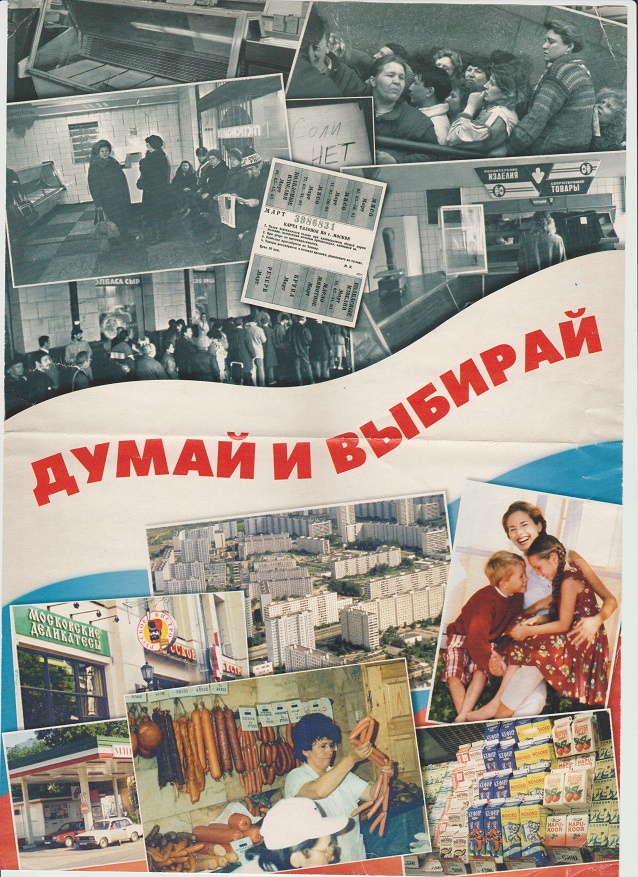
Here’s a Yeltsin poster from the election that makes the point. However dismal things were in 1996, people could remember the last days of the USSR and the empty shelves and the ration cards. The caption is “Think and Vote”.

STILL THE US ELECTION

(Answer to question from Sputnik — what if Trump refuses to leave?)

The question is misleading. First, Trump has said that, if the Electoral College vote goes against him, he will leave. But that has not yet happened and won’t until January when a joint session of the new Congress, under the Vice President, formally counts the votes. Because a number of states have sent two sets of Electors, this will not be straightforward.

Another matter that could affect the outcome is the Executive Order of September 2018 on foreign interference in the election. The Director of National Intelligence is supposed to present a report in 18 December and the government has extensive powers should interference be discovered. However, as of writing, it appears that this report is unlikely to refer to the central issue which is the assertion that the voting machines, with foreign involvement or ownership, rigged the election.

So, it’s not over yet.

The situation could become very fraught – already polls indicate that between a third and a half of the population believe the election was fraudulent and Trump won.

Whatever happens, we will likely find ourselves in a race between the internal decay of the USA and the warmongering tendencies of an Obama administration redivivus.

RUSSIAN FEDERATION SITREP 17 DECEMBER 2020

PUTIN PRESS CONFERENCE. Here. COVID-19 a big theme – he lists what has been done – 277,000 beds, 40 purpose-built hospitals, over 500,000 medical staff deployed.

ECONOMY. Numbers from Putin: GDP down 3.6%, industrial production down 3%, agricultural industry up 1.8%, real incomes down 3%, unemployment up to 6.3%, national debt lowest ever at US$70 billion, international reserves up to US$587.7 billion, National Wealth Fund up to ₽13.5 trillion (about US$180 billion), 70% of federal budget comes from non-oil and gas revenues.

POLITICAL PARTY STANDINGS. I am not much surprised by the latest from Levada (question: for which would you vote this Sunday?). United Russia is 29%, Zhirinovskiy’s party 11%. KPRF 7%, Fair Russia 5% and the rest in the weeds. A ranking that you would have had pretty much any time in the last 20 years (but Zhirinovskiy and the KPRF often switch positions because they share some base). Pretty stagnant: and Zhirinovskiy and Zyuganov go back to the beginning. One big change though: Yabloko gets 1%. Once it was a contender; I think it died partly because the pedestal party stole a lot of its program but mainly because it always refused to unite with other like-minded parties. Putin says about 16 parties are now qualified to run without needing to collect signatures but most of them are no-hopers.

CHOOSE YOUR HEADLINE “Russia’s economy ‘recovered’ quicker than most of industrialised world” or “Russia in retreat as the Soviet collapse continues“.

KALININGRAD. In another triumph for NATO’s policy, Moscow has announced that a motorised rifle division has been formed there. This formation far outmatches NATO’s puny multi-national battlegroups in the Baltics and Poland. Poking the bear has consequences.

WATER. Crimea has always had a water supply problem and in 1950 it was decided to build a canal connecting springs in the Ukrainian SSR with the Crimean Oblast, then part of the RSFSR. The project was completed in 1965 by which time the Crimean Oblast had been transferred to the Ukrainian SSR. After incorporation into the Russian Federation in 2014, Kiev began to reduce the water supply. Rationing was imposed in parts of Crimea a couple of weeks ago as water supplies got low. Moscow is spending money to improve the situation. The Western media is full of stuff about how Crimea is costing Moscow more than it’s worth. Nonsense and wishful thinking of course – no wonder the West is always surprised by Moscow. Planning and realism always beats fantasists muttering in echo chambers.

DOESN’T MAKE ANYTHING. On Sunday four Bulava missiles fired from an SSBN and successful test of a Tsirkon hypersonic missile. On Monday successful test launch of Angara-A5 heavy-class carrier rocket and excellent test results from Sputnik COVID-19 vaccine. On Tuesday successful test flight of MC-21-310 airliner equipped with Russian-made engines.

ARMATA. The army will begin receiving T-14 Armata MBTs next year. Nothing was said about T15s.

THE ARCTIC IS A RUSSIAN LAKE. It was only when I researched this piece that I realised just how far ahead of the other Arctic powers Russia was: the race is over, Russia won.

NAVALNIY. Stupid gets stupider. The stuff they think they can make us believe. Incredible.

TROUBLE IN PARADISE. Washington sanctions Turkey over the S-400 purchase.

SANCTIONS. A German report estimates Europe loses €21 billion annually because of Russian sanctions. For comparison, that’s what Berlin plans to spend on COVID aid in the first half of 2021.

US ELECTION. Putin has sent congratulations to Biden. But it’s not over yet – several states have sent competing Electors. Polls show a lot of doubt: Daily Kos finds only 51% feel the election was fairly conducted (Q3); Fox finds 36% think it was stolen; Politico says 32% don’t trust the results (POL7).

WESTERN VALUES™. Telling the truth might be “feeding the Russian narrative“.

AMERICA-HYSTERICA. Now they think Trump gone, it’s coming out “Cite alleged approval by Hillary Clinton–on 26 July–of a proposal from one of her foreign policy advisers to villify [sic] Donald Trump by stirring up a scandal claiming interference by the Russian security services“.

SHOWERS, GOLDEN. Helmer recounts how Steele made a career of inventing anti-Russia stories.

NUGGETS FROM THE STUPIDITY MINE. “How Vladimir Putin’s anti-vaxxers are trying to use Covid to kill us as surely as his agents did in Salisbury

BELARUS. Lukashenka has approved plans for new power-sharing arrangement.

© Patrick Armstrong Analysis, Canada Russia Observer

THE US ELECTION IS NOT OVER

(First published at Strategic Culture Foundation

President Putin is correct not to congratulate Joe Biden on being elected. There are two reasons. The first is that the complex US election process has not finished; therefore, as Trump has not conceded, there is no “President-elect”. The second reason is that the results may be overthrown by reason of fraud. In which case, Putin will, at the end of the story, look smarter than those who rushed to congratulate Biden before the process was complete.

The hearing in the Pennsylvania Senate and the lawsuits filed in Georgia and Michigan in the last week of November were the first public appearance of the fraud arguments and their supporting evidence – although the alternate media had been on the case from the beginning. Contrary to the utterances of the news media, it was only then that the case was presented in its fullest – the previous legal actions having been only preliminary manoeuvring. The evidence for fraud falls under four heads: eyewitness accounts, improbabilities, statistical analysis and the matter of voting machines and their software. It’s difficult to make up numbers – there are relationships and patterns the fraudster may not know about: better to just make up a final percentage à la the USSR. This piece gives a summary of some of the difficulties with the published results; this piece describes some of the “statistical aberrations”.

Parenthetically, one might observe that the US government declares foreign elections to be fraudulent on a mere fraction of this evidence. Or even, as in the case of Belarus, with no proffered evidence at all: no exit polls, no blurry films; nothing at all.

There are now hundreds, if not thousands, of eyewitness accounts of strange happenings – sudden arrivals of ballots, observers kept away, counting stopped but apparently continuing in secret, suspiciously pristine postal ballots, stacks of ballots with only Biden’s name filled out, Trump votes destroyed, suspicious ballot “curing”, signature problems, backdating postal ballots, wandering USB drives, dead people voting, computer “glitches” sending Trump votes to Biden. Many of these are incorporated into affidavits in the lawsuits and may be read and judged by the public. Many eyewitness accounts, of course, can be dismissed for one valid reason or another, but there are too many now, with more appearing, for casual dismissal.

There are improbabilities in the result. Biden received fewer votes than Clinton or Obama in most areas but many more in the “battleground states”. There were striking exceptions in “down-ballot” voting: in the key states there were large differences between the votes for Biden and for the Democratic Senate candidate. There are cases of historically high – almost Soviet-level – turnouts in key precincts in the “battleground states”. There were improbably high turnouts in nursing homes and in group homes. There are many cases where more votes were cast than voters registered. It was generally a bad day for Democratic candidates: seats were lost in the House and in state legislatures but we are expected to believe that Biden won a strong victory. Despite the spectacular difference in enthusiastic crowds, we’re told that more people turned out for Biden on the day. Perhaps any one of these can be explained but can all of them?

Statistical analysis comprises the next grouping of evidence. We see that votes for Biden, most of the time, and votes for Trump, all of the time, roughly accord with the curve of Benford’s Law. But in those areas where Biden needed the votes, they do not. Violations of Benford’s Law are commonly used by forensic accountants to indicate fraud. An analysis of moving averages over time shows a settled ratio of votes for Biden with a sudden jump in the hours when counting was “stopped”. In some cases votes seem to have been processed faster than physically possible. Other analyses point to suspicious spikes of votes for Biden. A number of statisticians have been attracted to the question and their analyses suggesting fraud are appearing. Again there are too many of these pointers – all of them in the same direction – to be easily dismissed.

Finally there is the whole collection of problems with some voting machines – especially Dominion – and their associated software. The argument is that the machines and software were specifically designed to produce fraudulent results: totals can be changed, votes switched from one candidate to another, incoming vote weighted in favour of one candidate and so on. There are affidavits to this effect. US Embassy cables and previous investigations had shown problems with Dominion machines but, nonetheless, they and the associated software were widely used in 2020. There is possible foreign involvement in these important machines: many parts are made in China; affidavits claim that voting tallies were sent to other countries on the Internet and were massaged there and that passwords into the system were widely available. A computer security expert attests that “hundreds of thousands of votes” were transferred from Trump to Biden by the machines. These issues are attracting computer programmers and hackers and there are now a number of videos on the Internet showing how easily the machines can be hacked.

In summary, the argument is that the machines were programmed to rig the vote in the key states (and perhaps everywhere) by an amount that was thought to be sufficient. But the Trump vote was so much greater than anticipated that the counting had to be “halted” in the “battleground states”; in the “halted” time, ballots were manufactured to compensate. The image of a smooth red curve being overtaken by a blue stepped curve has become the logo of those who believe there were such injections.

This is now quite a large heap of accusations, witness statements and assertions: can these charges be proved in a court (leaving aside the question of whether US courts can be trusted to rule on such a partisan issue – vide General Flynn’s experience)? Or, given the provisions of Article II, Section 1 of the Constitution – “Each State shall appoint, in such Manner as the Legislature thereof may direct, a Number of Electors…” – can sufficient state legislatures be convinced to select Trump-voting Electors? We will find out. But there are certainly too many things to be airily dismissed and there is nothing to suggest that either side will concede until the issue has been fought out to the end.

But, whatever is decided, half the population will be convinced that the election was stolen – indeed a Rasmussen poll in mid-November showed that nearly half the population – including 30% of Democrats! – already believes that “Democrats stole votes or destroyed pro-Trump ballots in several states to ensure that Biden would win”.

2020 has not been a good year for the United States: COVID-19 has wreaked havoc, the economic gains of the past few years have eroded, civil violence and rioting have been common. A disputed election leaving half the population thinking its candidate was cheated out of office will not make things more peaceful. Many are speaking of, if not outright civil war, severe civil strife.

And, in a condition of widespread civil strife and who knows what else, what is the future of the Imperium Americanum? Many pundits will quote Plehve’s alleged remark about the attractiveness of a “little, victorious war” to distract the population. But what little wars are there left? Afghanistan? Iraq? Hardly victorious. It is unlikely that overthrowing Maduro would be very short or, even if it were, that it would distract impassioned American rioters. A war with Iran would be neither little nor victorious. A really severe civil war would divide the US military and bring it home. The consequences of the November 2020 election, whoever winds up in the White House in January, will be long-lasting; the Imperium will have important concerns at home.

What from Moscow’s perspective? The ingathering of American resources to deal with problems in the homeland will be welcomed but the dangers of a nuclear state imploding will not. 2021 may make 2020 look like a blessed haven of stability.