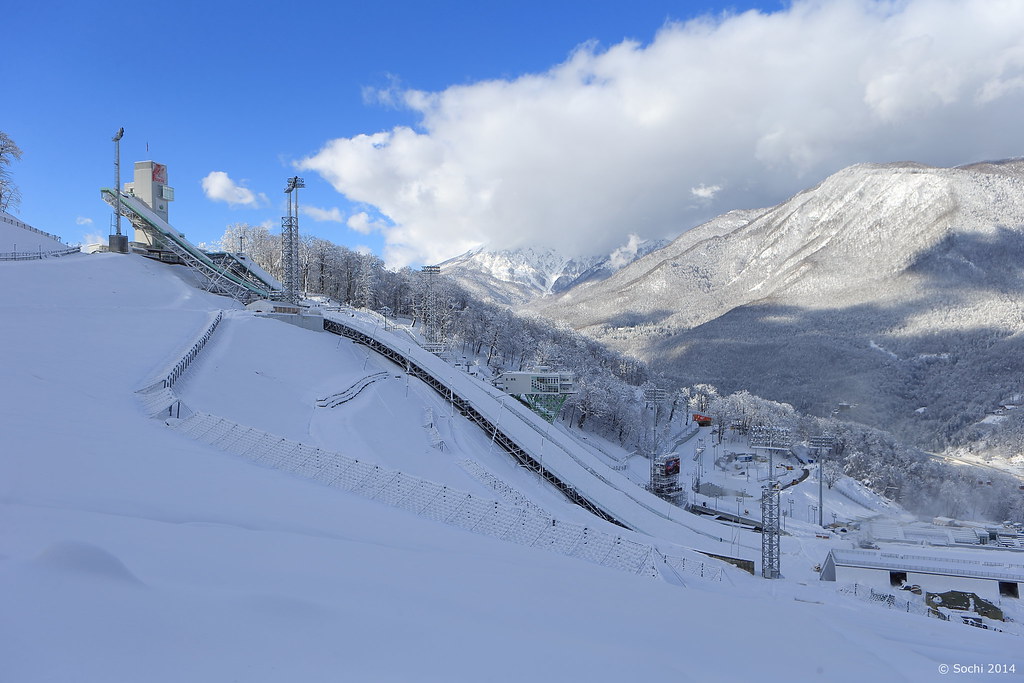
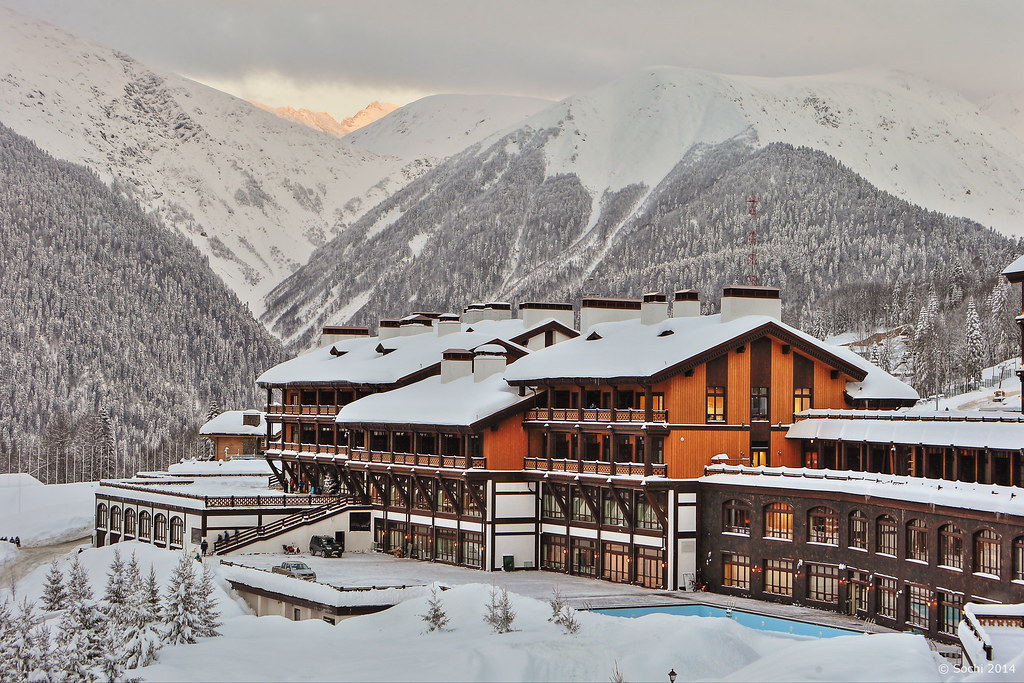
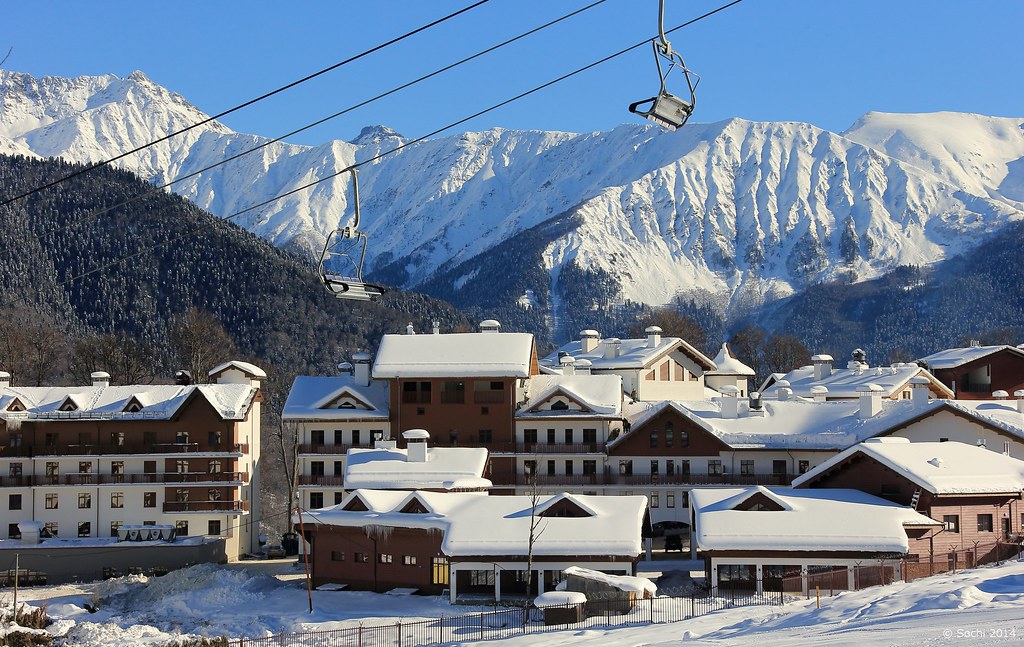
Why is the West waging a campaign against the Sochi Olympics?

http://us-russia.org/2067-why-is-the-west-waging-a-campaign-against-the-sochi-olympics.html

JRL/2014 /21/13

Vlad has summarised some of the barrage of propaganda that has been unleashed on us about the past, present and future disaster of the Sochi Olympics. They open in a week and we will find out who’s been telling the truth: the Western MSM or the Russian authorities. My bet is that Gian-Franco Kasper will prove correct in his forecast that the Games will be good: As to cost, “We have to see that what we did in the Alps we needed 150 years and they had to do it in five years. If you see that then it shocks you”.

What interests me is what will be the effect of this propaganda colliding with reality. People are expecting to see half-finished crummy shacks, cracked and rutted roads, no snow, double toilets, poverty, homosexual persecution and all the rest. The Games will be covered by TV and millions will watch them for hours and hours. And in the background of this or that event, they will see things like this or this or this or this or this. That’s not what they’ve been told they will see.

Barring a disaster, Western propaganda will take a body blow from reality. Millions will see that they have been lied to. There will be serious cognitive dissonance. And that’s the part of these Olympic Games that I’m looking forward to watching.

Readings Into Putin

http://us-russia.org/1734-readings-into-putin.html

The reaction to Putin’s essay in the New York Times shows how preconceptions can overwhelm reality. Because so many op-ed writers and politicians knew what Putin really meant, they didn’t pay much attention to what he actually said. Seeing Putin as an enemy, they failed to notice the obvious. If Putin really was the enemy they think he is, he would be delighted to see the USA mired in an incoherent military intervention – “limited”, “shot across the bow”, “unbelievably small” but not “pinpricks” – with a vacillating leadership, opposed by two-thirds of its population, probably its legislature and most of the world and with no allies to speak of. Something that could only weaken the USA. On the contrary, he extracted the USA from this future.

The themes in his essay are ones with which Putin-watchers are familiar, the central one being “The United Nations’ founders understood that decisions affecting war and peace should happen only by consensus”. In short, there is a set of international norms and rules to govern the use of armed force that have more-or-less worked for years. It is gravely weakened when “influential countries bypass the United Nations and take military action without Security Council authorization”.

Who could deny that? Whatever one may think of the effectiveness of the UN, so long as one does not renounce it altogether – and Washington has not – then Putin is correct. Moscow has, of course, a strong self interest in preserving the UNSC but that does not make Putin’s defence of it stupid or wrong.

Putin believes that a US strike on Syria: “would increase violence and unleash a new wave of terrorism”; Moscow is a proponent of the status quo; things can get worse. He reminds us that the overthrow of Khadafy spread trouble into Mali; they did get worse. He maintains that the fighting in Syria has nothing much to do with “democracy”. He reiterates for the nth time that Moscow is “not protecting the Syrian government, but international law.” And that Moscow has many times called for talks without preconditions and blocked Washington’s demand that Assad must go first (how can you expect to have talks if the victor is pre-assigned)?

Some have taken contemptuous disagreement with his belief that it was not Assad that used poison gas. These people should speak more carefully: German intelligence is apparently doubtful, US intelligence is hardly certain either. Putin’s belief is not, therefore, outrageous.

So, familiar themes: the UNSC must be upheld (note that he nowhere suggests that it is perfect, just that it is all the world has today); intervention in a horrible civil war is not likely to make anyone happy and the USA’s behaviour is making it be seen as a bully. Altogether his remarks are unremarkable. Or would be, had they come from the Dalai Lama, the Pope, or, come to think of it, Senator Obama a few years ago. But, because people know that Putin is an enemy, a dictator, a hypocrite, they know that what he is saying is… well, let us consider an incoherent piece in The New Yorker: despite the fact that Putin repeats points “made in good faith by American and Europe opponents of air strikes” it’s only “mendacity” and “hypocrisy”. So, even when Putin speaks the truth, he’s lying. Finally this curious retort: “‘American exceptionalism’ was Moscow’s idea. So quit complaining, Vladimir.”

But what seems to have made some Americans want to vomit was this paragraph: “It is alarming that military intervention in internal conflicts in foreign countries has become commonplace for the United States. Is it in America’s long-term interest? I doubt it. Millions around the world increasingly see America not as a model of democracy but as relying solely on brute force…”. Or that he questions “American exceptionalism”. But just what is “American exceptionalism” in this context? Washington can bomb anyone it wants? we must all go along with it when it does? the US is never wrong? only the US can criticise others ? what? And, anyway, how dare a thug like Putin lecture us!

The brutal truth is that the USA, in the person of its leaders, has looked ineffectual, confused, weak and alone. It was not Putin who did this. Putin in fact saved it from greater folly and that is hard to forgive. A real enemy would take delight in watching that train wreck develop. Instead Putin has given Obama a way out: perhaps not a “friend” but a concerned neighbour that would have to live with the results.

Even if the writers don’t get it, most of their readers seem to. The most recent three comments on The New Yorker piece at this time of writing are contrary to the author’s line: 1 “Is there any of you with enough humility to say the words THANK YOU to a world leader. Putin needs to receive a gift from the UNITED STATES.” 2 “Americans have had their nose put out of joint and received a lesson in -wait for it — rationality after the hysterical incoherence that has gripped the polity.” 3 “What is curious to me is what our own propaganda and actions looks like to the rest of the world? What does it look like to those countries when a President Bush lectures them? Or Obama?”

On the original NYT piece, the top three pick comments are: “Say what you will about the Russians and Mr. Putin in particular. This reaching out is unprecedented. Surly our country and our leaders cannot ignore this gesture from the Russian government.” The second one is rather scornful of Putin but the third is not: “Aside from the obviously specious claim that it was the rebels who used the gas, much of this post is thought provoking and has a tone of reasonableness that I find disturbing to my prejudices. What a crazy world we are living in when Russia sounds more sane and responsible than our own government on a serious international crisis”.

This disconnect shows a gap between Americans and their opinioneers and gives another example how pre-conceptions determine observation. And did we not see this before when the authorities ignored Moscow’s warnings about the Tsarnaev brothers? If you believe Putin is a thug then he has nothing to tell you and you don’t have to listen.

But it seems that few readers were fooled: opposition to involvement in the Syrian war was and is overwhelming; few supported Obama and his strikes; many are grateful to Putin for stopping another open-ended military operation.

As Putin pointed out, these “humanitarian interventions” not only are more complicated than expected (vide Somalia, Kosovo, Libya) but have unanticipated consequences. Whatever deficiencies the UN system has, it is better in most cases to operate within its creaky framework. Finally, Putin has a point: consider that Somalia had general UN support, Kosovo was agreed to by most of NATO, Libya by some of NATO and the putative Syria intervention by hardly anybody. It is becoming “commonplace”.
Georgian Reflections

http://www.russiaotherpointsofview.com/2013/05/georgian-reflections.html

http://us-russia.org/1282-georgian-reflections.html

http://ruvr.co.uk/2013_05_29/Georgia-favourite-stick-Russia/

My readers will have observed that I talk about Georgia a lot when ostensibly talking about Russia. There’s a reason: for two decades Georgia has been the favourite stick with which to beat Russia; for two decades we have been told Moscow is trying to eat Georgia; for two decades Georgia has been the contrast to illustrate what Russia could be if it weren’t so Russian; for two decades Georgia has been painted as the victim of Moscow’s worst impulses; for two decades Westerners have believed everything from Tbilisi and nothing from Moscow. A cornerstone of the anti-Russia edifice indeed and the “mine canary” of Russian intentions.

For two decades Russia has been interpreted through memes; assumptions deemed so true as to need no evidence; assumptions that reveal the facts that prove them; assumptions so resistant to reality that they create reality; assumptions that are non-falsifiable. Of the many memes three important ones are: Moscow wants its empire back; Moscow wants to control energy routes; Moscow hates democracies. Georgia was the perfect demonstration: formerly part of that empire, it had a pipeline route and was a stout democracy. QED. Facts were hammered to fit the memes. I have set the larger argument out in The Fire Below ($10 e-book). (Here)

We were told three things about Saakashvili’s Georgia (Shevardnadze, fêted in his day as a great democrat, was immediately forgotten). It was a true democracy improving in all ways, as true democracies should, not least economically; Saakashvili had courageously taken a serious bite at corruption; Georgia was a true ally of the West – worthy indeed of NATO membership and a proud contributor to the War on Terror. These Georgian merits were contrasted with Russian deficiencies: Georgia was a democracy, Russia wasn’t; Georgia was overcoming corruption, Russia was sunk in it; Georgia was an ally, Russia was an enemy, of us but especially of our new Georgian friend. Western media, Western politicians lapped this stuff up.

Until August 2008. Many noticed that Moscow had its chance to do what it supposedly wanted to: its victorious army was on the ground; the Georgian army had fled; the West was flubbing. But it didn’t: didn’t seize Georgia, didn’t seize the pipeline, didn’t drive to Tbilisi and overthrow the government. The memes were shaken. The August 2008 War shattered Saakashvili’s veracity, bona fides and reliability. I and others have written much about this; three references will suffice. As the war changed from the expected victory march into a disaster, Saakashvili’s explanations became ever less credible. The US Embassy, despite a serious clue, swallowed Saakashvili’s story whole. Even the exquisitely precious EU report scoffed at Saakashvili’s stories. Altogether an embarrassing display of the West’s credulity and one better forgotten.

As it pretty well has been forgotten.

But the new government is proving to be a much more effective destroyer of Saakashvili’s cornerstone myths of democracy, anti-corruption and reliable ally. Based on the large opposition Saakashvili created over the years (his adulators seldom noticed how many former colleagues and allies had given up on him), members of the new government know reality better than Western consumers of Saakashvili’s propaganda. And ordinary Georgians, living in that reality, overwhelmingly support the new government and approve its actions as this poll, carried out in April by a Swedish organisation, shows.

Democracy. Objective observers had already observed the improbable turnout figures for Saakashvili’s first election after the “Rose Revolution”. The OSCE described enough finagling in its 2008 report to have given Saakashvili the three or four percentage points he needed to avoid a runoff election against a single opposition candidate. In a case that even the Saakashvili-worshiping media could not ignore, an anti-government demonstration was suppressed with far more violence (and a remarkable array of expensive technology, paid for by whom?) than we have ever seen in Moscow. Critical media outlets were squashed – in one famous case, by armed police in mid-broadcast. The media was tightly controlled. Georgia had political prisoners in its over-stuffed prisons. Not so “democratic” after all.

Corruption. Saakashvili eliminated the Soviet-era traffic police; an organisation that did little but extract bribes from drivers. A good step indeed. However, corruption exists in several forms. There is the low-level highly visible form of a traffic cop with his hand out but there is also the higher, more important but less visible, form of money disappearing at the top power levels. We are now hearing about this in Georgia. Saakashvili’s elaborate presidential palace is hardly appropriate for a poor country; neither are his personal expenses. Charges and arrests are coming: two of Saakashvili’s allies; the Mayor of Tbilisi; a governor. A couple of days ago the former Prime Minister and former Health Minister were arrested; the charges include election-fixing and several other crimes. There is a gigantic disparity between the claimed growth rate and the staggeringly high unemployment rate: the survey mentioned above has nearly 50% claiming to be unemployed and looking for work. I can think of only two ways high growth can be consistent with spectacular unemployment rates: either the growth is a façade of luxury hotels and other fripperies or corruption and cronyism have kept the money locked in a tiny group of connected people.

Ally. There have long been stories that Tbilisi was encouraging, training and/or hosting jihadists. A claimed conference in December 2009, Russian accusations; a former Georgian parliamentarian summing up more assertions. Formerly, I filed these away in the “possible but not proven” file. In August 2012 several Georgian soldiers were killed in a firefight; the official story was that it was an operation against kidnappers who had infiltrated from Dagestan in Russia. But today’s Public Defender has a different theory: he says the “armed group, involved in the clash, was formed, armed and trained by then leadership of the Georgian Interior Ministry, which recruited members of the group mainly from Chechen exiles by promising them to give free passage to Russia’s North Caucasus via Georgia.” Both Prime Minister Ivanishvili and the US Ambassador (made suddenly wiser by the Boston Marathon bombing) think this accusation should be investigated. Just what would such an investigation find? And, more interesting, would any of Saakashvili’s loyal sponsors in Washington have been aware of this?

And there are more questions still. Ivanishvili thinks the August 2008 war should be investigated; Saakashvili, of course, does not. Will the death of Zurab Zhvania be satisfactorily investigated? there are those who think he was murdered. Will we ever find out who paid for the significant number of weapons Georgia acquired under Saakashvili? (From Ukraine 12 2S3 152mm self-propelled guns, 40 BMP-2 IFVs, 23+ BTR-80 APCs, 6 Mi-24P/Mi-35P/Hind-F combat helicopters, 2 Mi-8/Mi-17/Hip-H Helicopters, 16 T-72 Tanks, 1 9K33 Osa/SA-8 Mobile SAM system, 48 9M33/SA-8 Gecko SAMs. It obtained from the Czech Republic, over the same time, 55 T-72 tanks, 24 Dana 152mm self-propelled guns, 6 RM-70 MRLs and 55 guns or large mortars.) None of these (well, OK, maybe the HIPs and BTRs) is appropriate to the alleged purpose of the US training scheme. Will we ever learn the inside details of the “Rose Revolution” that brought Saakashvili to power in the first place? And how about Georgia as a conduit of efforts to de-stabilise Russia? (Fanciful? Read this Dear Reader and ask yourself, if you think it credible: Georgia has no money, from where did it get the sums Lebedev is talking about?) It’s all melting away.

Washington’s schemes for Russia and its neighbours are not looking so good now. The “Orange Revolution” is dead and Ukraine will not be joining NATO (not that Ukrainians ever wanted to in the first place). The “Tulip Revolution” was always DOA. Putin turns out to have been telling the truth when he said Chechnya was a jihadist war. Russians still prefer Putin to the oppositionists by a substantial margin. Moscow has checkmated the foreign N“G”Os by replicating Washington’s own law designed at a time when powerful foreign interests were trying to sway American opinions. The Russian economy is still in business. Latest news suggests Washington has accepted Moscow’s line on Syria; namely that Assad and his government cannot be excluded if there are to be meaningful talks.

And Georgia’s “Rose Revolution” was a sham: not democratic, not incorruptible, not an ally. Believers were manipulated. As were the Georgians, who have had a pretty wretched time of it since 1989.


Should Obama listen to calls for a full-scale containment of Russia

http://us-russia.org/970-should-obama-listen-to-calls-for-a-full-scale-containment-of-russia.html

http://english.ruvr.ru/experts14/

http://www.facebook.com/AmericanUniversityInMoscow/posts/608478319166660

Should Obama pay any attention to Freedom House’s rating of Russia? No, and neither should anyone else. They are not “independent” ratings of freedom.

Freedom House doesn’t like Putin very much: Russia’s “democracy score” has declined from 4.96 in 2003 to 6.18 in 2012 on a scale where 1 is the best and 7 the worst. Worse today, oddly enough, than either Libya or Kosovo but at least not quite as bad as Zimbabwe or North Korea. It doesn’t like Russian elections either. In 2006 we were told “Russians cannot change their government democratically.” But the fact that they have not chosen to elect the Communists, Zhirinovskiy or any of the ephemeral and self-destructive “liberal” parties is not evidence that they cannot; only that they have not.

The goalposts are always moving: new regulations on registering political parties reduced pluralism in 2003 but the registration of many new parties in 2012 “seemed designed to encourage division and confusion among the opposition.” The centralised appointment of regional governors was condemned in 2005 but the return to election in 2012 apparently only helps pro-Kremlin incumbents. Even going uphill, Russia is going downhill.

In 2013 Russia gets a downward arrow “due to the imposition of harsh penalties on protesters participating in unsanctioned rallies and new rules requiring civil society organizations with foreign funding to register as ‘foreign agents’”. It’s OK for Washington to require permits to demonstrate and charge hefty fines or imprisonment for violations, but wrong for Moscow. It’s OK for the USA to demand foreign financed organisations register as such, but wrong for Russia to do so. Why? This is “decision-based evidence making”. To Freedom House, elections, whether the ruling party wins two-thirds of the vote or drops to one half, are always “deeply flawed”. Press freedoms, no matter how many are free to travel to Washington to complain, are always “curtailed”. Demonstrations, no matter how many, are “consistently reduced”.

How “non-government” is Freedom House? Well, it is certainly very much government funded. How about the freedom part? The cynic, looking at these scores over 2003-2012: Latvia from 2.25 to 2.11. Georgia, 4.83 to 4.86. Ukraine 4.71 to 4.82, Armenia 4.92 to 5.39, Kazakhstan 6.17 to 6.54 might be forgiven if he saw a pattern. A pattern that, oddly enough, was replicated in the famous “colour revolutions”. In Ukraine and Georgia NATO membership suddenly shot to the top of the new “democratic” governments’ priorities and in the Kyrgyz Republic a NATO base became very important. Could it be that Freedom House’s assessment correlates closely with geopolitical purposes?

Every now and again, someone gives the game away. The Executive Director of the US branch of Amnesty International when Pussy Riot was declared to be prisoners of conscience was Suzanne Nossel. In and out of US Administrations and NGOs, at AI she boasted she was the author of a 2004 article in Foreign Affairs magazine entitled ‘Smart Power’. “Progressives now have a historic opportunity to reorient U.S. foreign policy around an ambitious agenda of their own… the great mainstay of twentieth-century U.S. foreign policy: liberal internationalism… liberal internationalists see trade, diplomacy, foreign aid, and the spread of American values as equally important.” She now heads PEN American Center and is still proud of “smart power”. She evidently sees no conflict of interest between advancing “human rights” and advancing US foreign policy.

So, not so “non-governmental” or “human rights” after all; more like a government funded organisation supporting US foreign policy.

The Magnitsky Bill: The Sources of America’s Obsession with Russia

http://us-russia.org/594-the-magnitsky-bill-the-sources-of-americas-obsession-with-russia.html

http://english.ruvr.ru/experts4/

Why this bizarre American obsession about Russia – a power that truly is not very pertinent to Washington’s strategic and security concerns? Considering, for example, what Obama and Romney talked about in their foreign policy debate, we see that Moscow hardly featured. I’m perplexed and all I can offer in explanation is a jumble of partly-baked theories.

Perhaps lefties dislike Russia because it rejected socialism; indeed the Soviet experience stands as an indictment against the whole scheme. If you believe more government is the solution, or that equality is the answer, Russia’s rejection of the Soviet experiment is a standing rebuke to your convictions.

Righties dislike Russia because, communist or not (and how many think it still is?) it’s still Russia. But why should they dislike Russia per se? Apart from the communist period, Russia has never been very germane to American concerns – not, at least, since the Alaska Purchase. And yet, as David Foglesong has argued, many Americans were obsessed about Russia long before the Bolsheviks. Russia was then seen as a sort of backwards twin brother. But Americans had a long obsession with China too: all the missionaries, the “who lost China” excitement in the 1950s. Why Russia still?

Another notion is that Americans have to have a rival, an opponent, a counter, an enemy even. It’s geopolitical chiaroscuro: the light can only shine against the darkness. Russia is large, significant and gives a contrast more substantial than, say, Venezuela would. But, best of all, unlike China, US-Russia trade is pretty inconsequential. So Russia is a low-cost opponent. It’s safe to abuse Russia; abusing China comes with a cost.

In periodic American fits of moral censure, Russia is a safe target. An issue as trivial as Pussy Riot can be played up as a momentous moral outrage. On the other hand, any sustained condemnation of the treatment in Saudi Arabia of Shiites or Pakistani and Filipino servants would come with a cost. Outrage against Russian “occupation” of parts of Georgia is one thing; outrage about Chinese occupation of Tibet would be something else. It is always pleasing to illustrate one’s moral superiority by manifesting outrage against someone else’s moral imperfections but a target that can bite back would cost more than the transitory satisfaction of being among the Saved Remnant. Russia’s sins are a perfect fit: pleasing moral superiority without uncomfortable consequences.

Or is Russia an ungrateful child? In the 1990s there was much talk about US aid and advice reforming Russia, the “end of history” and all that. Russia was, evidently, on the edge of becoming “just like us”. But it didn’t and such back-sliding cannot be forgiven.

Or is Russia just one of those unfortunate countries whose fate it is to be explained by foreigners after a two-week visit? A palimpsest on which to write the presumptions you brought? Martin Malia wrote a fascinating book showing how Westerners from Voltaire onwards found Russia to be the perfect exemplar of whatever it was that they wished it to be. So, in Russia you can find whatever you’re looking for: a “geostrategic foe”, for example.

So abusing Russia satisfies many political needs: a safe opponent; a contrast that can be painted as dark as you like; an object of feel-good moral righteousness; a sullen teenager who won’t listen to Daddy; a blank slate on which to write.

But best of all, something like the “Magnitskiy Bill” feels good and it doesn’t cost anything much. The geopolitical equivalent of banning Big Gulps in New York City.

Pussy Riot conducts a typing school

http://us-russia.org/80-pussy-riot-conducts-a-typing-school.html

JRL/2011/ 151/18

PUSSY RIOT CONDUCTS A TYPING SCHOOL

As we all know, a group calling itself Pussy Riot staged a stunt in Moscow’s Christ the Saviour Cathedral in February. Three members were arrested and have been sentenced to two years in jail. Which, less time served in “preventative detention” which counts twice, amounts to 14 months in prison. With the possibility of parole.

I’m not here going to talk about what they said and did in the church or any of the stunts that they pulled before or during the trial that probably extended the process. I’m not even sure of my own opinion about what should have happened to them. My concern here is the suspicious unanimity of coverage in the Western media.

We hear much about how they are mothers, as if there were some hitherto unknown legal principle that mothers get a free pass. [Note Eugene Ivanov has corrected me: there is a provision on Russian law for clemency towards pregnant women and mothers of small children which was not applied in this case. But, even so, I do not recall and Western outlet pointing this fact out.] We are told their ages and they are described as a “punk band” or sometimes as a “feminist punk band”. They are protesters against Putin. And, of course, it is taken for granted that Putin is really the law and judge in the case. Der Spiegel has all the memes. Masha Lipman misses out telling us that some are mothers. A particularly vapid piece in the New York Times about their style misses the mother part too. But a piece in Huffington Post gets them all in. An especially absurd piece in the Globe and Mail hits all the notes – and more: “Like the Pussy Riot heroines, whose names should be written with markers across all of our bodies, if only to remember an era in which we, too, were not afraid.” The Guardian gets them all in. As does the Bellona NGO. Something not mentioned in all the stuff about Putin and the Russian Church being in cahoots is that both the Chief Mufti and the Chief Rabbi also supported Putin).

There is a great deal of information about Pussy Riot to be found on the vibrant Russian blogosphere but, it seems, few Western media outlets bothered to look. Here for example (Warning VERY NSFW) are photos of another of their performances, albeit under another name, (sex in a museum in 2008). Further information here. No music then. And no charges or arrests either. Or another performance involving chickens and a grocery store in 2010 (again under a previous name – go to 2:29). Again neither music nor arrests. So “punk band” is hardly a complete description. The reader is also invited to compare the actual film of the cathedral event with the edited version. Quite a difference; that alone ought to set reporters to wondering if they were being manipulated. In short, there was some background that could have been examined but wasn’t: all we heard was young, mothers, punk music band and political. And this was all spun into a story that Putin was cracking down on political dissent. But they, and their source group, Voyna, had been political before and the authorities ignored them. Perhaps they wanted more attention. But, in the Cathedral church of Moscow – with all its history – their latest stunt did result in an arrest.

Russia, like other countries, has laws about public order even if the Russians (and, as we will see, the Ukrainians) quaintly call it “hooliganism”. Here is New York City’s and the UK’s for example. Poland has a law against blasphemy and an individual has been fined for something she said in an interview (but not in a church). But the standard story did not mention this and often barely hinted that the charges were not that the young mothers were protesting Putin (something rather common and even placid these days) but committing a public order disturbance and insulting religion. Furthermore, numerous Western countries have “hate crime” legislation and people are punished – even jailed – for that. But all we heard was young, mothers, punk music band and political. The most hyperbolic (and idiotic) headline was surely “Pussy Riot trial ‘worse than Soviet era’”. No, actually, it wasn’t: lack of vegan food is not quite the same as the “conveyer” or “beat, beat and beat again”. The Guardian headline creators might want to read their Solzhenitsyn again – a required text in Russian schools, by the way.

In short, Western consumers of its media outlets were treated to a very partial story indeed and to one version. Little effort was made to research any background. It was typing not reporting.

So who wrote the script that so many media outlets faithfully re-typed? Alexander Goldfarb perhaps: we are told that he “set up Pussy Riot’s legal fund in the United States”. He turns out to be the Executive Director of the International Foundation for Civil Liberties which was set up by Boris Berezovskiy. Given that Berezovskiy has more than once said that his aim in life is to bring Putin down by whatever methods, why would any supposedly impartial reporter re-type his press releases? Goldfarb was also a key player in that other media re-typing exercise, the death of Litvinenko, and was the source of much of that story. Some say there are other manipulators: the US State Department or its innumerable funded groups. (NOTE: The reader is reminded that, when all the normal sources of “news” are re-typing the same press release, reality must be sought elsewhere at the margins. Click through the references in these last two and decide for yourself how plausible their arguments are.)

Last Friday a crucifix erected near the former headquarters of the Soviet political police in Kiev in commemoration of Ukrainians who died in the communist years was cut down by one of the members of FEMEN (also Dear Reader, thanks to laws in many Western countries, the URL is also NSFW). She was young, possibly a mother, not apparently a punk band member (but a self-confessed feminist) and there was a political motive. The Ukrainian authorities are preparing a charge of hooliganism against her too. Will this also become a huge story? Perhaps it will, given that Berezovskiy doesn’t like President Yanukovych. And, dare I suggest it, now that Ukraine does not have a government that wants to get in to NATO. Stay tuned.


Pussy Riot Conducts a Typing School

http://us-russia.org/80-pussy-riot-conducts-a-typing-school.html

JRL/2011/ 151/18

As we all know, a group calling itself Pussy Riot staged a stunt in Moscow’s Christ the Saviour Cathedral in February. Three members were arrested and have been sentenced to two years in jail. Which, less time served in “preventative detention” which counts twice, amounts to 14 months in prison. With the possibility of parole.

I’m not here going to talk about what they said and did in the church or any of the stunts that they pulled before or during the trial that probably extended the process. I’m not even sure of my own opinion about what should have happened to them. My concern here is the suspicious unanimity of coverage in the Western media.

We hear much about how they are mothers, as if there were some hitherto unknown legal principle that mothers get a free pass. [Note Eugene Ivanov has corrected me: there is a provision on Russian law for clemency towards pregnant women and mothers of small children which was not applied in this case. But, even so, I do not recall and Western outlet pointing this fact out.] We are told their ages and they are described as a “punk band” or sometimes as a “feminist punk band”. They are protesters against Putin. And, of course, it is taken for granted that Putin is really the law and judge in the case. Der Spiegel has all the memes. Masha Lipman misses out telling us that some are mothers. A particularly vapid piece in the New York Times about their style misses the mother part too. But a piece in Huffington Post gets them all in. An especially absurd piece in the Globe and Mail hits all the notes – and more: “Like the Pussy Riot heroines, whose names should be written with markers across all of our bodies, if only to remember an era in which we, too, were not afraid.” The Guardian gets them all in. As does the Bellona NGO. Something not mentioned in all the stuff about Putin and the Russian Church being in cahoots is that both the Chief Mufti and the Chief Rabbi also supported Putin).

There is a great deal of information about Pussy Riot to be found on the vibrant Russian blogosphere but, it seems, few Western media outlets bothered to look. Here for example (Warning VERY NSFW) are photos of another of their performances, albeit under another name, (sex in a museum in 2008). Further information here. No music then. And no charges or arrests either. Or another performance involving chickens and a grocery store in 2010 (again under a previous name – go to 2:29). Again neither music nor arrests. So “punk band” is hardly a complete description. The reader is also invited to compare the actual film of the cathedral event with the edited version. Quite a difference; that alone ought to set reporters to wondering if they were being manipulated. In short, there was some background that could have been examined but wasn’t: all we heard was young, mothers, punk music band and political. And this was all spun into a story that Putin was cracking down on political dissent. But they, and their source group, Voyna, had been political before and the authorities ignored them. Perhaps they wanted more attention. But, in the Cathedral church of Moscow – with all its history – their latest stunt did result in an arrest.

Russia, like other countries, has laws about public order even if the Russians (and, as we will see, the Ukrainians) quaintly call it “hooliganism”. Here is New York City’s and the UK’s for example. Poland has a law against blasphemy and an individual has been fined for something she said in an interview (but not in a church). But the standard story did not mention this and often barely hinted that the charges were not that the young mothers were protesting Putin (something rather common and even placid these days) but committing a public order disturbance and insulting religion. Furthermore, numerous Western countries have “hate crime” legislation and people are punished – even jailed – for that. But all we heard was young, mothers, punk music band and political. The most hyperbolic (and idiotic) headline was surely “Pussy Riot trial ‘worse than Soviet era’”. No, actually, it wasn’t: lack of vegan food is not quite the same as the “conveyer” or “beat, beat and beat again”. The Guardian headline creators might want to read their Solzhenitsyn again – a required text in Russian schools, by the way.

In short, Western consumers of its media outlets were treated to a very partial story indeed and to one version. Little effort was made to research any background. It was typing not reporting.

So who wrote the script that so many media outlets faithfully re-typed? Alexander Goldfarb perhaps: we are told that he “set up Pussy Riot’s legal fund in the United States”. He turns out to be the Executive Director of the International Foundation for Civil Liberties which was set up by Boris Berezovskiy. Given that Berezovskiy has more than once said that his aim in life is to bring Putin down by whatever methods, why would any supposedly impartial reporter re-type his press releases? Goldfarb was also a key player in that other media re-typing exercise, the death of Litvinenko, and was the source of much of that story. Some say there are other manipulators: the US State Department or its innumerable funded groups. (NOTE: The reader is reminded that, when all the normal sources of “news” are re-typing the same press release, reality must be sought elsewhere at the margins. Click through the references in these last two and decide for yourself how plausible their arguments are.)

Last Friday a crucifix erected near the former headquarters of the Soviet political police in Kiev in commemoration of Ukrainians who died in the communist years was cut down by one of the members of FEMEN (also Dear Reader, thanks to laws in many Western countries, the URL is also NSFW). She was young, possibly a mother, not apparently a punk band member (but a self-confessed feminist) and there was a political motive. The Ukrainian authorities are preparing a charge of hooliganism against her too. Will this also become a huge story? Perhaps it will, given that Berezovskiy doesn’t like President Yanukovych. And, dare I suggest it, now that Ukraine does not have a government that wants to get in to NATO. Stay tuned.

Memes Shape the Story

Memes function as an epistemological filter determining what the facts and motives are and where to look to find them. The memes told their believers what Moscow’s motives were in the case of Georgia – Moscow’s motive and principle of its actions was an attempt to reverse the collapse of the Soviet Empire. The 2008 war was commonly fitted into the pre-existing story that Moscow was seizing its chance to defeat and humiliate Georgia and regain control over its behavior. But the adherence to the memes, together with the general ignorance of the context and Tbilisi’s ambitions, blinded their adherents to Moscow’s real concern. And that was that Moscow feared that a fire set in Georgia would spread across the mountains into the Russian Caucasus. Moscow feared this in 2008 because it had seen it happen in the 1990s. Moscow feared a repeat of what had already happened once before.

Tomorrow’s News Today

http://www.russiaotherpointsofview.com/2012/03/tomorrows-news-today.html

This video is entitled “Falsifications in the Election of the President of Russia 4 March”. It shows several scenes: voting with a false identity, a local election committee interrupted as it is creating results in a back room and instructions given to a team of multiple voters. The film part isn’t much of anything: shots of hands, floors and someone in a van – all giving that atmosphere of handheld verisimilitude – but the sound is suspiciously good. The whole thing could have been knocked together in a couple of hours.

One fact, two suppositions and one conclusion.

The fact of course is that the video is a fraud: it’s not 4 March yet and the voting hasn’t started.

But whose fraud is it?

One can imagine that some of the pro-Putin people could have put this thing together so as to discredit in advance the kinds of videos that we saw after December’s Duma vote.

But one can also imagine that Russia’s not inefficient signals intelligence organisation has discovered a fraud video being created and stockpiled in advance by the antis.

There are big stakes in this election and a lot of people inside and outside Russia would like to discredit Putin.

The conclusion is that the discrediting apparatus of the “coloured revolution” package: exit polls (done by whom, over what time and how representative?), blurry videos and anecdotes are easily contrived. Opinion polls are real; contradicting their predictive power requires much more robust evidence than these easily-manufactured trifles.

An investigation into the authors has been opened but we probably won’t find out anything for months, if ever.

Who Ya Gonna Believe? The Associated Press or Your Lyin’ Eyes?

http://www.russiaotherpointsofview.com/2012/02/who-ya-gonna-believe.html

http://www.network54.com/Forum/155335/message/1328636681/WHO+YA+GONNA+BELIEVE—

http://www.strategytalk.org/phpBB2/viewtopic.php?p=78543&highlight=&sid=1ccc7774f1e3f5c0364e8d95997513fd#78543

http://www.facebook.com/permalink.php?story_fbid=369120276450487&id=286819014680614

http://www.bne.eu/storyf3234/Counting_the_crowds_at_Russian_demos

http://www.silobreaker.com/counting-the-crowds-at-russian-demos-5_2265471854229585993

http://www.counterpunch.org/2012/02/10/or-your-lying-eyes-truth-and-fiction-in-the-news-business/

http://www.aljazeera.com/indepth/opinion/2012/03/2012347111873641.html

http://www.counterpunch.org/2012/02/10/or-your-lying-eyes-truth-and-fiction-in-the-news-business/

JRL/2011/ 22/7

AP reported Saturday’s demonstrations in Moscow as follows.

For the anti-Putin (”For Clean Elections”) demonstration in Bolotnaya Square: “The protest — which drew 120,000 people, according to organizers”.

The pro-Putin (“Anti Orange”) demonstration at Poklonnaya Gora: “A separate rally in Moscow in support of Putin drew no more than 20,000 people. Most of them were teachers, municipal workers, employees of state-owned companies or trade union activists, who had come with co-workers on buses provided by their employers.”

However, thanks to the New Media, we no longer have to swallow what the Associated Press says. Here are photos of the pro-Putin demonstration and here are films. Poklonnaya Gora is a very large space and, as this photo shows, it was full (the distance from where the photo was taken to the buildings in the background is about 700 metres). Here is a space calculator with which, dear readers, you are invited to play, comparing the photograph and your estimate of how tightly packed the crowd is. (When the program loads, hit the button that says НАЧАТЬ and move the tabs at the top around to fit what you estimate the photo to show). You will have no problem getting more than 100,000 and perhaps as many as 150,000. A far distance from AP’s “no more than 20,000”. And also consider how many buses it would take to bus them in. If 50,000 were bussed in, that would be more than 1000 buses which would amount to a tightly-packed line of buses 10 kilometres long or about the distance from Poklonnaya Gora to the Kremlin walls and back again. Surely someone would have noticed!

By the way, note the little high narrow church to the right: that is St George’s Church in Poklonnaya Gora. If you see it on TV purporting to be the anti-Putin demo – as apparently has happened at least once – you’ll know you’re being manipulated.

Here are two photo sets of the anti-Putin demos and a space calculator for that. For contrast, here is an overhead photo of Saturday’s demonstration and one of December’s demonstration in the same place. Large to be sure, “tens of thousands” certainly, but not nearly the same number as before and nowhere near the 120,000 that AP happily quoted the organisers (not, usually, an unbiased source) as claiming.

For your amusement, dear readers, here is AP’s statement of values: “For more than a century and a half, men and women of The Associated Press have had the privilege of bringing truth to the world.”

But, the truth is that the pro-Putin demo pulled more people than the anti-Putin demo.

Here is a very partial list of media outlets that repeated AP’s version: Globe and Mail (Canada); Daily Mail, Guardian (UK); NY Daily News, Fox, ABC, NPR, Time, Salon (USA); Hurriyet (Turkey); Drogheda (Ireland); India Times (India). And so on. A Google search on “‘Putin drew no more than 20,000 people’ Moscow” returns over 7000 hits. A lot of news outlets apparently agree AP brings “truth to the world”.

But not in this case. It’s time to ask yourself why you pay for your newspaper subscription.

One can understand why many Russians think that there is a “media war” on against them.