RUSSIAN FEDERATION SITREP 19 January 2012

PUTIN PLATFORM. An article in Izvestiya lays out the outlines of Putin’s election platform. And perhaps we have a clue as to why he thinks he must return as President. It’s one of the most concise statements of his desire for gradual reform he has ever given us. “A recurring problem in Russian history has been the elites’ desire to achieve sudden change, a revolution rather than sustained development. Meanwhile, both Russian and global experience demonstrates how harmful these sudden historical jolts can be… This is balanced by a different trend, a diametrically opposed challenge – in the form of a certain inclination to inertia, dependency, the elites’ uncompetitiveness and high levels of corruption.” Perhaps he feels that only he has the political muscle to steer between these twin shoals. He reiterated the long list of achievements since 2000 when many “foresaw one future for Russia: bankruptcy and breakup.” In short, vote for me, you know what I’m doing, you’ve seen what I’ve done. He promises more such pieces. I was also interested to see what I believe to be his first public reference to Khattab – a figure not as well known in the West as he should be.

POLLING. A VTsIOM poll shows Putin’s numbers rising since the Duma election and the rest of the field well behind. A Levada poll a few weeks earlier showed a similar rise for Putin and comparable numbers for the rest of the field. Another VTsIOM poll finds most Russians (53%) favour gradual political reforms while 39% (but note the rise from 30% in 2008) want rapid and radical reforms. All this bodes well for Putin’s winning in the first round in March.

PROTESTS. Igor Shuvalov observed that the recent protests were a sign of Russia’s irreversible political transformation and “will not be stifled”; “When per capita GDP is approaching $15,000, a country crosses a certain line, it begins to perceive itself differently, and the political system becomes more flexible”. Putin made a similar observation in Izvestiya: “Lastly, the middle classes are people who can choose politics. As a rule, their education is such that they can take a discriminating attitude to candidates rather than ‘voting with their heart’. In short, the middle classes have begun shaping their real demands in various fields.”

CORRUPTION. The former Moscow Region 1st deputy prosecutor was detained in Poland and Moscow has begun extradition procedures: he is accused of protecting an underground casino ring. A member of the Investigative Committee says the federal budget lost US$220 million last year in crimes on government purchase contracts. A former police captain has been charged with facilitating a bribe so a company could have the case against it closed. A former policeman was sentenced to 26 years for murdering an investigator looking at his rackets.

GOVERNORS. Medvedev submitted a bill to the Duma restoring direct election of regional heads. I’ve forgotten all the twists and turns but I believe it was first by presidential appointment, then direct election, then presidential appointment with two variations and now direct election again. Well, it takes time to figure it all out.

RUSSIA INC. RosStat has announced that consumer price inflation in 2011 was 6.1%; this is the lowest in the post-Soviet period. And Putin says Russia’s GDP grew 4.2% in 2011, third among the major economies (behind China at 9.5% and India at 7.8%. USA was 1.6% and Eurozone 1.5%.) (World numbers to 3Q 2011 here). More grist for Putin’s campaign mill.

THE MIGHTY RUSSIAN ARMS BUILDUP. The Defence Ministry says the Air Force will receive over 60 modernised MiG-31 (first flight by prototype 1975) by 2020.

ROCK SPIES. Well well, eventually it comes out. The British admit to spying in the “rock case” of 2006. Maybe we will eventually learn that, as Moscow said at the time, they were surreptitiously passing money to NGOs. Not quite how the story was spun when we first heard of it: Russian “paranoia” and “campaign of pressure against Russian NGOs”.

IRAN. The Foreign Minister has said that an attack on Iran by Western powers could cause an unpredictable “chain reaction”. Russia is also trying to tone down statements and actions against Syria. Despite the prattle in Western news outlets about Russian “support” for “allies”, the real truth is that Russia is cautious about changes. And indeed, foreign meddling in this part of the world often leads to unhappiness down the line.

GAS. We are informed by Ukraine’s gas company that Russian gas prices will be about US$416 per thousand cubic metres this year. This compares with the German price in December of US$435.

© Patrick Armstrong Analysis, Ottawa, Canada (see http://www.russiaotherpointsofview.com/)

The End of USAID in Russia Exacerbates US-Russia Tensions

http://us-russia.org/310-the-end-of-usaid-in-russia-exacerbates-us-russia-tensions.html

Patrick Armstrong
Patrick Armstrong Analysis,
Ottawa, Canada
USAID is an NGO, NGOs are good. USAID promotes democracy, democracy is good. Putin is kicking it out of Russia, Putin is bad. Throw in something about Syria or Georgia (well, perhaps not Georgia, after the prison revelations) and you’re done. Simple story, writes itself. Journalism 101.
But let’s go a little deeper than the surface browsing practised by the Western MSM. USAID is funded by the US State Department and as the proverb has it: “he who pays the piper calls the tune”. (Russians have the exact equivalent of this English proverb “Кто платит, тот и заказывает музыку”). What tune might that be?
Item. Two days after the Duma election – before the results were fully in, US Secretary of State Clinton called for a “full investigation” of accusations of irregularities and expressed ”our serious concerns about the conduct of the election”.
Item. The “irregularities” had been helpfully pointed out by Golos, the so-called independent Russian election monitor. It receives much of its funding from USAID. Maybe it had some interesting communications with US officials with the suggestion of payment for the “correct” results.
Item. BelayaLenta.com, the supposed home-grown Russian protest group, appears to have come into existence last October and gives its address as Bellevue, WA 98007 USA. 
Item. Pussy Riot has been declared “prisoners of conscience, sentenced solely for the peaceful expression of their views” by Amnesty International. The new Executive Director of the US branch (appointed in January) is Suzanne Nossel. She worked at the US State Department and in the Clinton Administration. She proudly states that she is “the author of a 2004 article in Foreign Affairs magazine entitled ‘Smart Power’ and coined the term that Secretary of State Hillary Clinton has made a defining feature of U.S. foreign policy”. In the article she opined “Unlike conservatives, who rely on military power as the main tool of statecraft, liberal internationalists see trade, diplomacy, foreign aid, and the spread of American values as equally important.” Apparently Pussy Riot fits into this grand design of “the spread of American values”.
So, the tune that is being paid for seems rather obvious: Putin’s election and that of his supporting party is illegitimate; he is creating new “prisoners of conscience”; honest Russians, on their own initiative, are protesting this.
But United Russia’s electoral results were those predicted by many opinion polls over some time, actually a whisker worse: (William of Ockham would suggest that if you are fixing election results, you do not fix them so that your support party does worse). Putin’s victory accorded with numerous opinion polls. Which is very strong prima facie evidence of their legitimacy. (Unless one throws out all opinion polling in Russia in which case the perennial Number Two – the Communists – with a backup from Zhirinovskiy’s party – actually won. Which would be less to Washington’s taste. But who’s being logical here?)
So, what then is the “democracy” that USAID, this not very non-governmental organisation, is pushing? It appears to be one without Putin. Whether Washington likes it or not, Putin is supported by many more Russians than practically any Western leader is by his population. Washington evidently does not like it; but it’s not really “democracy” to try and undermine him, is it? It’s more “the spread of American values” or, perhaps, American interests, isn’t it?
It will be interesting to watch what happens to the Russian opposition. I expect the Communists and super-nationalists to continue – I believe them to be Russian-rooted and Russian-funded. But what will become of Navalniy, Kasparov, Kasyanov and all the other oppositionists so beloved of Western capitals? Will they actually prove to have any Russian funding and support?
I believe the Russians are right on their imitation of the US FARA Act. I believe that, in a “democratic” country (that word again), citizens have a right to know whose money is trying to influence their opinions. The absence of USAID’s money may clarify the situation in Russia.

RUSSIAN FEDERATION SITREP 29 December 2011

MEDVEDEV SPEECH. He gave his annual speech to parliament last week. As is customary he started with achievements. Quite a list in fact: improvements in the economy overall, in the demographic situation, poverty reduction, military improvement. All true enough, albeit presented as positively as possible. But, in the present situation, his proposals for political reform are the most interesting. And, given the continuing existence of The Team, we may assume that these have Putin’s approval and will become law. The principal ones – and, he said, more will be coming – are the return to direct election of regional heads, the creation of a proportional voting system for districts (sounds like a return to the previous system of half individual representative and half party vote) and the reduction of the numbers of signatures required to register a party or presidential candidate. Instructions were given to the government and a bill on the last was sent to the Duma. The condition for candidates and parties to produce millions of signatures was inherently bogus and brittle. Specialists in collecting or producing the signatures appeared: the results were suspect and the authorities could always find enough fraudulent signatures to disqualify whom they wanted. So a reduction in the number required will be an improvement but better still would be to allow all registered parties to nominate a presidential candidate. Will the easier registration requirements apply in the presidential election? Not clear although one of his advisors is quoted as saying they will. If so, there could be a multitude of candidates competing for the “liberal” vote. This will have the benefit of demonstrating to Western observers infatuated with the parade of “liberals” that few of them have either support or programs.

OTHER CHANGES. Putin has ordered web cameras be established at all polling stations immediately and transparent ballot boxes will be bought and provided.

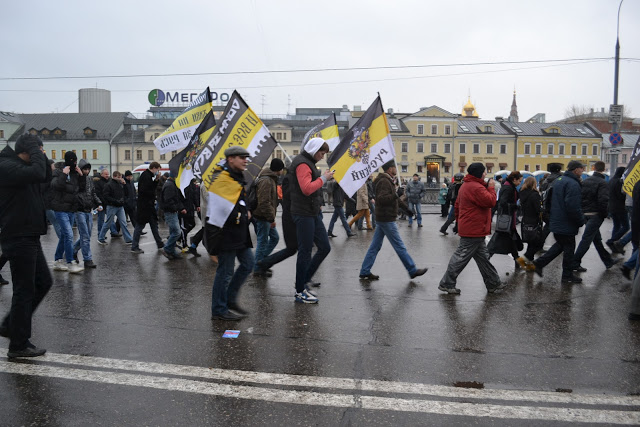
DEMONSTRATION. Another protest on Saturday; photos here, here and here. Clearly this one had a much bigger organised political party component. Two size estimates – 45K and 56K. In short, a number comparable to the Boloynaya Square protest of two weeks before. Momentum is not building: indeed Levada shows that nearly two-thirds had participated in the earlier protests. By the way, there are other opinions demonstrating these days: here is a demo on the 17th. The first photo says it all: Stalin, Putin, Aleksandr III “Yes! Single Power”.

WHO? Levada has done a survey of who was there and we can see the New Young People of whom I spoke last Sitrep (note that some questions allowed more than one answer). Men (60%), under 40 (56%), higher education (62%), self-described “liberal” or “democrat” (69%), heard of protests through the Net (89%), reasonably prosperous (68%). 20% hadn’t voted in the Duma election or had spoiled their ballot; 38% voted Yabloko, 19% Communist and 12% Just Russia. Only 37% had not protested the elections before. What were they protesting against? Falsified elections (73%) certainly but many responses show a generalised discontent with the way things are going. A solid majority want new elections, dismissal of the CEC head and punishment for fraudsters. Preferences for leaders are diffuse: about a quarter like Yabloko and Yavlinskiy but the remainder are well spread out. But there is a firm anybody-but-Putin stance. So, much as I suspected: young, educated, reasonably well-off and liberal. Putin’s children indeed but they’re tired of dad.

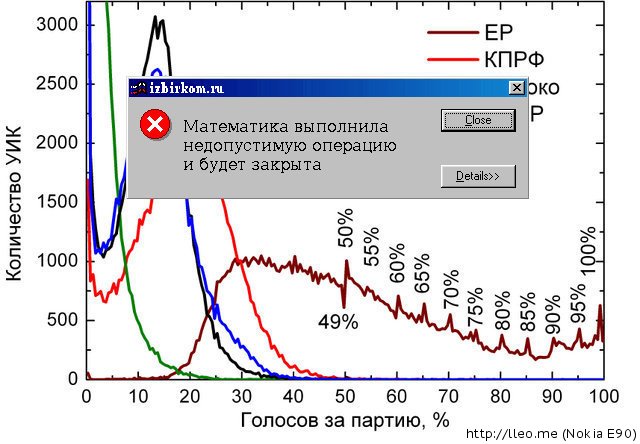
ELECTION FRAUD. Still nothing that I have seen convinces me of game-changing fraud. Vedomosti, which was looking at polling stations in Moscow it thought were the most fraudulent has given up and confesses it has not found big fraud (Google translation) and has, weakly, fallen back on anecdote. The Gaussian argument, popular in Russia, is fully discussed here and remains unconvincing. I reiterate: results in step with numerous opinion polls (in fact the ruling party did a bit worse than predicted) are strong prima facie evidence of reasonably accurate elections and need more than (partisan) anecdotes and credulous Western reports to contradict. Anatoly Karlin lists the various (and varied) opinions about the degree of fraud here.

KHODORKOVSKIY. Bet this doesn’t feature in Western coverage. The Grand Chamber of the European Court of Human Rights rejected re-examination of the 31 May judgement that “incontestable proof” to back allegations of political motivation behind his first trial “had not been presented”. A long-winded way of saying that it found no evidence that it was politically-motivated. But the meme has been established.

WTO. At last Russia is in. The overcoming of Tbilisi’s “veto” is further evidence of Saakashvili’s slippage.

© Patrick Armstrong Analysis, Ottawa, Canada (see http://www.russiaotherpointsofview.com/)

Western Interference in Russian Election

Note February 2016. These were done for the Russia Profile Weekly Experts’ Panel which I cannot find on the Net now. Many were picked up by other sources and I have given links where I can find them.

Can’t find a reference.

The Western Kommentariat finds in Putin’s remarks about Western (ie Washington’s) influence on the protests to be an “extraordinary attack” showing that he may be taking “a harder line against Russia’s opposition”. As usual there is no attempt to consider his perspective. Let’s try: here are some of the things Putin sees.

BelayaLenta.com, the supposed Russian protest group, (White Ribbon – you can’t have a coloured revolution without a colour) appears to have come into existence in October and gives its address as Bellevue, WA 98007 USA. By the way, white armbands were worn by collaborators in Nazi-Occupied USSR – not the most felicitous choice of colour.

Golos, the so-called “independent” Russian election monitor, seems to have some interesting communications with US officials with the suggestion of payment for the “correct” results. It receives funding from the USA. Independent? Only if you think Washington’s motives are the disinterested pursuit of democratic virtue.

Hillary Clinton was very quick off the mark to condemn the results, far more so many international observers who saw nothing untoward and much stronger than the official OSCE report. Almost, a cynic would say, as if she had been handed, by accident, as it were, the briefing note prepared in case United Russia claimed much more than opinion polls predicted.

The Western MSM is in full cry about how the elections were fraudulent, making up numbers where necessary to justify the preconception (“United Russia’s real vote in Moscow was 23.5%”).

What else does he see?

An election outcome, long predicted in opinion polls, in which his party lost a lot of support.

Even those who are looking for fraud aren’t finding it. Vedomosti’s recount in Moscow has turned up what it claims are 7456 votes for United Russia stolen from other parties in 294 voting stations (totalling about 440,000 votes). Given that it is finding fewer examples as it looks at more stations (it started with what it considered to be the worst cases), it is running into diminishing returns. Indeed the effort seems to have stopped – nothing has been added to the website since 14 December. Even if Vedomosti’s accusations are correct, 7500, or 15,000 or even 30,000 votes in Moscow City’s seven million voters amounts to a few tenths of one percent. Hardly the fraud the Western media is talking about.

The popular non-Gaussian argument is declared here to be bad mathematics and the author proves his point by showing similar non-Gaussian statistical effects from the latest UK election.

The North Caucasus results are suspicious but minorities are very good at maximising their presence at the centre (I commend a study of Quebec which, for more than a century, has managed to do this – even abandoning normal preferences when necessary. See the 2011 results for an especially dramatic example of a landslide of support switching).

Perhaps all this reminds Putin of other campaigns involving exit polls (very easily faked), press campaigns (easily started) and foreign funding (always present). True, the “White Revolution” is still missing a new leadership team. Could it be Zyuganov and Zhirinovskiy? After all, they took two-thirds of the seats United Russia lost and if the election was stolen, it was stolen from them.

So, his conclusion is not the wild fantasy of a diehard enemy. I see these things and wonder too.

RUSSIAN FEDERATION SITREP 15 December 2011

DEMONSTRATIONS. On Sunday there was a small (~500) nationalist demo, Monday saw 5-6K turn out for the authorities but the big one was Saturday’s. I am going with Alexandre Latsa’s estimates – he was there, took pictures and made a methodical estimate. He tells me he estimates about 25-30K at the maximum with many coming and going for a total over the day of maybe 50K. There were demonstrations around the country, so about 75K would be a decent estimate across Russia. Who were they? The photos show the usual oppositionists – disgruntled ex-officials, nationalists, Communists and so on – but also a lot of young middle class people who, presumably, hadn’t protested before. Latsa estimates that perhaps two-thirds were these young middle class people. For lack of a better term I will call these NYP – new young people. What generalisations can be made about them? They came to maturity in the Putin Age, have only childhood memories of the worst of the 1990s and none from the Communist period. They are, so to speak, Putin’s “children”. (Putin agrees). But children grow up and become independent. I suspect that they do not much fear change (I think many older Russians do). They are not especially representative of the population but every Russian city will have some. They are computer-savvy and linked together by the New Media: I doubt they pay much attention to TV newscasts. What were they protesting? Vote-fixing to be sure but they don’t look particularly angry in the photos. I am coming to believe that they were protesting not so much against counterfeit elections as against counterfeit politics: a protest against the Establishment; an Establishment that includes Zyuganov, Zhirinovskiy and the rest: beneficiaries of the stagnant political structure for two decades. They were saying you can’t ignore us any longer! This makes me more convinced that Putin’s decision to return was a bad one especially in the way it was done: a back-room agreement with Medvedev, announcement and servile approval from United Russia. I do not believe that the NYP have any interest in the familiar oppositionists, most of whom they would regard as tainted and – most tellingly – obsolete. I doubt that they have “leaders” (facilitators like Navalniy perhaps. By the way, there’s more to be known about him than The New Yorker tells). I believe that something new has been born but I don’t think that the NYPs or anyone else has any idea of what. I think “Putin’s Children: Flying the Nest” puts it well. It is worth noting, however, that it’s not that clear-cut – many of the people at Monday’s demo look like NYPs too.

NYP POLITICS. It seems to be agreed that the NYPs have not taken much interest in politics before. Have they started to? and if so, who will capitalise on their new interest? Not, I suspect, anyone that we have heard of. But they may continue to reject politics and make their effect felt in some other sphere. Until polling data on the phenomenon appears, no one can say. A protest has been authorised for next week and we will learn more.

ANTI-PUTIN? Is a protest against the mouldy political system – with which he has had a lot to do – a rejection of Putin the presidential candidate? At present he will be running against Zyuganov, Zhirinovskiy, Yavlinskiy – all surely more obsolete to an NYP than he is. Mironov is new to presidential elections but he’s Establishment too. Perhaps Prokhorov will be on the ballot but will NYPs rally around a plutocrat who made a fortune in the 1990s? I don’t think anyone has any idea what the NYPs will do in the presidential vote.

FRAUD. I remain unconvinced that there was game-changing fraud on the part of United Russia. Vedomosti has been doing a recount in Moscow. After examining 294 “protocols” (the document from each polling station showing its results), starting with what it expected to be the worst, it claims to have uncovered 7456 United Russia votes stolen from other parties. As 294 protocols cover 440,000 votes at about 1500 each, this is not a very high percentage. And, because its investigation is already running into diminishing returns with fewer alleged stolen votes in each new protocol examined, the total votes alleged to be stolen will not likely rise very much more. Even if we accept – and double, or triple – these numbers, the alleged theft is a fraction of one percent of Moscow’s seven million voters. The non-Gaussian argument is declared here to be bad mathematics and the author proves his point by showing similar statistical effects from the latest UK election. (I especially recommend that you read him – Google translation). As always the North Caucasus stands out but minorities are amazingly skilful at maximising their presence at the centre where the cheques are written and it is prudent for them to pretend super-loyalty; pumping 80% up to 90% or 95% is again not game-changing. Exit polls do not impress me – too easy to fake or mis-sample. And the results broadly fit previous opinion polls.

© Patrick Armstrong Analysis, Ottawa, Canada (see http://www.russiaotherpointsofview.com/)

Duma Election Results

Note February 2016. These were done for the Russia Profile Weekly Experts’ Panel which I cannot find on the Net now. Many were picked up by other sources and I have given links where I can find them.

https://wikileaks.org/gifiles/docs/60/60513_-os-2011-222-johnson-s-russia-list-.html

JRL/2011/222/21

The preliminary results show United Russia down about 14 points, the Communists and Zhirinovskiy (who, to some degree, share an electorate) up about 10 points (to their combined level of the 1999 election, thereby reversing a gentle decline in their total since the high in 1993 when they totalled 35%). Just Russia is up about 6 points and the other three parties remain in the weeds, failing to cross the 7% entry barrier (or the coming 5% for that matter). Turnout is down about three and a half points. Given the way the calculations work, therefore, United Russia will have about 225 seats, well down from its 315 the last time around. It would seem therefore, that of the now-disgruntled former United Russia voters, some stayed home, some voted Communist or Zhirinovskiy and some voted for Just Russia. In any case, Yabloko and Right Cause – the “liberal” parties – did not profit.

Putin & Co are victims of their own success. Yeltsin’s team tried to create “pedestal parties” to support him in the Duma – Russia’s Choice, Our Home Russia – but they were feeble attempts: hurriedly assembled, indifferent performers and soon forgotten. United Russia has proved to be more enduring and more successful. But it has the weakness of being only a pedestal for the Boss to stand on: its ideas are the Boss’; its members are the powerful and their hangers-on; its notion of creativity is waiting for the phone to ring. All deficiencies that Putin and Medvedev have complained about many times. This is not inspiring and it is clear that the population is tiring of it. Although it is worth pointing out that in any parliamentary system, 50% would be regarded as a major victory. But nonetheless a fall from two-thirds to one-half is not a vote of confidence.

Putin and Medvedev are taking it calmly. Indeed, since the result accords well with opinion polls from many sources over some months, they must have known it was coming.

Which raises, to my mind, the principal lesson that should be clear to everybody: Russian elections do, reasonably accurately, represent the state of feeling in the country. Of course there is fiddling at the edges, pressure is brought to bear and all the rest. But no country can afford to preach because no country runs a stainless system. But, as I and others have maintained for years, Russian elections do give, grosso modo, the state of the nation. In short, they are sufficiently free and fair.

The anti-Russia league, for whom it is and always has been an unshakeable article of faith that Russian elections are phoney, will have great difficulty in continuing to claim that Russian elections are manipulated, decided-in-advance, shams created by the Kremlin to fool the simple-minded. Efficient dictatorships run efficient elections; even if they have to throw out the ballots and replace them with the “correct ones”. It is inconceivable that the cunning and evil master manipulator that they believe Putin to be would have manipulated the results so that his party lost 90 seats and its command of parliament.

But I’m sure that they will try to save their theory, no matter how they have to twist reality. I look forward with amusement to watch them.

RUSSIAN FEDERATION SITREP 8 December 2011

ELECTION RESULTS. The almost final results give a Duma with 238 seats for United Russia (down 77); 92 Communists (up 35); 64 Just Russia (up 26) and 56 Zhirinovskiy’s party (up 16). (Interactive map by regions). United Russia will dominate, but no longer be able to bully. Which is a step in the right direction.

ELECTION FRAUD. There is a lot from the usual media outlets about widespread, even game-changing, fakery. I would suggest that those who believe this reflect on what might be termed the Prime Law of Election Fixing: Don’t fix it so that your party loses votes and seats. Especially when they have been saying that every previous Russian election was fraudulent. This should be obvious to anyone. Secondly the results accord well (as previous elections have) with opinion polling (indeed United Russia did a bit worse). This piece shows that the results are consistent with numerous polls (here’s a reasonably perceptive forecast from two months earlier and another, based on polls, from the day before). To persist in assertions of game-changing fraud in the face of these facts is just ridiculous. By the way, if you go by the English-speaking media you would think that foreign observers thought the elections were frightful: not so, here are a number of foreign observers saying that they were good enough. The OSCE report does not suggest big-scale fixing either; indeed it reads like other OSCE reports: administrative resources, lack of competition, some bad behaviour.

LOGIC. There is a simple point of logic here, I think. Opinion polls told us that United Russia was sinking and that even Putin’s ratings had declined. This is the factual basis for pieces like this one. So far so good. But to then to claim that the election was so fraudulent that – that what? the Communists actually won? United Russia gave itself 10-20-30 points? Enough to get a majority? – contradicts the very opinion polls that were the basis for the first observation. (Was there cheating? Of course there was, and not just by United Russia. There’s cheating in all elections everywhere. Enough to be a game-changer? I doubt it.)

IMPLICATIONS. Half the vote is hardly a repudiation of United Russia but such a reduction is hardly an endorsement either. For some months opinion polls have been showing a weariness with this assemblage of power-worshippers. It is a wake-up call. I would expect more “retirements” of officials: not because they failed to cook the results but because they have been repudiated by the electorate. I do not believe that it will affect the presidential vote greatly (opinion polls again: The Team’s ratings are still pretty high) but it might/might result in Putin having to go to a second round of voting. On the other hand, given that the number two candidate will probably be Zyuganov of the Communists, it might not. However tired Russians may be of Putin, they must be even more tired of Zyuganov who ran for President in 1996, 2000 and 2008. To say nothing of Yavlinskiy (1996 and 2000) and Zhirinovskiy (1991, 1996, 2000 and 2008). Of these, Putin is certainly the least stale. But I still think he should have retired. At any rate both Medvedev and Putin are taking it pretty calmly; but, given the polls, they must have seen it coming. And, once again, the “liberals”, so beloved of the West, failed. Here, as a change from “Putin stole it”, is a piece saying the Communists are back.

CHECHNYA. Chechnya, again, produced a 99%+ turnout with 99%+ voting for United Russia. I actually believe this result is correct (plus or minus). Kadyrov’s father once said Chechens had been fighting for independence for decades without success and it was time to try some other method than war. I believe Chechens still want independence but understand that it would come at a terrible cost and then be followed by invasion by jihadists. This is, after all, what happened after the first war in 1994. It is therefore necessary never to let Moscow suspect that independence is what you are after (sovereignty is an acceptable public aim) but to move gradually in that direction. In this respect it is useful to be able to cover your moves by showing outstanding “loyalty” to Moscow. Chechnya is the sort of society in which the word can be put out through the tayps and families that it is in everyone’s best interest to turn out and vote for Moscow’s party. And something similar can be seen elsewhere in the North Caucasus where United Russia always gets big numbers.

DEMONSTRATIONS. We shall see what Saturday’s demonstrations bring.

MAGNITSKIY. The case was re-opened, we are told, so that his relatives can have his name cleared.

NAVY. A task force, led by the aircraft carrier Admiral Kuznetsov, has left Severomorsk for the Atlantic and Mediterranean. Not, we were told last week, bound for Syria.

© Patrick Armstrong Analysis, Ottawa, Canada (see http://www.russiaotherpointsofview.com/)

NATO’S Word of Honour and Arms Races

http://www.russiaotherpointsofview.com/2011/12/natos-word-of-honour-and-arms-races.html

http://www.america-russia.net/eng/geopolitics/293578777

http://www.america-russia.net/geopolitics/293578777 (Russian)

http://radioalisa.hopto.org/index.php?option=com_content&view=article&id=9672:q-q———-&catid=76:hot-topic&Itemid=205

http://www.inosmi.ru/politic/20111205/179323560.html?id=

http://www.bsr-russia.com/en/defence/item/2010-nato-and-its-unfulfilled-promises.html

Some attention has been paid to an address to the Russian people on 23 November in which President Medvedev set out Russia’s possible reaction should its concerns about the European Missile Defence system not be accommodated. For once, the Western media reported it reasonably accurately with most news outlets echoing the BBC’s heading: “Medvedev sees arms race if missile shield not agreed”. A conditional statement: if this, then that.

Here is what Medvedev said.

Our only goal was to preserve the basic principle that Europe does not need new dividing lines, but rather, a common security perimeter with Russia’s equal and legally enshrined participation.” He reiterated Russia’s desire to build a “genuine strategic partnership” with NATO. But, he said: “Rather than showing themselves [NATO members] willing to hear and understand our concerns over the European missile defence system at this stage, they simply repeat that these plans are not directed against Russia and that there is no point for us to be concerned… But our requests that they set this out on paper in the form of clear legal obligations are firmly rejected… but our colleagues should understand that these obligations must have substance and not be just empty words”.

Shortly after, he told the Armed Forces leadership “However, it is not enough to issue oral statements.” And he reiterated the conditionality of Moscow’s responses “If our signal is not heard, then, as I said on November 23, we will deploy other defence means, including the adoption of tough countermeasures and deployment of the main attack force.”

Medvedev’s statement is obviously conditional: if NATO continues to ignore Russia’s concerns, Russia will feel that it must take steps to counter what it perceives as a threat. Russia is not “starting a new arms race”; it is saying that NATO is. Medvedev is saying if you continue to ignore our concerns, then we will have to respond.

But, as Medvedev says, NATO insists that these defence provisions are not aimed at Russia. So why doesn’t he just accept NATO’s word? After all, the stated reason for European missile defence is, and always has been, the need for defence against potential “rogue states” with nuclear weapons and delivery systems. And the fact that no “rogue state” yet has such things does not counter the prudent reality that it is better to have a defence in place than find out too late that you should have had. So, how have we got into the position that Medvedev does not accept NATO’s word of honour?

The answer is very simple: experience has taught Russia that NATO’s word of honour isn’t worth anything: “empty words” indeed. Here are two examples of the evanescent character of NATO’s promises.

Moscow was promised in the Gorbachev years that NATO would not expand. How do I know that the promise was given? After all, nothing was written down. I know this because the US Ambassador of the period has said that the promise was made; I have been personally told by another NATO Ambassador of the period that the promise was made and “After speaking with many of those involved and examining previously classified British and German documents in detail, SPIEGEL has concluded that there was no doubt that the West did everything it could to give the Soviets the impression that NATO membership was out of the question for countries like Poland, Hungary or Czechoslovakia”. And how long did that promise last?

Let us move to a more recent test of NATO’s trustworthiness. A UNSC resolution authorised NATO states and others to create a no-fly zone over Libya for humanitarian reasons: “to take all necessary measures to protect civilians under threat of attack in the country, including Benghazi, while excluding a foreign occupation force of any form on any part of Libyan territory” Within fairly short order this mutated into sustained destruction of Kaddafi’s forces and installations; then weapons were supplied to the rebels (so much for 13. “strict implementation of the arms embargo”) and special forces gave them training and directed the air attacks. In short, NATO aircraft swiftly became the rebels’ air force retaining only the hollowest pretence of the impartiality the Resolution implied. “We came. We saw. He died”. Regardless of whether NATO’s, probably decisive, assistance in overthrowing Kaddafi will be regarded as a Good Thing in the future, providing the rebel forces with an air force, weapons and special forces is very far from the UN Resolution that Moscow thought it was abstaining on. What was NATO’s word of honour worth in this case?

Russia has no reason whatsoever to trust NATO’s mere assertion of intention. Here, from a Russian perception, are more examples of the worthlessness of NATO’s promises. But, really, the two examples of NATO Expansion and Libya, so important and so patent, are more than enough to show that NATO’s solemn declarations – how shall I put it – are subject to re-interpretation. I’m sure that Russians have an equivalent of the saying “fool me once, shame on you; fool me twice, shame on me,” NATO has fooled them more than once.

If NATO really means what it says that the European missile defence scheme is not directed at Russia, why can’t it formally say so with a public, binding, signed statement to that effect? As long as it doesn’t, Moscow can be forgiven for thinking that it’s just another in a series of NATO promises that will be casually discarded at some later date.

As George Kennan said, in 1998 of NATO Expansion: “I think it is the beginning of a new cold war… I think the Russians will gradually react quite adversely and it will affect their policies. I think it is a tragic mistake. There was no reason for this whatsoever. No one was threatening anybody else.” Not for the first time, “Mr X” got it right.

RUSSIAN FEDERATION SITREP 1 December 2011

DUMA ELECTION. There have been innumerable reports that Russians are sick and tired of political realities; we hear this every time an election comes up (after all, a prevailing meme is that Putin & Co only hold onto power by cheating and manipulation) and it’s forgotten until the next time. However, there does seem to be some genuine evidence that people are getting tired of United Russia. This is The Team’s dilemma: while it has successfully constructed a “pedestal party”, something that eluded Yeltsin, United Russia is still little more than a grouping of those in power and those who want to be. Many of its apparatchiks are not very popular in local areas. Nonetheless, one could hardly expect the perennial, and unchanged, opposition of the Communists and LDPR to offer much more hope. I expect that United Russia will remain the largest party but would not be surprised to see its percentage cut – no bad thing (Putin would agree: less of a rubber stamp and more of a Duma that thinks. Not, of course, that he wants any discontinuity). What I’m less confident about is what the disgruntled will do. Many I suspect will stay home but it will be interesting to see whether Just Russia, Right Cause or Yabloko profit from the mould that has grown on United Russia. For years now the Communists and LDPR have shared a (declining) sector of the vote and I don’t think that their total share will much change. We’ll find out on Sunday. As for those who are convinced Russian elections are rigged, I recommend Anatoly Karlin’s piece which shows that results accord with earlier opinion polls. (And for those who think they’re rigged, all I can say is that that would be an improbable amount of rigging.)

CFE. Washington has decided to stop passing CFE information to Russia “after repeated efforts, including high-level efforts to save the treaty”. Then the UK did the same citing Russia’s failure to fulfil its obligations. Now let me see if I’ve got this right: after long negotiation and re-negotiation of this effective arms reduction treaty, Russia ratified it in 2004. NATO, after sticking in some new conditions, and ignoring the satisfaction of one of them, did not. Russia complained for years and finally withdrew in 2007 from a treaty only it, Belarus, Ukraine and Kazakhstan had ratified. And it’s Russia that that won’t cooperate?

WTO. At last! A Swiss-developed compromise has been accepted by Tbilisi and Moscow and it appears that Russia will be admitted next month. Bidzina Ivanishvili says Saakashvili was pressured into agreeing; I am inclined to agree with him and it’s another sign of how much standing he has lost since his adventure in South Ossetia. Obama promised Medvedev that he would start to end Jackson-Vanik (and how indeed could the two co-exist?).

RUSSIA INC. The Central Bank of Russia now estimates private capital outflow for 2011 will be US$70 billion, not US$36 billion; it was US$38.3 billion last year, down from US$56.9 billion the year before. Not a good sign at all.

SOMETHING NOT TO BE IMAGINED TEN YEARS AGO. Medvedev’s economic adviser says that Moscow is prepared to help stabilise the European economy via the IMF; the sum mentioned was up to $10B.

RUSSIAN WARSHIPS TO SYRIA. CGS General Makarov denies it. But, once again, Moscow, fearing that all change is for the worse (vide Kosovo and Libya), is trying to be the middle man.

RELIC. As a reminder that there is more to Russia than Kremlin rumourology, a relic important in Orthodoxy has attracted enormous crowds of worshippers throughout Russia.

STALIN. Given the endless and unending nonsense about Putin and Stalin, I doubt the creation of a GULag Museum in Moscow will be noticed any more than the inclusion of sections from the GULag Archipelago on school reading lists is remembered.

THE MIGHTY RUSSIAN ARMS BUILDUP. The Air Force expects about 90 new or refurbished aircraft in 2012 and the Navy 8-10 diesel submarines by 2020. Pay increases. Not much: this is the USAF’s 2012 shopping list.

TROUBLE IN PARADISE. The presidential elections in South Ossetia have gone sour; the local Supreme Court has invalidated the results; the opposition candidate insists she won. Trouble coming. Discussion here.

ANOTHER “COLOURED REVOLUTION” FAILS. The newly elected President of the Kyrgyz Republic (Otunbayeva kept her word not to run) says the Manas agreement will not be renewed. Now that Pakistan has shut down NATO supply lines into Afghanistan, I would advise NATO to start taking Moscow’s concerns seriously.

© Patrick Armstrong Analysis, Ottawa, Canada (see http://www.russiaotherpointsofview.com/)

RUSSIAN FEDERATION WEEKLY SITREP 27 October 2011

DEMOGRAPHICS. The Russian demographic problem – which, incidentally, has its roots in the Soviet days and is mirrored in most FSU countries (Latvia perhaps the worst) – was the consequence of problems at each end. Low birth-rates and high infant mortality combined with too many early (and largely preventable) deaths. But, contrary to the customary poorly-sourced pieces that the Western MSM is rife with, progress is being made. Anatoly Karlin has been posting on the subject for several years and is well worth reading. His latest argues that Russia’s population has actually increased and is today higher than it was in 2009. While the natural population increase is still negative – but less and less so every year – the increase has come from immigration. Improvements have been made at both ends of the problem but Karlin provides data showing that deaths by alcohol, suicide and homicide have seen great reductions. They are still rather higher than they should be but these are factors where comparatively easy resolutions can be found. In short, it appears, barring some new disaster, that the Russian demographic crisis is on the way to being solved; that the various government programs are having their effect and that increasing prosperity will continue to raise life expectancy and reduce infant mortality. Thus Russia’s “demographic crisis” is yesterday’s news and the improvements – with more expected – serve as another of the many reasons that Russians generally approve of the Putin team. It cannot be said too often that the reasons for the Team’s popularity, trust and support in Russia is not that opinion polls are fixed, or that the mass media is as it was in the Soviet days or that Russians are naturally subservient (all assumptions of the Russophobic tendency) but because Russians can see every day the effect of a governing team that, generally speaking, does what a government is hired to do.

WTO. The long dreary saga of Russia’s attempt to join the WTO drags on. Although a member of the G8, firmly in the top 15 economies of the world and an important trader, being on the waiting list for years, promises of support from Washington and others, Russia has still not joined Zimbabwe, Papua New Guinea, Mongolia, Guinea-Bissau and 149 other countries in the group. On Friday Foreign Minister Lavrov said all the terms had been completed. All but one that is: the tradition is that all members must agree and Georgia, a member since 2000 – a gift to Shevardnadze I believe – does not. The latest from Tbilisi is that an official calls for Moscow’s agreement to “jointly monitor the Russian-Georgian border with international observers”. US Congressmen are getting into the act. Russians can be forgiven for seeing all this as another door being slammed in their faces; always a new goalpost, further down the field. We shall see – there is some indication that the EU is tired of Georgia’s intransigence.

LUZHKOV. Confirming what many suspected, the head of the Presidential Administration has said that the reason for firing Luzhkov as Mayor of Moscow was not just his “extremely inefficient city management” but also “the horrible level of corruption.” Luzhkov has threatened to sue. Medvedev has just ordered a probe into the 2003 sale of land in Moscow. The land had been set aside to house foreign embassies but was sold to a company belonging to Luzhkov’s wife.

POLITKOVSKAYA. Another former policeman has been charged with organising her murder.

GRAIN EXPORTS. Putin has said that he expects Russian grain exports to total 24 to 25 million tonnes this year. They were greatly reduced last year because of the bad summer

PATRIOTIC WAR. It’s autumn and time for 1812 war re-enactments. Getting bigger each year.

GAS WARS. Ukraine has given up the idea of contesting at the Stockholm Court of Arbitration the 2009 gas price deal negotiated by then-PM Tymoshenko. Kiev still hopes to get a lower price by negotiations and PM Azarov is optimistic. Ukraine has extensive shale gas deposits and has recently signed exploration contracts with Shell and ExxonMobil and is hopeful of freeing itself from dependency on Russian supplies.

© Patrick Armstrong Analysis, Ottawa, Canada (see http://www.russiaotherpointsofview.com/)