WHY MOSCOW’S FOREIGN PHILOSOPHY IS “WESTPHALIAN”

First published at https://www.strategic-culture.org/news/2018/04/02/why-moscow-foreign-philosophy-is-westphalian.html Picked up by JRL.
These days there are two styles of foreign policy being practised; Paul Robinson here describes them: one is a “a traditional, Westphalian, order in which states are equal sovereign entities”. In the other style, there are said to be two kinds of states: “the just and the unjust”; they are not “legally or morally equal”. Others have called the second “idealism” or “moral diplomacy”. There is a continuous tradition of the USA regarding itself as quite a new category of country as recounted here and so the moralistic stance is sometimes called “Wilsonian” after the President who wished to “teach the South American republics to elect good men” but it’s quite bipartisan: witness the “Roosevelt Corollary” in which Theodore Roosevelt arrogated to the United States of America, as a “civilised country”, the right to intervene “in flagrant cases of such wrongdoing or impotence”. Neither of these approaches is new: there have always been countries that have believed that their gods gave them the mission of instructing and disciplining their neighbours and there have always been countries that were content to leave others alone.

The moralistic position is erected on the assumption that the speaker’s country is virtuous; that its virtue is evident and demonstrable: that its virtue is a fact. The lack of virtue of the other country is also a fact. Some countries are virtuous and others are not and the virtuous ones are permitted to do things the others can’t. Not assumption but reality; not hope but realisation; not relative but absolute; not subjective but objective. Stated that baldly, one wonders how any adult can believe such a thing. But they do. And with straight faces too:

Our children need to know that they – the citizens of the exceptional country, the most powerful, good and noble country in the history of mankind.

Most of all, America is indispensible — and exceptional — because of our values… The world looks to us to stand up for human rights, LGBT rights, religious and ethnic minorities, women, people with disabilities and people everywhere who yearn for peace. We challenge ourselves and other nations to do better.

How fortunate that the best and noblest country in human history is also the most powerful! The United States is the current headquarters of the notion that some (or is it only one?) countries are “exceptional” and operate under different, but higher, standards than mere ordinary ones. In the last couple of decades the idea has spread throughout the Western world generally via, as Robinson observes, the (self-awarded) distinction of “those who respect and those who don’t respect human rights“. The West, it need hardly be said, considers itself to be a respecter.

So some of us are morally elevated and the rest of us are not. Those who aren’t should look to their defences: it’s bad for one’s life expectancy to be on the defaulters’ list as Slobodan Milosevich, Saddam Hussein and Muammar Qaddafi can attest. It is striking how often this moral superiority is expressed by sanctions and bombing rather than by example, but the morally exceptional can do such things because they are morally exceptional. And, when Milosevic is exonerated, the WMD that was the pretext for Saddam’s overthrow isn’t there and it’s discovered that Qaddafi wasn’t “bombing his own people”, moral purity lets the exceptionalists shrug it off and move on; children die, but in a good cause. Exceptionalists bomb hospitals by mistake; the others do it on purpose.

The “idealistic” camp is led by Washington, while Moscow has come to be the chief spokesman for the “realistic” camp. Practically every speech Putin makes on foreign affairs has an appeal to “multilateralism” or to Robinson’s “traditional, Westphalian, order in which states are equal sovereign entities”. Here he is in an interview in 2000, but many many times since:

The world cannot develop effectively and positively if one state has a monopoly on taking and implementing whatever decisions it wants… In the history of mankind, such a drive for a monopoly has never ended well. For that reason, we are constantly proposing a different democratic world structure.

There are several reasons why Putin (and Yeltsin before him) calls for the primacy of the United Nations in a multilateral world system. Two are obviously self-serving: Russia is a permanent member of the UNSC and, second, it fears that it’s on the Exceptionalist hit list. And, given the predominance of “human rights violations” as justifications for “humanitarian interventions”, the annual condemnatory US State Department human rights report shows it has reason to fear.

But there is another reason why Moscow is dedicated to “a traditional, Westphalian, order in which states are equal sovereign entities”. And it’s one that’s easy to forget:

The USSR spent 70 years pushing an “exceptionalist” foreign policy and it was a bust.

The USSR, as the “world’s first socialist state” was the standard-bearer for the “bright future of mankind”, a novus ordo seculorum, even a new type of human – “новый советский человек“. It was the exceptional country, it was the “most good and noble country in the history of mankind”, it was the leader of “people everywhere who yearn for peace”. It intervened all over the world in support of its self-awarded moral superiority. National Communist parties echoed Moscow’s superior wisdom. The German Communist Party collaborated with the Nazis to weaken the Weimar Republic. Why? Because socialism would prevail when Weimar went down. But it didn’t: the Nazis prevailed and the USSR paid a mighty price for their triumph. Cuba, a socialist state (“The Island of Freedom”), had to be supported by the Leader of World Socialism. That support brought the world close to a nuclear war. Any little movement that called itself socialist called for Moscow’s help, even countries the Politburo’s decrepit members had never heard of. They had to be provided with weapons, loans, aid and diplomatic support. It would have been impossible for the World’s First Socialist state not to intervene in Afghanistan when the so-called socialist government there began to wobble. Once socialist, socialist forever:

When forces that are hostile to socialism try to turn the development of some socialist country towards capitalism, it becomes not only a problem of the country concerned, but a common problem and concern of all socialist countries.

How could the USSR avoid lending money or weapons to any state that said it was socialist? Peace movements had to be infiltrated because theory said that only socialism brought peace. Being exceptional has heavy obligations:

More than any other people on Earth, we bear burdens and accept risks unprecedented in their size and their duration, not for ourselves alone but for all who wish to be free. (John Kennedy actually, but Brezhnev probably said something like it, although at greater length.)

And it all came to nothing. Consider, for example, Poland. The USSR liberated it from the Nazis who had killed off about a fifth of the population; Stalin redrew the map so that, for the first time in history, all historical Poland was united and that territory was almost completely ethnically homogeneous. The USSR intervened in Polish politics and civil life for four decades by enforcing, as it believed it was morally obliged to do, the “bright future of mankind” to the expected benefit of the Polish people. Or so the exceptionalists in the Kremlin said. And with what result? The moment it became clear that the tanks weren’t coming, Poland threw off the Soviets, the alliance and the whole socialist package. And so throughout the other Fraternal Socialist States. It was a bubble. Exceptional countries have no friends because they have no equals, they can only have clients; but clients have to be fed or coerced.

The Russian Federation, as the successor to the USSR, inherited what it owed and what it was owed. But there was a big difference: the debts were real; the credits were not. Russia has paid all that it owed and written off most of what it was owed. In the case of Cuba, in 2014 Putin wrote off $32 billion in debt. The USSR had lent money to African “socialist” countries – as Leader of the Socialist World how could it refuse? Putin just wrote off $20 billion of that. And so on. Exceptionalism was money down the hole.

In 1987 a short piece by Yevgeniy Primakov appeared in Pravda: “A New Philosophy of Foreign Policy”. Essentially it argued that the USSR’s foreign policy had been a failure: it had reduced security and was bankrupting the country. After 70 years of exceptionalism, what was left? No friendship, often the opposite. No monetary profit, just costs. The Leader of the Socialist Bloc and the Bloc itself evaporated as if they had never been. It was all for nothing. And worse than nothing: here’s Putin himself in 1999:

For almost three-fourths of the outgoing century Russia lived under the sign of the implementation of the communist doctrine. It would be a mistake not to see and, even more so, to deny the unquestionable achievements of those times. But it would be an even bigger mistake not to realise the outrageous price our country and its people had to pay for that Bolshevist experiment. What is more, it would be a mistake not to understand its historic futility. Communism and the power of Soviets did not make Russia a prosperous country with a dynamically developing society and free people. Communism vividly demonstrated its inaptitude for sound self-development, dooming our country to a steady lag behind economically advanced countries. It was a road to a blind alley, which is far away from the mainstream of civilisation.

“Outrageous price”. “Historic futility”. “Inaptitude”. “Steady lag”. “A road to a blind alley”. Nothing: no money, no friends, no power, no prosperity. Nothing: neither at home nor abroad.

Moscow knows the exceptionalist road is “a road to a blind alley” because it wasted 70 years on that road. However imperfect and irritating the “traditional, Westphalian, order in which states are equal sovereign entities” may be, Moscow knows that “idealism” is completely worthless.

It’s worth observing that the “Westphalian system” is named after the several agreements in 1648 that ended the religious wars in Europe by accepting the principle of cuius regio, eius religio or that each state would be allowed to do things its own way. In other words, Westphalianism was accepted only after idealism had burned everything to the ground.

It’s an old lesson that Russia has learned but Washington, with its still-large purse, hasn’t. Yet.
THE NOVICHOK TALES, PART √-1

(Overheard in the Kremlin by our secret source)

OK, we’ve spent millions. Hidden our production facilities from the OPCW (but strangely failed to prevent the Super-Duper Ultra Top Secret formula for Novichok being published everywhere). Years in the making, millions spent: so what do we use it for?

Whack out some traitor we traded away years ago because we figured that he had already done all the damage he could.

Good, makes sense to me. But how?

Spray it.

Spray it on what?

Ummmm… Pets.

No. The Brits will just abandon them to their deaths. They hate animals.

Cars.

No. You can’t be sure British cars will start in the rain.

Food.

No. We don’t want to kill everybody else in the restaurant. That might get people excited.

Doorknobs.

Doorknobs? Why?

Because everybody touches the outdoor doorknob. Especially when leaving the house. And, Boss, that’s what The Manual says.

The Manual? What? Oh, wait, I remember now. We all learned it in the KGB: “Doorknobs, the Secret to a Successful Wet Job”. There was a study (hundreds killed, but hey! that’s how it goes. And they were only Ukrainians) that showed that only the people you want to whack out actually touch the doorknob.

I knew you’d remember, Boss. Ahhhh the good old days, eh?

Yes. Those Golden Days in the KGB. Ya know I gotta thank the WaPo for reminding me that I was a former KGB guy; occasionally I forget because it was sooooo long ago. But thanks, Jeff, it’s always a thrill to remember. But, back to business, will anybody suspect us?

But isn’t that the point, Boss? I thought you wanted more sanctions. Sanctions make Russia stronger. Plus it’s a great time to cut down on Foreign Ministry expenses. There will be a lot of expulsions.

OK. Do it. But, you do assure me that it’s many times more lethal than anything else and there’s no antidote. We don’t want the two of them making phone calls in a week or two. Let alone resurrecting on Easter. Either their Easter or ours.

Guaranteed Boss. And Boris tells me that, if they do, he’ll get all the media in the UK and its allies to cover it up too.

Boris! Gotta say, one of our best investments. Stupidity is our greatest ally. And, the best part is that nobody gets it. Novichok was good but Durakchok is way better: spray it around and everybody becomes an idiot. OK. Thanks guys, good job! Got to get back to inspecting my watch collection and training up Labs to frighten Merkel. Oh, but wait: are there any Western elections coming up that I should know about?


WHY I AM LEAVING FACEBOOK

Some years ago a friend, whose advice I generally take, suggested that I join Facebook because it could be used as a good source of news. And so I have found it to be. I have a relatively small group of “friends” and the general rule I use is whether that “friend” can tell me something I don’t know. So I have kept the list to about 100 – some family and a couple of people for amusement (one of whom I have always considered to be deeply shallow). In my little corner of FB the subject is Russia and all that. The “Russia subject” gets bigger as the Western world stumbles and fails and now covers quite a large territory of discussion. Generally speaking, I didn’t regret following my friend’s advice and found my corner of FB to be very valuable to me as a communications and information system.

I knew that my activity was being mined for advertising and the like but that didn’t bother me too much. My circle was small, I never filled out the lists of favourite movies or other rubbish and my interests are too eclectic to fit (I notice that Amazon has given up predicting what I might like). So I figured that was a price I could be comfortable with. I noticed that some people were banned but I wasn’t. Although I, as the anti-Russia panic grew and spread, realised that sooner or later I would be. So I began to see that the day would come when I left FB. Because my little corner is doubleplusungood. I make no apology for using Orwell’s Newspeak for it is becoming the language of the West.

For a year or so I considered leaving but didn’t get around to initiating the process. What made me think the time had come was this report “U.S. visa applicants to be asked for social media history: State Department“. Now you just know that’s going to happen. And you just know that the vast NSA structure will sooner or later be hooked into visas to detect thoughtcrime. As a Canadian I don’t need a visa to get into the US but who knows what will happen. And the last thing I want is the system noticing that I don’t duckspeak. And then we see this: “Department Of Homeland Security Compiling Database Of Journalists And ‘Media Influencers’“. Well, I’m a “media influencer” in a small way and not in the direction of goodthink either. We are, by the way, about to receive a demonstration of just how much information FB has.

So time to get out. But where to go? Because I did come to rely on my circle on FB for news (real news I should say, not the fake news spewed by the MSM) and want to preserve the opportunity. I have decided to give the Russian Facebook, V Kontakte (“In Contact”) a try. Over the next few weeks I will moving over to it. One reason is that I have never heard of anyone being banned from VK for thoughtcrime as many of my FB contacts have been. But that’s only one reason.

Now I am not so simple-minded as to think that the Russian security services don’t mine VK and other social media sources for information. Of course they do – no security service on earth could resist the temptation no matter what the law might say. But I am less concerned about the Russians doing this than the Americans. There are two reasons.

The first is that I pass through the USA much more often than through Russia. I like cruising and many cruises involve coming under US jurisdiction. And, of course, it is only to the USA and its tools, lost in their Russomania, that I am guilty of thoughtcrimes: the Russians would regard me as a paragon of goodthink!

But there is another, more profound, reason. Witness the 2015 San Bernardino attack. The killers were active on social media. Witness the Boston Marathon bombing; again much activity on social media. In neither case were they apprehended before the attack. In fact, can anyone think of a terrorist attack in the USA in which the attackers were caught before they did it? Other than entrapments, of course. And yet the NSA regularly vacuums up all communications – social media and otherwise. Why is it doing this? Not, apparently, to catch terrorists. I do not believe that the Russians use bulk collection; I believe they are much more targetted in their collection. I say this because the Russians do catch terrorists before they strike. But I say it also because Moscow actually is fighting jihadists; it is not, as Washington is, alternately bombing them and arming them. Therefore I have much greater trust in the Russian security organs’ powers to mine social media.

So, altogether, I find myself in the interesting position – unimaginable 40 years ago when I started working for the Department of National Defence (How I got here) – of opting for a Russian social media network on the grounds that it is freer and more trustworthy than an American. But such are the times in which we live.

So I invite you to move over too.

(Those who question my conclusions might read this “Bill Binney, the ‘original’ NSA whistleblower, on Snowden, 9/11 and illegal surveillance” and follow up the issues raised in the piece.)

RUSSIAN FEDERATION SITREP 5 APRIL 2018

PRESIDENTIAL ELECTION. Being away for so long, I wasn’t following it closely but some things I didn’t expect. Putin won of course but did a bit better than I thought he would. I really thought Grudinin would do better but he turned in the worst performance of a KPRF candidate. Zhirinovskiy also faded. The “liberals” are finished as a force I think: you can’t go around saying that Crimea is part of Ukraine and expect people to not notice that you’re parroting Washington. 20 years of Washington’s behaviour has reversed a strong pro-American sentiment. In this respect Simonyan’s piece is relevant: “We no longer want to live like you. For fifty years, secretly and openly, we wanted to live like you, but not any longer. We no longer respect you”.

PUTIN 2.1. The electorate voted for more of the same and that’s what they’ll get. And, if you were a Russian, so would you have: grosso modo, the improvements across the board since 2000 that you have personally seen and tasted are compelling. Putin has to find a successor but he can be confident that because he is trusted whomever he picks will be too. I have every confidence that Putin will make a good choice: by and large he has chosen pretty well and his team is remarkably stable. Someone, I expect, not too well known now because he (or she, certainly very wrong to rule that out: Russia has the highest percentage of women business leaders) should be in his 40s.

SKRIPALMANIA. This ridiculous story is collapsing. Years of flaccid acquiescence by MSM stenographers have made the anti-Russia fabulists sloppy: after some wavering on thallium and Scaramella, the Litvinenko story settled down; MH17 stated on message throughout (except for a slip-up in the Dutch report: see port engine intake) but this one was incoherence and absurdities from the start. We are reminded of a similar anti-Russia fabrication in 1994. What next? Re-writing history, of course. Or pretending it away. Craig Murray is the best single source: not wrong yet.

SPORTING DANGERS. Ever notice the coincidences? Georgia’s invasion timing? Just when the lies about Sochi are revealed it’s time to move the narrative to Ukraine? Ban Russia from the Olympics but clear it after. The soccer World Cup will be held in Russia in a couple of months and it will be held in a dozen Russian cities; the world will see that they’re not miserable s—holes full of wretched people suffering under Putin’s boot. What to do? This is too big a deal for the governments of soccer-mad countries to dare to boycott. Nerve agent attack? When that story bursts, then what? It seems that sports are the greatest threat to world peace.

WADA YA KNOW? Norwegian asthmatics win! What a good thing only Russians dope, isn’t it?

AMERICA-HYSTERICA. We have an interesting American poll showing that an increasing number of Americans believe that there is a “deep state”. Here’s the poll; read it for yourself. How could that be?

WESTERN VALUES™. Remember due process? Presumption of innocence? International agreements? Vienna Convention? Rule of law? Beijing remembers: see below.

NEW NWO. China weighs in on Skripalmania reminding us that no matter how subservient NATO allies may be, the rest of the world is less impressed: “Over the past few years the international standard has been falsified and manipulated in ways never seen before.” The petroyuan moves a step closer with the opening of an oil futures market in Shanghai. With the gold-yuan exchange in Hong Kong already functioning, it’s only a matter of deciding the right time to connect the two. The Chinese Defence Minister visits Moscow: “The Chinese side came to let the Americans know about the close ties between the Russian and Chinese armed forces.” Step by step.

GERMANY. Expel 4 diplomats to show “solidarity”, approve Nord Stream. Does that make sense?

UKRAINE. An American survey shows that the mood in Ukraine is bad and expecting worse. Well, that’s one post-Maidan Ukraine expectation that will be fulfilled. Nadia Savchenko, a former Ukrainian hero, has been arrested in Ukraine on terrorism charges. She dares to suggest that the massacre was a false flag. (Read Ivan Katchanovski’s paper: “This academic investigation concludes that the massacre was a false flag operation, which was rationally planned and carried out with a goal of the overthrow of the government and seizure of power. It found various evidence of the involvement of an alliance of the far right organizations, specifically the Right Sector and Svoboda, and oligarchic parties, such as Fatherland. Concealed shooters and spotters were located in at least 20 Maidan-controlled buildings or areas”. Here are confessions by some of the snipers that your local news outlet has been too busy to tell you about.)

© Patrick Armstrong Analysis, Canada Russia Observer

REFLECTIONS ON THE SKRIPAL STORY

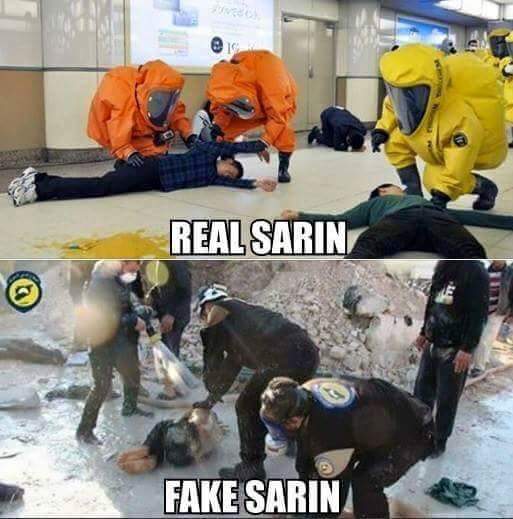
SARIN REAL FAKE

1. It’s obvious nonsense brought to you by proven liars.
2. The point of propaganda is to leave an impression after the details have been forgotten.
3. To get involved in discussing the minutiae of the story is to help the propagandists’ aims.
4. Therefore treat it as a badly constructed story that is failing to convince.
5. Do this by analysing the comments on the news stories which (at least the ones I’ve looked at) show that people are sceptical.
6. Also mock the meanderings of the story: At the restaurant! In the car! On the doorstep! Incredibly lethal but strangely ineffective. Miraculous recovery of daughter. Baby wipes as effective protection. Reminiscent of White Helmets and their flip flops, rubber gloves and paper masks; but, come to think of it, it’s the same authors in both stories. Who, after so many lies, are becoming overconfident and sloppy.

It’s a startlingly incompetent theatrical production and should be responded to with contemptuous mockery.

NOBODY CARES ABOUT “THE NEWS”

First published at https://www.strategic-culture.org/news/2018/01/22/nobody-cares-about-the-news.html

In his mordant novel Scoop, Evelyn Waugh has one of his characters explain what “The News” is:

News is what a chap who doesn’t care much about anything wants to read. And it’s only news until he’s read it. After that it’s dead.

There is a great deal of wisdom in this little remark that I will attempt to unpack. It also, in my opinion, succinctly explains why we, who believe ourselves to be so brilliantly analytical and persuasive on sites like this one, have so little success in changing the opinions of our friends and neighbours (or awakening them as we might prefer to say).

First let us consider the “chap who doesn’t care much about anything”. There are, to be sure, two kinds of these but we’re only interested in the second. The person who really doesn’t care about anything doesn’t pay any attention to “The News”. No newspaper ritual for him, no dutiful watching “The News” at night; maybe he wants the sports news but he doesn’t care about “The News”. There are plenty of people like this. Some never were interested, others have given up pretending; as one has often said to me about political news: “What’s the point? There’s nothing I can do. It’s just depressing”. That’s a perfectly understandable point of view and it can be held by someone who, like the individual I’m thinking of, is generally aware that most of “The News” is propaganda or worse.

I’m not talking about people who don’t care much and don’t even pretend to care. What I am interested in are those people who do read newspapers, who do sit down at the TV: those who do devote a portion of their day to “The News”. Why would anyone who “doesn’t care much” do so? I can think of several reasons and these reasons, of course, overlap in many individuals. They may consider it to be a duty for a citizen to be to be informed and that they exercise that civic duty by paying attention to “The News” every day. Second, there may be an element of snobbery: because they “pay attention” and they are “concerned”, they are entitled to feel themselves superior to those lumps whose only interest is how their team did yesterday. “The News” provides an unending supply of conversational topics: everyone can talk about the current human interest story or project faux concern about tsunamis; those who wish to affect an interest in the outside world can express outrage at the destruction of “the last hospital in Aleppo”. And finally, there is simple habit: at breakfast there’s the paper, at night the TV news: you’ve been doing it for forty years, why stop now? A subset of followers of “The News” are politics junkies; but for many of them it’s a variation on team sports: “Did you hear what that idiot on the other political team just did? “

On the other hand, people who write on sites like this one or read them have broken away from “The News” habit. We are sceptical; suspicious; we notice that, all of a sudden, everybody is talking about the same thing in the same way and wonder what’s really going on; we remember what was said before; we research; we look up things; we compare: we no longer believe “The News”. That doesn’t make us smarter; it’s just a life choice. You can put it in terms of red pill and blue pill if you like – and from a propaganda perspective, there’s value in that analogy – but the essential difference between us and those who watch “The News” is that we do care much and they don‘t care much. And that leads to frustration on both sides of the care divide: we think that, just because these people spend time on “The News” that they are interested in the facts and subjects behind “The News”. But we’re wrong: they pay attention to “The News” out of a sense of duty, a feeling of superiority, a desire to participate in the latest narrative or habit. They’re not actually very interested in the subject matter: as Waugh understood, they don’t care much. They are not watching or reading critically. And they are certainly not interested in having us tell them more about the realities or, worse, telling them that they are being misled. They don’t really care about “the last hospital in Aleppo” but they do care about being told that they’re being deceived: “Are you saying I’m stupid?”.

And that leads us to the second half of Waugh’s comment. “it’s only news until he’s read it. After that it’s dead”. There’s no memory in “The News” for those who don’t care much: they have no memory that “the last hospital in Aleppo” was destroyed last week too, and the week before that and three times the week before that. If it’s not on “The News” any more, it doesn’t exist; if it’s not now, it’s not. Because they really don’t care much. Their motivation for paying attention to “The News” is not, in fact, or if so only very weakly, to become informed about hospitals in Aleppo, tsunamis or political developments in Sudan. There is of course a factual reality underneath “The News” – there are hospitals in Aleppo, the tsunami did happen, Sudan exists – but, seen through the lens of “The News”, it’s a transient and ephemeral factual base. It’s only news when it’s perceived and it ceases to be news when it’s not perceived. “The News” is a continual present. It is a rolling story, or series of stories: early reports of the tsunami hitting, rolling banner “Tsunami Watch”, our reporter on the scene, films and photos, teddy bears, smashed buildings, rescuers, funding appeals, talking heads, and the story fades away. Meanwhile another narrative has been building up to replace it. The stories roll on and on and there’s always a new cliffhanger to make you tune in tomorrow.

Waugh’s observation is profound indeed. It explains why so many people spend significant time ingesting “The News” and also why “The News” leaves so little trace. It explains why those of us who care much about the actual realities underneath “The News” have almost no success in persuading our news-watching neighbours that what they saw last night was partial, or slanted, or a lie. They don’t care much about it, they’re not really watching “The News” very deeply or with close attention and they quickly forget the stories as they roll by. They’re not stupid – although it’s tempting for those us who do care much to think so – they just don’t care much.

It’s rather depressing isn’t it? The ones who don’t bother to watch “The News” don’t care, and those who do watch “The News” don’t care either. The only encouraging thing that I can think of is that the people who watch “The News” will watch whatever is put in front of them: if the central narrative changes completely, it will still be “The News”.

(People can change of course although I suspect it’s a solitary occurrence when some excess makes an individual start to question the deception. I recommend Phil Butler’s book Putin’s Praetorians in this respect. It contains the testimonies of people who came to question the Russia narrative as presented by “The News”. But, in most cases, it wasn’t because somebody persuaded them, it was because they came to doubt it themselves. After that, persuasion had a chance to reinforce their new viewpoint.)

RUSSIAN FEDERATION SITREP 18 JANUARY 2018

AMERICA-HYSTERICA. I believe that we are approaching the exposure of the plot. Some reading to bring you up to speed. The conspiracy explained (part of it actually – there were other players. MSM too). Happenings: 1) documents 2) interviews of principals 3) reborn investigations of e-mails and Clinton Foundation. First charges laid in Uranium One (an American charged with bribing a Russian too!). Today’s step. The Dossier is central to the conspiracy. I reiterate: there was no Russian government involvement in the US election; there was no Russian government collusion with Trump. It was a story invented to support a conspiracy against Trump and then an attempt to cover up the conspiracy when, in the destruction of the plotters’ expectations, he was elected. This is very big.

HEALTH. The Minister has provided some statistics that show the steady improvement in Russians’ health. For the first 11 months of 2017, the death rate decreased by about 3% with a considerable drop in deaths by alcohol poisoning (16%). Infant mortality continued its steady decline and so the population increases from each end. In the last five years, alcohol consumption dropped a lot as has smoking; meanwhile exercise rates are up. The overall effect is an increase in life expectancy: now put at 72.6 years for men and 77 years for women. It seems that Russians are more optimistic about the future and less depressed by the present. This further strengthens my belief that Russia is poised to take off in a way that it never has before.

GOLD. Russia has bought quite a lot of gold (and maybe more than it’s telling us). Photos from the gold vaults. I wonder if China will show its hoard.

RUSSIA INC. Growth of 1.7% and inflation down to 2.5% last year. In comparison the EU’s growth forecast was 1.7% but they’re now saying 2.2%; the USA’s was 3.2%. But here are different figures with USA 2.2%. But, anyway, considering sanctions and so on, that’s not bad.

RUSSIAN BASES IN SYRIA ATTACKED. On the night of 5/6 January the Russian bases at Khmeimim and Tartus (Syria) were attacked by 13 UAVs, 10 at the former. The aircraft were armed with mortar bombs. Seven were shot down, six were hacked of which three of which were safely landed. The aircraft themselves were fairly crude but the navigation systems and other electronics were quite sophisticated. The attack was launched from the de-escalation zone in Idlib. On the 12th in a complicated operation involving special forces, artillery with smart munitions and air reconnaissance, the MoD says the people responsible were killed and the depot destroyed (videos). Plenty of rumours of course: a US reconnaissance aircraft was said to be in the area; the Pentagon denies involvement; Putin said it wasn’t Ankara. Certainly the air defences showed their ability – especially by taking over six of the UAVs and bringing three to a soft landing. So, if the US was involved (and who knows what’s going on in Washington’s idiotic and incoherent activities there?) then it discovered that Russian air defences are formidable. (They will only be strengthened – this was an all round learning experience.)

BEEDO! BEEDO! BEEDO! A rather ridiculous publicity video showing the USAF bravely intercepting two Russian fighters flying from Russia to Russia along the very restricted international air corridor in the Baltic. The US side claims the Russians did not “did not broadcast the appropriate codes required by air traffic control and had no flight plan on file”. The Russians say they did. I remind readers that it was NATO that rejected a Russo-Finnish proposal that all aircraft fly with their transponders on.

SANCTIONS FOR THEE BUT NOT FOR ME. A Russian company has signed to launch 12 Dove-series satellites for an American company.

KOREA. As Churchill observed, jaw-jaw is better than war-war and we’re getting talking in Korea. One assumes Beijing is somewhere in the background. Moscow and Beijing are coordinating their efforts. Much, if not most, is hidden and consumers of the MSM would be astounded to hear that President Moon gives Trump some of the credit.

THE TRUMP EFFECT. Whether I, Korybko or the Saker has got it right, things are changing and “America First” is making other countries wonder where they fit in. Doctorow observes, others bemoan, but it’s happening.

FANTASIA UKRAINIA. There are no nazis in Ukraine. And, if there are, there aren’t many of them. And if many, they have little influence. If influential there, then nowhere else. Never mind: 25 December is now a holiday and Hallowe’en is making progress so all is well. (This fatuous piece savaged here).

© Patrick Armstrong Analysis, Canada Russia Observer

TRUMP CUTS THE GORDIAN KNOT OF FOREIGN ENTANGLEMENTS

First published at https://www.strategic-culture.org/news/2018/01/02/trump-cuts-gordian-knot-foreign-entanglements.html

Picked up by

https://www.sott.net/article/372828-Trump-knows-what-hes-doing-Cutting-the-Gordian-Knot-of-foreign-entanglements

https://www.therussophile.org/trump-knows-what-hes-doing-cutting-the-gordian-knot-of-foreign-entanglements.html/

http://mikenormaneconomics.blogspot.ca/2018/01/patrick-armstrong-trump-cuts-gordian.html

https://www.zerohedge.com/news/2018-01-05/trump-cuts-gordian-knot-foreign-entanglements

http://world.news.aboutcivil.org/news/trump-cuts-the-gordian-knot-of-foreign-entanglements

http://financialliteracyy.com/trump-cuts-the-gordian-knot-of-foreign-entanglements/

https://madhousenews.com/2018/01/trump-cuts-the-gordian-knot-of-foreign-entanglements/

http://abundanthope.net/pages/Political_Information_43/Trump-Cuts-the-Gordian-Knot-of-Foreign-Entanglements_printer.shtml

http://dailyreadlist.com/article/trump-cuts-the-gordian-knot-of-foreign-entanglemen-5

http://lesakerfrancophone.fr/trump-tranche-le-noeud-gordien-des-intrications-a-letranger

Referred to at http://www.moonofalabama.org/2018/01/trump-offloads-foreign-policy-problems-lets-eu-grow-a-spine.html

President Trump is a new phenomenon on the American political scene. Not a professional politician begging for funds but a rich man who spent his own money and raised money on his own name: he arrived in office unencumbered with obligations. Free from a history in politics, he owes nothing to anyone. Add in his personality, grandiosity and late-night tweets and the punditocracy is in a state of angry incomprehension. Even more offensive to their notions of propriety is that this “dangerously incompetent“, unqualified, mentally ill man beat the “most qualified presidential candidate in history“. No wonder so many of them believe that only cunning Putin could have made it happen – even if they don’t know how. But the punditocracy is as befuddled about him today as it was last year and the year before. (Scott Adams, who got it right, reminds us just how clueless they were.) The very fact that Trump won despite the opposition of practically every established constituency in the United States shows that there is more to him than readers of the NYT and WaPo or watchers of CNN and MSNBC (can) understand.

What follows is an attempt to divine Trump’s foreign policy. It proceeds from the assumption that he does know what he’s doing (as he did when he decided to run in the first place) and that he does have a destination in mind. It proceeds with the understanding that his foreign policy intentions have been greatly retarded by the (completely false) allegations of Russia connections and Russian interference. There was no Russian state interference in the election (the likelihood is that Moscow would have preferred known Clinton) and, as I have written here, the story doesn’t even make sense. I expect when the Department of Justice Inspector General completes his report that the Russiagate farrago will be revealed as a conspiracy inside the US security organs. We do not have a date yet, but mid-January is suggested. Readers who want to follow the story are recommended to these websites: Dystopiausa, CTH and Zerohedge.

We start with four remarks Trump often made while campaigning. Everyone would be better off had President Bush taken a day at the beach rather than invade Iraq. The “six trillion dollars” spent in the Middle East would have been better spent on infrastructure in the USA. NATO is obsolete and the USA pays a disproportionate share. It would better to get along with Russia than not.

To the neocon and humanitarian intervention crowd, who have been driving US foreign policy for most of the century, these four points, when properly understood (as, at some level, they do understand them), are a fatal challenge. Trump is saying that

  • the post 911 military interventions did nothing for the country’s security
  • foreign interventions impoverish the country;
  • the alliance system is neither useful nor a good deal for the country;
  • Russia is not the once and future enemy.

A Chinese leader might call these the Three Noes (no regime change wars, no overseas adventures, no entangling alliances) and the One Yes (cooperation with Russia and other powers).

Which brings us to his slogan of Make America Great Again. We notice his campaign themes of job loss, opiates, lawlessness, infrastructure, illegal immigration, the stranglehold of regulations, the “swamp”, the indifference of the mighty, the death of the “American Dream”. None of these can be made better by overseas interventions, carrier battle groups or foreign bases. But they can be made worse by them. There is every reason to expect that by MAGA he means internal prosperity and not external might. Trump has little interest in the obsessions of the neocon and humanitarian intervention crowd. “We need a leader that can bring back our jobs, can bring back our manufacturing, can bring back our military – can take care of our vets… The fact is, the American Dream is dead.” No foreign adventures there. So, in summary, Trump’s foreign policy of Three Noes and One Yes is a necessary part of making America “great” again. If I am correct in this and this is indeed his aim, how can he do it?

There is a powerful opposition in the United States to the Three Noes and One Yes. And it’s not just from the neocon/humanitarian interventionists: most Americans have been conditioned to believe that the USA must be the world’s policeman, arbiter, referee, example. Perhaps it’s rooted in the City on a Hill exceptionalism of the early dissenter settlers, perhaps it’s a legacy of the reality of 1945, perhaps it’s just the effect of unremitting propaganda, but most Americans believe that the USA has an obligation to lead. Gallup informs us that, in this century, well over half of the population has agreed that the USA should play the leading or a major role in the world. The percentage in the punditocracy believing the USA must lead would be even higher.

Interventionists are becoming aware that they do not have a soulmate in the White House and they’re wagging their rhetorical fingers. “The fact is, though, that there is no alternative great power willing and able to step in“. “If nations in the South China Sea lose confidence in the United States to serve as the principal regional security guarantor, they could embark on costly and potentially destabilizing arms buildups to compensate or, alternatively, become more accommodating to the demands of a powerful China” warns the intervention-friendly Council on Foreign Relations. The US has an obligation to lead in North Korea. It must lead for “Middle East progress“. A former NATO GenSek proclaims the US must lead. “US should be the great force for peace and justice globally“. “The absence of American leadership has certainly not caused all the instability, but it has encouraged and exacerbated it.” The ur-neocon tells us that America must lead. Chaos is the alternative. Must resume (resume??!!) its imperial role (which apparently means even more military expenditure lest its military lead be lost). Innumerable more examples calling on the US to lead something/somewhere everything/everywhere can easily be found: it would be much more difficult to find one pundit advising the US to keep out of a problem somewhere than find twenty urging it to lead.

If I have understood him aright, what would Trump see if he read this stuff? Lead, lead, lead… everything everywhere. The South China Sea, the Middle East and North Korea specifically but everywhere else too. More infrastructure repairs foregone so as to ensure what?… That ships carrying goods to and from China safely transit the South China Sea? “Friendly” governments installed in “Kyrzbekistan“? Soldiers killed in countries not even lawmakers knew they were in? 40,000 troops out there somewhere? Trying to double the Soviet record for being stuck in Afghanistan? How many bridges, factories or lives is that worth? Trump sees more entanglements but he sees no benefit. He’s a businessman: he can see the expense but where’s the profit?

How to get out of these entanglements? It’s too late to hope to persuade the legions bleating that “America must lead” and, even if they could be persuaded, there isn’t enough time to do so: they salivate when the bell rings. President Trump can avoid new entanglements but he has inherited so many and they are, all of them, growing denser and thicker by the minute. Consider the famous story of the Gordian Knot: rather than trying to untie the fabulously complicated knot, Alexander drew his sword and cut it. How can Trump cut The Gordian Knot of American imperial entanglements?

By getting others to untie it.

He walks out of the Paris Agreement (“a watershed moment when it comes to debating America’s role in the world“). And the TPP (“opened the door toward greater Chinese influence, and won’t benefit the U.S. economy in the slightest“). His blustering on Iran caused the German Foreign Minister to express doubts about American leadership. He brusquely tells NATO allies to pay their own way (“America’s NATO allies may be on their own after November if Russia attacks them“). By announcing Jerusalem as the capital of Israel he unites practically everybody against Washington and then uses that excuse to cut money to the UN. His trash talk on North Korea has actually started the first debate about the utility of military force we’ve seen for fifteen years. He pulls out of Syria (quietly and too slowly but watch what he doesn’t talk about). One last try in Afghanistan and then out. Re-negotiate all the trade deals to US benefit or walk away. Be disrespectful of all sorts of conventions and do your best to alienate allies so they start to cut the ties themselves (his tweet on the UK was especially effective). Attack the media which is part of the machinery of entanglement. Confiscate assets. It’s a species of tough love – rudely and brusquely delivered. He (presumably) glories in opinion polls that show respect for the USA as a world leader slipping. He doesn’t care whether they like him or not – America first and leave the others to it.

The Three Noes and One Yes policy will be achieved by others: others who realise that the USA is no longer going to lead and they will have to lead themselves. Or not. Perhaps, as the neocons love to say, US leadership was necessary in the immediate postwar situation, perhaps NATO served a stabilising purpose then but there has been nothing stabilising about US leadership in this century. Endless wars and destruction and chaos and loss. Thus abroad and – the part that Trump cares about – so at home. It’s not incompetence, as the people who fail Adams’ test tell themselves; it’s a strategy.

(All real theories must be falsifiable; let’s see in a year’s time whether the US is more entangled or less entangled. It should be pretty apparent by then and, by the end of Trump’s first term, obvious to all.)
(Afterword: I have been thinking about this for some time as I ponder the Trump phenomenon. But I was inspired to write by Israel Shamir’s piece about how the Jerusalem decision has united everybody against it. I was also pleased to see that Andrew Korybko has just published a piece that argues along the same lines as I. The principal difference between his take and mine is that he sees the plan as using the chaos to strengthen the US’ world position whereas I see Trump as essentially an isolationist. But we both see the same mechanism at work.)