Georgian Reflections

http://www.russiaotherpointsofview.com/2013/05/georgian-reflections.html

http://us-russia.org/1282-georgian-reflections.html

http://ruvr.co.uk/2013_05_29/Georgia-favourite-stick-Russia/

My readers will have observed that I talk about Georgia a lot when ostensibly talking about Russia. There’s a reason: for two decades Georgia has been the favourite stick with which to beat Russia; for two decades we have been told Moscow is trying to eat Georgia; for two decades Georgia has been the contrast to illustrate what Russia could be if it weren’t so Russian; for two decades Georgia has been painted as the victim of Moscow’s worst impulses; for two decades Westerners have believed everything from Tbilisi and nothing from Moscow. A cornerstone of the anti-Russia edifice indeed and the “mine canary” of Russian intentions.

For two decades Russia has been interpreted through memes; assumptions deemed so true as to need no evidence; assumptions that reveal the facts that prove them; assumptions so resistant to reality that they create reality; assumptions that are non-falsifiable. Of the many memes three important ones are: Moscow wants its empire back; Moscow wants to control energy routes; Moscow hates democracies. Georgia was the perfect demonstration: formerly part of that empire, it had a pipeline route and was a stout democracy. QED. Facts were hammered to fit the memes. I have set the larger argument out in The Fire Below ($10 e-book). (Here)

We were told three things about Saakashvili’s Georgia (Shevardnadze, fêted in his day as a great democrat, was immediately forgotten). It was a true democracy improving in all ways, as true democracies should, not least economically; Saakashvili had courageously taken a serious bite at corruption; Georgia was a true ally of the West – worthy indeed of NATO membership and a proud contributor to the War on Terror. These Georgian merits were contrasted with Russian deficiencies: Georgia was a democracy, Russia wasn’t; Georgia was overcoming corruption, Russia was sunk in it; Georgia was an ally, Russia was an enemy, of us but especially of our new Georgian friend. Western media, Western politicians lapped this stuff up.

Until August 2008. Many noticed that Moscow had its chance to do what it supposedly wanted to: its victorious army was on the ground; the Georgian army had fled; the West was flubbing. But it didn’t: didn’t seize Georgia, didn’t seize the pipeline, didn’t drive to Tbilisi and overthrow the government. The memes were shaken. The August 2008 War shattered Saakashvili’s veracity, bona fides and reliability. I and others have written much about this; three references will suffice. As the war changed from the expected victory march into a disaster, Saakashvili’s explanations became ever less credible. The US Embassy, despite a serious clue, swallowed Saakashvili’s story whole. Even the exquisitely precious EU report scoffed at Saakashvili’s stories. Altogether an embarrassing display of the West’s credulity and one better forgotten.

As it pretty well has been forgotten.

But the new government is proving to be a much more effective destroyer of Saakashvili’s cornerstone myths of democracy, anti-corruption and reliable ally. Based on the large opposition Saakashvili created over the years (his adulators seldom noticed how many former colleagues and allies had given up on him), members of the new government know reality better than Western consumers of Saakashvili’s propaganda. And ordinary Georgians, living in that reality, overwhelmingly support the new government and approve its actions as this poll, carried out in April by a Swedish organisation, shows.

Democracy. Objective observers had already observed the improbable turnout figures for Saakashvili’s first election after the “Rose Revolution”. The OSCE described enough finagling in its 2008 report to have given Saakashvili the three or four percentage points he needed to avoid a runoff election against a single opposition candidate. In a case that even the Saakashvili-worshiping media could not ignore, an anti-government demonstration was suppressed with far more violence (and a remarkable array of expensive technology, paid for by whom?) than we have ever seen in Moscow. Critical media outlets were squashed – in one famous case, by armed police in mid-broadcast. The media was tightly controlled. Georgia had political prisoners in its over-stuffed prisons. Not so “democratic” after all.

Corruption. Saakashvili eliminated the Soviet-era traffic police; an organisation that did little but extract bribes from drivers. A good step indeed. However, corruption exists in several forms. There is the low-level highly visible form of a traffic cop with his hand out but there is also the higher, more important but less visible, form of money disappearing at the top power levels. We are now hearing about this in Georgia. Saakashvili’s elaborate presidential palace is hardly appropriate for a poor country; neither are his personal expenses. Charges and arrests are coming: two of Saakashvili’s allies; the Mayor of Tbilisi; a governor. A couple of days ago the former Prime Minister and former Health Minister were arrested; the charges include election-fixing and several other crimes. There is a gigantic disparity between the claimed growth rate and the staggeringly high unemployment rate: the survey mentioned above has nearly 50% claiming to be unemployed and looking for work. I can think of only two ways high growth can be consistent with spectacular unemployment rates: either the growth is a façade of luxury hotels and other fripperies or corruption and cronyism have kept the money locked in a tiny group of connected people.

Ally. There have long been stories that Tbilisi was encouraging, training and/or hosting jihadists. A claimed conference in December 2009, Russian accusations; a former Georgian parliamentarian summing up more assertions. Formerly, I filed these away in the “possible but not proven” file. In August 2012 several Georgian soldiers were killed in a firefight; the official story was that it was an operation against kidnappers who had infiltrated from Dagestan in Russia. But today’s Public Defender has a different theory: he says the “armed group, involved in the clash, was formed, armed and trained by then leadership of the Georgian Interior Ministry, which recruited members of the group mainly from Chechen exiles by promising them to give free passage to Russia’s North Caucasus via Georgia.” Both Prime Minister Ivanishvili and the US Ambassador (made suddenly wiser by the Boston Marathon bombing) think this accusation should be investigated. Just what would such an investigation find? And, more interesting, would any of Saakashvili’s loyal sponsors in Washington have been aware of this?

And there are more questions still. Ivanishvili thinks the August 2008 war should be investigated; Saakashvili, of course, does not. Will the death of Zurab Zhvania be satisfactorily investigated? there are those who think he was murdered. Will we ever find out who paid for the significant number of weapons Georgia acquired under Saakashvili? (From Ukraine 12 2S3 152mm self-propelled guns, 40 BMP-2 IFVs, 23+ BTR-80 APCs, 6 Mi-24P/Mi-35P/Hind-F combat helicopters, 2 Mi-8/Mi-17/Hip-H Helicopters, 16 T-72 Tanks, 1 9K33 Osa/SA-8 Mobile SAM system, 48 9M33/SA-8 Gecko SAMs. It obtained from the Czech Republic, over the same time, 55 T-72 tanks, 24 Dana 152mm self-propelled guns, 6 RM-70 MRLs and 55 guns or large mortars.) None of these (well, OK, maybe the HIPs and BTRs) is appropriate to the alleged purpose of the US training scheme. Will we ever learn the inside details of the “Rose Revolution” that brought Saakashvili to power in the first place? And how about Georgia as a conduit of efforts to de-stabilise Russia? (Fanciful? Read this Dear Reader and ask yourself, if you think it credible: Georgia has no money, from where did it get the sums Lebedev is talking about?) It’s all melting away.

Washington’s schemes for Russia and its neighbours are not looking so good now. The “Orange Revolution” is dead and Ukraine will not be joining NATO (not that Ukrainians ever wanted to in the first place). The “Tulip Revolution” was always DOA. Putin turns out to have been telling the truth when he said Chechnya was a jihadist war. Russians still prefer Putin to the oppositionists by a substantial margin. Moscow has checkmated the foreign N“G”Os by replicating Washington’s own law designed at a time when powerful foreign interests were trying to sway American opinions. The Russian economy is still in business. Latest news suggests Washington has accepted Moscow’s line on Syria; namely that Assad and his government cannot be excluded if there are to be meaningful talks.

And Georgia’s “Rose Revolution” was a sham: not democratic, not incorruptible, not an ally. Believers were manipulated. As were the Georgians, who have had a pretty wretched time of it since 1989.


Is Washington’s concern over the ‘Russian menace’ in the EU energy market justified?

http://us-russia.org/1013-is-washingtons-concern-over-the-russian-menace-in-the-eu-energy-market-justified.html

JRL/2013/ 41/28

Practically the moment hydrocarbons were discovered in the Caspian Sea we were solemnly informed by the anti-Russia lobby that Russia must be cut out of the loop. Moscow was fomenting wars in order to control pipeline routes, its dearest desire was to dominate these routes, and, presumably, being Russians, would then force the world to its knees like some mad scientist in a movie. These hysterias cropped up again in the 2008 war – Moscow was going to seize the pipeline through Georgia. US business interests were never mentioned at all – it was all geopolitics and security – the so-called New Great Game. And it was a zero-sum game in which Russia could not be allowed to score a point. (Or cut into the profits of a US company.)

But here we are today and all is calm. Customers have various routes and suppliers; producers have various customers and routes. This is one of the meanings of “energy security”.

The American campaign to – what is the word? – contain? hamper? impede? circumscribe? cripple? Russia is not working very well. The “coloured revolutions” are gone leaving nothing in their place; Russia is building pipelines and customers are participating in the building; Russia’s economy is growing and forcing people to take it seriously.

It hasn’t conquered Georgia and seized the pipeline; neither has it conquered Azerbaijan to get at its oil; it isn’t demanding rack-rents from its customers using its “gas weapon”. Indeed it is proceeding rather normally and quietly.

Even though the wolf doesn’t come, the boys keep shouting. Better they, and we, should pay attention to real threats.

Will US-Russia Relations Begin a New Chapter in 2013?

http://us-russia.org/676-will-us-russia-relations-begin-a-new-chapter-in-2013.html

A very short answer.

No.

The overwhelming support for the “Magnitskiy Bill” shows that there is a considerable non-partisan majority in Congress that believes that Russia is an exception to normal rules: trade with Russia yes, but never without conditions.

The USA is lost to rational considerations in this respect; for Americans Russia is both the Eternal Enemy and The Brother Who Won’t Listen to Good Advice.

To Americans in power, that is: to ordinary Americans, Russia hardly signifies in the reality of unemployment and food stamps.

The opportunity that opened in 1991 has been squandered: Washington, and we who follow its lead, have taken another step to create an enemy. And at a time when we do not need any more than we already have.

The Magnitsky Bill: The Sources of America’s Obsession with Russia

http://us-russia.org/594-the-magnitsky-bill-the-sources-of-americas-obsession-with-russia.html

http://english.ruvr.ru/experts4/

Why this bizarre American obsession about Russia – a power that truly is not very pertinent to Washington’s strategic and security concerns? Considering, for example, what Obama and Romney talked about in their foreign policy debate, we see that Moscow hardly featured. I’m perplexed and all I can offer in explanation is a jumble of partly-baked theories.

Perhaps lefties dislike Russia because it rejected socialism; indeed the Soviet experience stands as an indictment against the whole scheme. If you believe more government is the solution, or that equality is the answer, Russia’s rejection of the Soviet experiment is a standing rebuke to your convictions.

Righties dislike Russia because, communist or not (and how many think it still is?) it’s still Russia. But why should they dislike Russia per se? Apart from the communist period, Russia has never been very germane to American concerns – not, at least, since the Alaska Purchase. And yet, as David Foglesong has argued, many Americans were obsessed about Russia long before the Bolsheviks. Russia was then seen as a sort of backwards twin brother. But Americans had a long obsession with China too: all the missionaries, the “who lost China” excitement in the 1950s. Why Russia still?

Another notion is that Americans have to have a rival, an opponent, a counter, an enemy even. It’s geopolitical chiaroscuro: the light can only shine against the darkness. Russia is large, significant and gives a contrast more substantial than, say, Venezuela would. But, best of all, unlike China, US-Russia trade is pretty inconsequential. So Russia is a low-cost opponent. It’s safe to abuse Russia; abusing China comes with a cost.

In periodic American fits of moral censure, Russia is a safe target. An issue as trivial as Pussy Riot can be played up as a momentous moral outrage. On the other hand, any sustained condemnation of the treatment in Saudi Arabia of Shiites or Pakistani and Filipino servants would come with a cost. Outrage against Russian “occupation” of parts of Georgia is one thing; outrage about Chinese occupation of Tibet would be something else. It is always pleasing to illustrate one’s moral superiority by manifesting outrage against someone else’s moral imperfections but a target that can bite back would cost more than the transitory satisfaction of being among the Saved Remnant. Russia’s sins are a perfect fit: pleasing moral superiority without uncomfortable consequences.

Or is Russia an ungrateful child? In the 1990s there was much talk about US aid and advice reforming Russia, the “end of history” and all that. Russia was, evidently, on the edge of becoming “just like us”. But it didn’t and such back-sliding cannot be forgiven.

Or is Russia just one of those unfortunate countries whose fate it is to be explained by foreigners after a two-week visit? A palimpsest on which to write the presumptions you brought? Martin Malia wrote a fascinating book showing how Westerners from Voltaire onwards found Russia to be the perfect exemplar of whatever it was that they wished it to be. So, in Russia you can find whatever you’re looking for: a “geostrategic foe”, for example.

So abusing Russia satisfies many political needs: a safe opponent; a contrast that can be painted as dark as you like; an object of feel-good moral righteousness; a sullen teenager who won’t listen to Daddy; a blank slate on which to write.

But best of all, something like the “Magnitskiy Bill” feels good and it doesn’t cost anything much. The geopolitical equivalent of banning Big Gulps in New York City.

Reset? What Reset?

http://us-russia.org/515-reset-what-reset.html

http://www.russiaotherpointsofview.com/

JRL/2012/196/33

An important part of the Obama Administration’s new approach was the improvement of US-Russia relations and accordingly Obama, soon after taking office, began to speak of a “reset” in relations. Secretary of State Clinton formally launched the “reset” in Geneva with Lavrov on 6 March 2009. She presented him with a “reset button”. Nothing wrong with that as a symbol and something to put on his desk except for the fact that the wrong word was used and that wrong word was written in the Latin alphabet. Are we to assume – Clinton said “we worked hard to get the right Russian word” – that the US State Department has no Russian translators or no people who know that the Russians have their own alphabet? Of course not, but she evidently couldn’t be bothered to consult them. Microsoft and Apple, by the way, know the right word and what alphabet to use. An amateurish beginning to something that was presented as a serious policy change.

But, in my opinion, revealing: if she got something so simple so wrong, was the “reset” ever a thought-out policy? Or was it just a transitory rhetorical flourish?

Yes missile defence installations in Poland and the Czech Republic were cancelled. But missile defence is very far from off the table and Russia’s concerns are still brushed off as not being worthy of a serious response.

Yes, after years and years, Russia is a member of the World Trade Organisation but the absurdly obsolete Jackson-Vanik Amendment endures. Possibly to be replaced by the “Magnitskiy List”.

Yes, Saakashvili is no longer loudly praised but Russia still “occupies” Georgian territory. There is no indication of any reconsideration of that bumper-sticker, and formally incorrect, view.

NATO expansion, arguably the most neuralgic issue for Moscow, has stopped, but it’s still Washington’s official policy.

And the nuclear weapons agreement – not trivial, to be sure, but something that would likely have happened anyway. And, even though it’s not fashionable to say so: perhaps these agreements are not as important as they once were.

There is still no understanding that Moscow has few reasons to, and several good reasons not to, trust mere assertions. We, Washington and the rest of us dragged in its wake, may indeed be the “good guys” but we need to do some work on keeping our promises.

So some progress here and there but nothing to suggest any real effort to “reset” the assumption that Russia’s point of view is not to be taken seriously. Missile defence? We’ve told you it’s about “rogue states” with nuclear weapons and delivery systems and not Russia; you’re being obnoxious when you doubt our word. Ossetians and Abkhazians? They’ve been annexed by Russia and their opinion is worthless. Trade with Russia? Not without conditions. NATO expansion? Still a good idea, if not quite now.

But this small progress stopped with Russia’s elections. I have written elsewhere about BelayaLenta.com, “independent vote monitors”, the strange events in the US branch of Amnesty International. And then we come to the charge that Moscow prevents “progress” (what progress?) on Syria. For the Obama Administration, Russia remains deeply “undemocratic” and an obstacle. It’s as if there had been no “reset” at all.

So the “reset” seems to have been a stunt with nothing much behind it. And, at the end of 2012, relations between the US and Russia aren’t much better than they were four years ago. For official Washington, Russia is still an object of visceral suspicion, rooted mistrust and wilful incomprehension.

Pussy Riot Conducts a Typing School

http://us-russia.org/80-pussy-riot-conducts-a-typing-school.html

JRL/2011/ 151/18

As we all know, a group calling itself Pussy Riot staged a stunt in Moscow’s Christ the Saviour Cathedral in February. Three members were arrested and have been sentenced to two years in jail. Which, less time served in “preventative detention” which counts twice, amounts to 14 months in prison. With the possibility of parole.

I’m not here going to talk about what they said and did in the church or any of the stunts that they pulled before or during the trial that probably extended the process. I’m not even sure of my own opinion about what should have happened to them. My concern here is the suspicious unanimity of coverage in the Western media.

We hear much about how they are mothers, as if there were some hitherto unknown legal principle that mothers get a free pass. [Note Eugene Ivanov has corrected me: there is a provision on Russian law for clemency towards pregnant women and mothers of small children which was not applied in this case. But, even so, I do not recall and Western outlet pointing this fact out.] We are told their ages and they are described as a “punk band” or sometimes as a “feminist punk band”. They are protesters against Putin. And, of course, it is taken for granted that Putin is really the law and judge in the case. Der Spiegel has all the memes. Masha Lipman misses out telling us that some are mothers. A particularly vapid piece in the New York Times about their style misses the mother part too. But a piece in Huffington Post gets them all in. An especially absurd piece in the Globe and Mail hits all the notes – and more: “Like the Pussy Riot heroines, whose names should be written with markers across all of our bodies, if only to remember an era in which we, too, were not afraid.” The Guardian gets them all in. As does the Bellona NGO. Something not mentioned in all the stuff about Putin and the Russian Church being in cahoots is that both the Chief Mufti and the Chief Rabbi also supported Putin).

There is a great deal of information about Pussy Riot to be found on the vibrant Russian blogosphere but, it seems, few Western media outlets bothered to look. Here for example (Warning VERY NSFW) are photos of another of their performances, albeit under another name, (sex in a museum in 2008). Further information here. No music then. And no charges or arrests either. Or another performance involving chickens and a grocery store in 2010 (again under a previous name – go to 2:29). Again neither music nor arrests. So “punk band” is hardly a complete description. The reader is also invited to compare the actual film of the cathedral event with the edited version. Quite a difference; that alone ought to set reporters to wondering if they were being manipulated. In short, there was some background that could have been examined but wasn’t: all we heard was young, mothers, punk music band and political. And this was all spun into a story that Putin was cracking down on political dissent. But they, and their source group, Voyna, had been political before and the authorities ignored them. Perhaps they wanted more attention. But, in the Cathedral church of Moscow – with all its history – their latest stunt did result in an arrest.

Russia, like other countries, has laws about public order even if the Russians (and, as we will see, the Ukrainians) quaintly call it “hooliganism”. Here is New York City’s and the UK’s for example. Poland has a law against blasphemy and an individual has been fined for something she said in an interview (but not in a church). But the standard story did not mention this and often barely hinted that the charges were not that the young mothers were protesting Putin (something rather common and even placid these days) but committing a public order disturbance and insulting religion. Furthermore, numerous Western countries have “hate crime” legislation and people are punished – even jailed – for that. But all we heard was young, mothers, punk music band and political. The most hyperbolic (and idiotic) headline was surely “Pussy Riot trial ‘worse than Soviet era’”. No, actually, it wasn’t: lack of vegan food is not quite the same as the “conveyer” or “beat, beat and beat again”. The Guardian headline creators might want to read their Solzhenitsyn again – a required text in Russian schools, by the way.

In short, Western consumers of its media outlets were treated to a very partial story indeed and to one version. Little effort was made to research any background. It was typing not reporting.

So who wrote the script that so many media outlets faithfully re-typed? Alexander Goldfarb perhaps: we are told that he “set up Pussy Riot’s legal fund in the United States”. He turns out to be the Executive Director of the International Foundation for Civil Liberties which was set up by Boris Berezovskiy. Given that Berezovskiy has more than once said that his aim in life is to bring Putin down by whatever methods, why would any supposedly impartial reporter re-type his press releases? Goldfarb was also a key player in that other media re-typing exercise, the death of Litvinenko, and was the source of much of that story. Some say there are other manipulators: the US State Department or its innumerable funded groups. (NOTE: The reader is reminded that, when all the normal sources of “news” are re-typing the same press release, reality must be sought elsewhere at the margins. Click through the references in these last two and decide for yourself how plausible their arguments are.)

Last Friday a crucifix erected near the former headquarters of the Soviet political police in Kiev in commemoration of Ukrainians who died in the communist years was cut down by one of the members of FEMEN (also Dear Reader, thanks to laws in many Western countries, the URL is also NSFW). She was young, possibly a mother, not apparently a punk band member (but a self-confessed feminist) and there was a political motive. The Ukrainian authorities are preparing a charge of hooliganism against her too. Will this also become a huge story? Perhaps it will, given that Berezovskiy doesn’t like President Yanukovych. And, dare I suggest it, now that Ukraine does not have a government that wants to get in to NATO. Stay tuned.

Syria, Russia, Hysteria

Note January 2016: I would no longer say that the war in Syria was sui generis. I think it’s clear that, whatever combustible material may have been lying around, Washington had a lot of involvement in starting the fire.

http://www.america-russia.net/eng/face/313347041

http://www.america-russia.net/face/313347041

http://www.russiaotherpointsofview.com/2012/07/syria-russia-hysteria.html

JRL/2011/ 135/35

http://americanpoliticalblogs.com/2012/07/flash-points/

The revolt in Syria, now in its eighteenth month, was not caused by Washington or by Moscow. It is sui generis: specifically it is the consequence of circumstances peculiar to Syria; in general, it is another of the several revolts in the “Arab World”.

But some of the commentary in Western circles – especially, but not exclusively, in the USA – is making it sound like a Manichean battlefield of a new Cold War. Perhaps the epitome of this view is John Bolton’s assertion that “Assad remains in power because of Russia and Iran, with China supporting him in the background.” This is nonsense: Assad remains in power because people in Syria are prepared to fight for him. Naturally, the longer the fight goes on, the more outsiders are attracted: recently the government of Iraq claimed that jihadist fighters were leaving there for Syria and it is quite believable that Teheran is involved as well. But this has nothing to do with Moscow or Beijing. Bolton, perhaps to be given an important position should Romney be elected, goes on to advise what should be done; true to his assumption that Moscow is Assad’s prop, he calls for missile defence installations in Poland and the Czech Republic, withdrawal from START etc etc (No suggestions of how to pressure China. Interestingly.) As to Syria itself, he suggests Washington should “find Syrian rebel leaders who are truly secular and who oppose radical Islam”. Given that “war is deceit”, he may be disappointed in his search. But in truth, Bolton’s piece, like many others from the US right, is not really about Syria or Russia, it is an attack on President Obama: “Obama is not up to the job in Syria.” Indeed, many of the pieces that argue that Moscow is to blame are actually attacks on Obama’s alleged weakness or incapacity. “The Security Council’s moral authority is nil with Russia and China in permanent seats” is followed by “shame on Obama”. This throwaway line “Russia’s belligerent support of a murderous Syrian dictator” is from a excoriation of Obama’s activities, root and branch. Russia is just another boot to throw at him. Not everyone in the US conservative camp is so enthusiastic: this speaks of “strategy creep”, this of the unintended consequences of the Libya intervention, this of past failures and confusions. But many of the strongest calls for intervention, and the strongest kicks at Moscow, come from this side of the argument.

But others, more in the “humanitarian intervention” camp, also see the route to Damascus as running through Moscow: “Many major players in the Syrian crisis consider the peace plan that reached its deadline Thursday as the final speed bump in figuring out how to get Russia to accept enough pressure on President Bashar al-Assad to stop the violence”. The Canadian Foreign Minister believes “Russia is enabling this regime to soldier on”. French President Hollande implies Russia is “protecting” Assad. US Secretary of State Clinton says Russia’s “policy is going to help contribute to a civil war”. We are solemnly informed that “Russia has put itself on the wrong side of the argument.” Accusations come and go: Russia is supplying Syria with attack helicopters one moment; the next they are already in Syrian stocks. Russian warships sail for Syria, but arrive somewhere else. Massacres change their stories. All this assumes, against any reasonable or factual probability, that Moscow controls or has a decisive influence on Assad’s actions. But Assad is fighting for his very existence. He already has all the weapons he needs. And many Syrians, who fear a jihadist-dominated result (something the Boltons and “humanitarians” seem quite unconcerned about) support him too.

Moscow’s alleged support of Assad’s regime is said to hinge on two vital interests: its “naval base” at Tartus and its desire to preserve arms sales to Syria. But, generally, these motives are asserted without much effort spent looking at either one.

Let us consider the first. While Tartus (or Tartous) is Syria’s largest commercial port, by world standards it is rather small. According to the World Port Source, in 2008 it handled 12.9 million tons of cargo, mostly imports, and occupies a mere 300 hectares. By contrast, Rotterdam, Europe’s largest, and number 4 in the world, handled more than 400 million tons in 2008 and is over 10,000 hectares in area. The Russians have a lease on a corner of this small port and examination on Google Earth does not show anything very military. According to a Russian military thinktank, its normal staff is a few dozen and it is little more than a place where Russian warships, after their long trip from the Baltic or Barents Seas, can obtain fresh food, water and fuel. Moscow has invested little in improving it. While there is no doubt some symbolic value to it, as a “naval base” it is rather insignificant. Paul Saunders has an informed discussion of it here.

As to weapons, we hear much, but few commentators attempt the few moments’ research to find out what. The Stockholm International Peace Research Institute and its Arms Transfers Database tracks arms transfers and is regarded to be as accurate as open sources get. If we go to its Trade Register page, we can find its record of transfers from Russia to Syria 1990-2011. In these two decades, Russia has supplied Syria with anti-tank, anti-aircraft and anti-ship missiles; engines for tanks provided by Czechoslovakia and the USSR; 24 MiG 29 air superiority fighters and 2 MiG 31 interceptors were sold – some sources suggest that they were taken out of Russian Air Force stocks so how operable they are is a moot point. More recently 36 Yak 130 trainer/light ground attack aircraft were ordered but have not been delivered. The large majority of weapons in the Syrian arsenal are Soviet-supplied and therefore upwards of three decades old. Given the reports of army units changing sides, many of these weapons will be in rebels’ hands by now. In any case these weapons are not very useful in the kind of war going on in Syria. The missiles are best used against their appropriate targets, the twenty-year-old tank engines power thirty-year-old tanks. The aircraft – if they can still fly – could conceivably be converted to ground-attack roles. But, given that by all accounts the fighting is mostly individuals and small arms, these weapons are hardly key for Assad’s survival. The most useful would have been the Yak 130s but they have not been delivered and apparently won’t be. So the arms market motive is rather overblown – it’s not a very large contributor to Russia’s arms sales and the weapons themselves are hardly the essential thing that is keeping Assad in power (the reader is invited to compare sales with India to see what a truly significant Russian market looks like). I reiterate, pace Bolton and the rest of them, Assad is kept in power – so far – by the fact that people are ready to fight on his behalf. Russia’s so-called support (and China’s) have little influence on this reality. A UN resolution (unless it licences NATO intervention; or, vide Libya, is interpreted as doing so) will not change anything. Assad and his opponents are playing for greater stakes than “world opinion”; they know what happened to Saddam Hussein and to Kaddafi.

Russia’s official position, courtesy of Foreign Minister Lavrov, is here. It is much based on principle. All governments like to claim that their actions are firmly based on principle. But these principles are friable: Washington, for example, was very firm on the principle of inviolability of borders in the Georgian case in 2008 but not so much in Yugoslavia in 1999; Moscow firmly held the opposite position each time. Moscow was very supportive of the human rights of Ossetians but not so much about those of Kosovars; Washington, again, the opposite. Each was adept at manufacturing reasons why inviolable principles in the one case did not apply in the other. Interest trumps principle.

But Lavrov’s piece above has much on caution. And that is very much a Russian interest. Caution is often missing from the “humanitarian interventionists”. The blunt question that must be asked of those who cheered on, and participated in, NATO’s Libyan intervention is this: are the Libyans, and their neighbours, better off today? And, are they likely to be? Western media had nonstop coverage of Kaddafi’s overthrow but there has been rather less reporting on the consequences: gunmen, chaos, jihadists, spillover into Chad and Mali (not that the author of the last can resist a little Putin-bashing when it comes to Syria). But “we came, we saw, he died” and we move on to the next “success”. Moscow is fundamentally a cautious power today, committed to the status quo. If the UN can be by-passed, Russia as a P5 member loses status and influence. If a government in Country A can be overthrown, could Russia’s government be next? And what happens after the government is overthrown: who has to deal with the consequences? A rational discussion of Moscow’s motives may be found here. Some principle but mostly self-interest and a strong mistrust of the West’s motives predominate.

As to “humanitarian interventions”, Moscow is sceptical. They have seen the breathless coverage in Western circles of atrocities fade away afterwards: where are the mass graves and rape camps we heard so much of in Kosovo? Was Kaddafi really “bombing his own people”? (A note on sources, Dear Reader. Because Western media outlets move ever forward, ever forgetting, these uncomfortable reconsiderations only appear in fringe sources or – like this, or this – in the deep back pages; the front page is always reserved for the latest excitement). And, given that so many “humanitarian interventions” are lightly entered into and the downstream effects ignored, what is the result for stability – something Moscow prizes? Syria’s borders are rather artificial (another map drawn on the floor of Wilson’s study at Versailles), the Assads have kept order (brutally): who will replace them? The Boltons (“Syrian rebel leaders who are truly secular”) and the “humanitarians” (“Stop the killing”) either think they know or don’t care. But consequences happen and Malians suffer the results. And (frightening thought!) each “humanitarian intervention” obligates another. After their terrible history, one can understand that Russians would value stability and the status quo. What the Russians see, covered by the shabby mantle of “humanitarianism”, are overthrows of previously recognised governments justified by propaganda campaigns lightly based on reality with a flippant disregard of the consequences. At the end, no one is much better off and unpleasant realities are ignored. And then another campaign starts.

But I may be taking this all too seriously. Maybe something else is going on. Apart from the opportunity to bash Obama, there may be another motive for painting Russia as the obstacle. Previous “humanitarian interventions” proved to be rather more difficult than expected. The Somalia intervention convinced Osama bin Laden that “You have been disgraced by Allah and you withdrew; the extent of your impotence and weaknesses became very clear”. NATO’s intervention in Kosovo lasted for nearly eighty days and at the end ground intervention was being contemplated. NATO’s actions in Libya lasted for even longer – over 200 days – and at the end involved much more effort than merely a “no-fly zone”. Syria would clearly be a tougher nut to crack. Perhaps Washington and NATO have no stomach for another “humanitarian intervention” and find it convenient to blame inaction on Russia. It’s an excuse.

Romney: Russia, the “Number One Geopolitical Foe”

Note February 2016. These were done for the Russia Profile Weekly Experts’ Panel which I cannot find on the Net now. Many were picked up by other sources and I have given links where I can find them. Can’t find a link for this. Question presumably was to comment on Romney’s statement.

Is Russia really the “number one geopolitical foe” of the United States? Of course it isn’t and it is quite absurd that anyone should be saying so after 911. Indeed, if we look at Romney’s charge sheet against Russia – “Russia continues to support Syria, supports Iran, has fought us with [by?] crippling sanctions we wanted to have the world put in place against Iran” – obviously he doesn’t believe it either: he thinks Iran and Syria are greater “foes” and that Russia is only an obstacle on the road to the happy future that beckons when unpleasant “foes” are overthrown. And, when challenged by the CNN interviewer, he backed down: “The greatest threat the US faces is a nuclear Iran”.

We are left in confusion: which is the “number one foe”? Or is there some mystical hierarchy in which Iran is a “threat” and Russia merely a “foe”? Ridiculous.

In other remarks it is apparent that Romney has absorbed all the memes about Russia that have been pounded in by incompetent reporting and lobbyists. At the Citadel in October he said “Russia is at a historic crossroads. Vladimir Putin has called the breakup of the Soviet empire the great tragedy of the 20th Century. Will he try to reverse that tragedy and bludgeon the countries of the former Soviet Union into submission, and intimidate Europe with the levers of its energy resources?” Well, Putin didn’t say it was the great tragedy; the Russian is very clear: not the superlative form at all. But the misquotation has been re-typed by innumerable lazy media outlets and has become the foundation factoid of the Russia-as-Eternal-Enemy stance. In a Washington Post interview in March we hear that: “He [Romney] is convinced that Putin dreams of ‘rebuilding the Russian empire’ [the misquotation again]. He says, ‘That includes annexing populations as they did in Georgia [what a peculiar way to put it] and using gas and oil resources’ to throw their weight around in Europe. He maintains that the START treaty was tilted toward Russia. ‘It has to end’, he says emphatically about ‘reset’. ‘We have to show strength’, I ask him about WTO, which has been much in the news as Putin blusters and demands entry into the trade organization. Romney is again definitive. ‘Letting people into WTO who intend to cheat is obviously a mistake.’” In the Foreign Policy piece he says one of Obama’s “gifts” to Russia (which has “rewarded these gifts with nothing but obstructionism”): “Without extracting meaningful concessions from Russia, he abandoned our missile defense sites in Poland”. (But isn’t the missile defence scheme supposed to be about “rogue states”? Apparently not: Romney seems to support Moscow’s suspicion that it’s really all about Russia.)

So they’re all there – Georgia, gas prices and a despotic, cheating, revanchist Putin – welded together by a misquotation and a string of casual assertions. All that’s missing is that Putin used to be in the KGB.

But it is clear that to Romney, Moscow’s original sin is not snapping to attention and saying Так точно! to every whim that comes out of Washington (except, of course, these days, those from President Obama).

One has to assume that Romney actually believes all this stuff and, if he does become President, this does not bode well for future US-Russia relations.

The End of USAID in Russia Exacerbates US-Russia Tensions

http://us-russia.org/310-the-end-of-usaid-in-russia-exacerbates-us-russia-tensions.html

Patrick Armstrong
Patrick Armstrong Analysis,
Ottawa, Canada
USAID is an NGO, NGOs are good. USAID promotes democracy, democracy is good. Putin is kicking it out of Russia, Putin is bad. Throw in something about Syria or Georgia (well, perhaps not Georgia, after the prison revelations) and you’re done. Simple story, writes itself. Journalism 101.
But let’s go a little deeper than the surface browsing practised by the Western MSM. USAID is funded by the US State Department and as the proverb has it: “he who pays the piper calls the tune”. (Russians have the exact equivalent of this English proverb “Кто платит, тот и заказывает музыку”). What tune might that be?
Item. Two days after the Duma election – before the results were fully in, US Secretary of State Clinton called for a “full investigation” of accusations of irregularities and expressed ”our serious concerns about the conduct of the election”.
Item. The “irregularities” had been helpfully pointed out by Golos, the so-called independent Russian election monitor. It receives much of its funding from USAID. Maybe it had some interesting communications with US officials with the suggestion of payment for the “correct” results.
Item. BelayaLenta.com, the supposed home-grown Russian protest group, appears to have come into existence last October and gives its address as Bellevue, WA 98007 USA. 
Item. Pussy Riot has been declared “prisoners of conscience, sentenced solely for the peaceful expression of their views” by Amnesty International. The new Executive Director of the US branch (appointed in January) is Suzanne Nossel. She worked at the US State Department and in the Clinton Administration. She proudly states that she is “the author of a 2004 article in Foreign Affairs magazine entitled ‘Smart Power’ and coined the term that Secretary of State Hillary Clinton has made a defining feature of U.S. foreign policy”. In the article she opined “Unlike conservatives, who rely on military power as the main tool of statecraft, liberal internationalists see trade, diplomacy, foreign aid, and the spread of American values as equally important.” Apparently Pussy Riot fits into this grand design of “the spread of American values”.
So, the tune that is being paid for seems rather obvious: Putin’s election and that of his supporting party is illegitimate; he is creating new “prisoners of conscience”; honest Russians, on their own initiative, are protesting this.
But United Russia’s electoral results were those predicted by many opinion polls over some time, actually a whisker worse: (William of Ockham would suggest that if you are fixing election results, you do not fix them so that your support party does worse). Putin’s victory accorded with numerous opinion polls. Which is very strong prima facie evidence of their legitimacy. (Unless one throws out all opinion polling in Russia in which case the perennial Number Two – the Communists – with a backup from Zhirinovskiy’s party – actually won. Which would be less to Washington’s taste. But who’s being logical here?)
So, what then is the “democracy” that USAID, this not very non-governmental organisation, is pushing? It appears to be one without Putin. Whether Washington likes it or not, Putin is supported by many more Russians than practically any Western leader is by his population. Washington evidently does not like it; but it’s not really “democracy” to try and undermine him, is it? It’s more “the spread of American values” or, perhaps, American interests, isn’t it?
It will be interesting to watch what happens to the Russian opposition. I expect the Communists and super-nationalists to continue – I believe them to be Russian-rooted and Russian-funded. But what will become of Navalniy, Kasparov, Kasyanov and all the other oppositionists so beloved of Western capitals? Will they actually prove to have any Russian funding and support?
I believe the Russians are right on their imitation of the US FARA Act. I believe that, in a “democratic” country (that word again), citizens have a right to know whose money is trying to influence their opinions. The absence of USAID’s money may clarify the situation in Russia.

Western Interference in Russian Election

Note February 2016. These were done for the Russia Profile Weekly Experts’ Panel which I cannot find on the Net now. Many were picked up by other sources and I have given links where I can find them.

Can’t find a reference.

The Western Kommentariat finds in Putin’s remarks about Western (ie Washington’s) influence on the protests to be an “extraordinary attack” showing that he may be taking “a harder line against Russia’s opposition”. As usual there is no attempt to consider his perspective. Let’s try: here are some of the things Putin sees.

BelayaLenta.com, the supposed Russian protest group, (White Ribbon – you can’t have a coloured revolution without a colour) appears to have come into existence in October and gives its address as Bellevue, WA 98007 USA. By the way, white armbands were worn by collaborators in Nazi-Occupied USSR – not the most felicitous choice of colour.

Golos, the so-called “independent” Russian election monitor, seems to have some interesting communications with US officials with the suggestion of payment for the “correct” results. It receives funding from the USA. Independent? Only if you think Washington’s motives are the disinterested pursuit of democratic virtue.

Hillary Clinton was very quick off the mark to condemn the results, far more so many international observers who saw nothing untoward and much stronger than the official OSCE report. Almost, a cynic would say, as if she had been handed, by accident, as it were, the briefing note prepared in case United Russia claimed much more than opinion polls predicted.

The Western MSM is in full cry about how the elections were fraudulent, making up numbers where necessary to justify the preconception (“United Russia’s real vote in Moscow was 23.5%”).

What else does he see?

An election outcome, long predicted in opinion polls, in which his party lost a lot of support.

Even those who are looking for fraud aren’t finding it. Vedomosti’s recount in Moscow has turned up what it claims are 7456 votes for United Russia stolen from other parties in 294 voting stations (totalling about 440,000 votes). Given that it is finding fewer examples as it looks at more stations (it started with what it considered to be the worst cases), it is running into diminishing returns. Indeed the effort seems to have stopped – nothing has been added to the website since 14 December. Even if Vedomosti’s accusations are correct, 7500, or 15,000 or even 30,000 votes in Moscow City’s seven million voters amounts to a few tenths of one percent. Hardly the fraud the Western media is talking about.

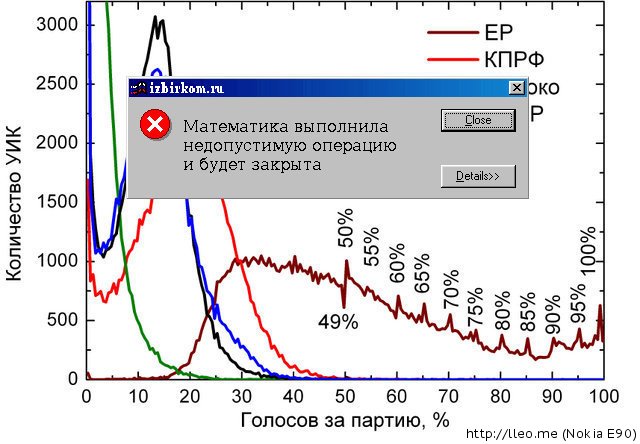
The popular non-Gaussian argument is declared here to be bad mathematics and the author proves his point by showing similar non-Gaussian statistical effects from the latest UK election.

The North Caucasus results are suspicious but minorities are very good at maximising their presence at the centre (I commend a study of Quebec which, for more than a century, has managed to do this – even abandoning normal preferences when necessary. See the 2011 results for an especially dramatic example of a landslide of support switching).

Perhaps all this reminds Putin of other campaigns involving exit polls (very easily faked), press campaigns (easily started) and foreign funding (always present). True, the “White Revolution” is still missing a new leadership team. Could it be Zyuganov and Zhirinovskiy? After all, they took two-thirds of the seats United Russia lost and if the election was stolen, it was stolen from them.

So, his conclusion is not the wild fantasy of a diehard enemy. I see these things and wonder too.