THE RIDDLE OF THE POTOMAC

(Inspired by questions from Sputnik asking my thoughts about US involvement in Syria: what it wants, what it’s doing and what will happen. My answer grew so large that it turned into this essay. Sputnik version https://sputniknews.com/analysis/201710311058699400-us-syria-strategy-failure/)

First published https://www.strategic-culture.org/news/2017/11/02/riddle-of-potomac.html

These questions are rather like asking someone to Unveil the Mysteries of the Universe and answer the Riddle of the Sphinx all in one go. I cannot: Washington is a mystery today and it has been since the early Obama days. At the heart of the mystery are two questions:

Who is in charge?

What do they want?

The United States of America is de-laminating: when even so solemn an outlet as Foreign Policy magazine wonders “Is America a Failing State?” it starts to become a commonplace.

What were the motives or aims of US involvement in trying to overthrow Assad in Syria? I can think of the following:

  1. Build a gas pipeline from Qatar into Europe.

  2. Weaken Russia by striking at an ally and cutting its gas sales.

  3. Obey orders from Jerusalem and Riyadh to weaken Syria/Iran.

  4. Arrogance, ignorance, overconfidence, “exceptionalism” and other delusions.

  5. Create chaos so the USA will still be king of the hill even if the hill is smaller.

  6. Something I haven’t thought of.

  7. Some or all of the above.

But trying to work out Washington’s policy is, to quote an alleged Churchillism about the USSR, like watching bulldogs fighting under a rug. You see that something is happening, you hear growls, but you don’t know who is doing what to whom or why. For example, last year then US Secretary of State Kerry and Russian Foreign Minister Lavrov spent days negotiating a truce in Syria; within a few days the US military attacked the Syrian Army at Deir ez Zor. Who was in charge then? And what was the purpose of either of these actions? No wonder the Russians have concluded that Washington is недоговороспособны: no agreement is possible either because it can’t make one or it won’t keep it.

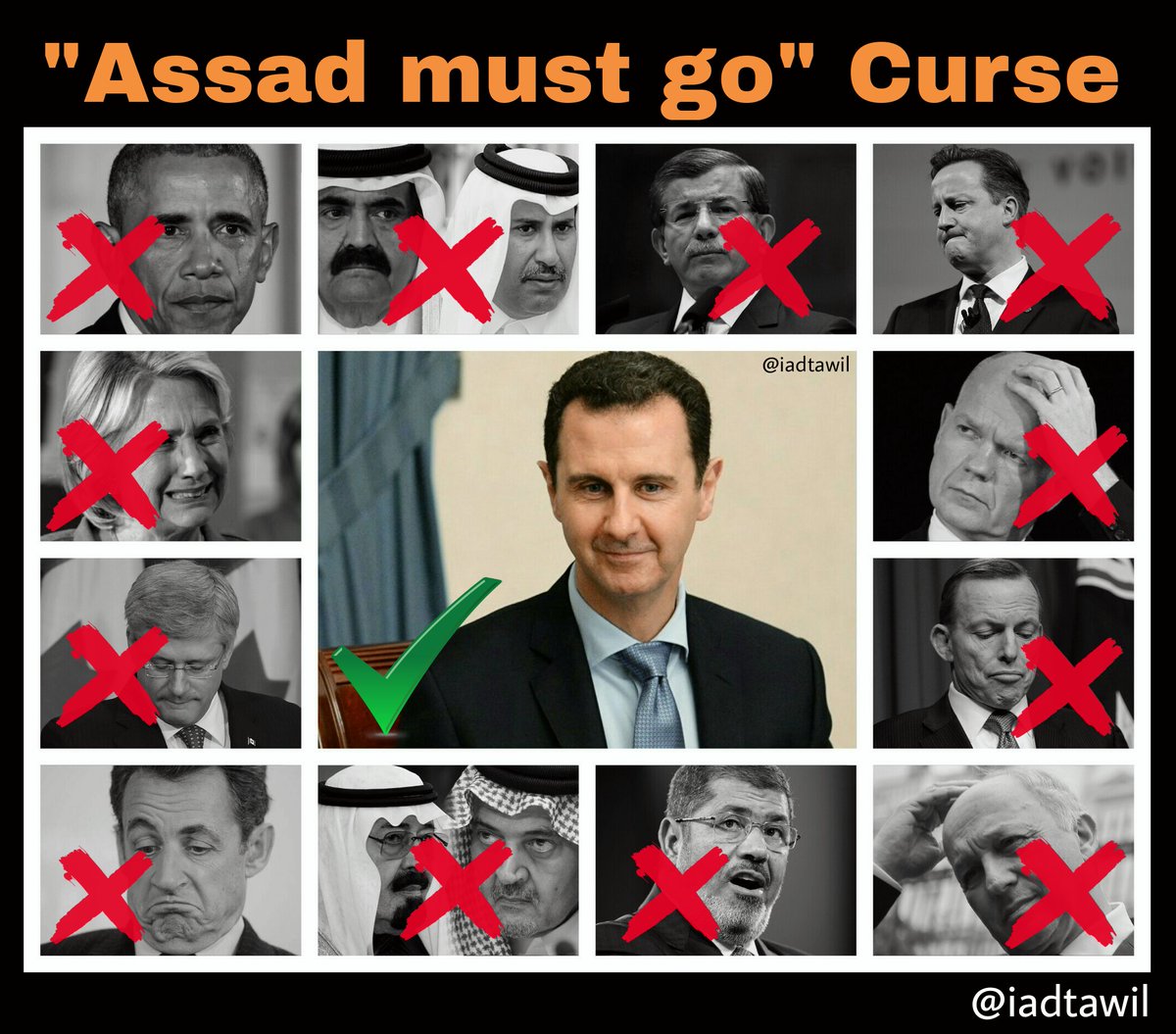
But what we can say is: whatever Washington, in whole or parts thereof, its sponsors or controllers, was or were trying to do in Syria, they have failed. The momentum, which seemed to be swinging against Assad two years ago, has reversed since Russia’s intervention and been replaced with the mockery of the “Assad must go curse“. Assad remains in power and supported by the population; Iran has gained power and influence; Jerusalem and Riyadh are nervous and unhappy; Russia is more influential and – most consequentially – shown to be reliable and effective; no gas pipeline will be built without the agreement of the Syrian government. Chaos has been reduced, order increased. Syria is the Thermopylae of the new New World Order. Every day the USA loses its position in the neighbourhood in proportion as Russia, Iran, Syria and Turkey increase theirs. Failure. Defeat.

Washington isn’t good at admitting defeat and it always comes up with another gimcrack scheme to postpone the day. But the Kurdish surrogates aren’t doing well and the latest bright idea in Afghanistan is a loser too. So we have to contemplate the shape of The End.

US wars end in one of three ways:

  1. A surrender ceremony on the deck of the USS Missouri in Tokyo Bay.

  2. Destruction, overthrow, walk away, amnesia; the proclaimed success is never connected to the consequent chaos. (This is today’s prevailing pattern – see Kosovo, Somalia or Libya).

  3. Helicopters lifting off the Embassy roof in Saigon.

It won’t be number one, it’s probably too late for number two so I guess we must look forward to helicopters on American Embassy roofs.

Unless President Trump can break the habit. Which brings us to another unanswerable question. When campaigning, his rhetoric suggested that he had the beginnings of understanding. His slogan, “Make America Great” had the important addition “Again”. Which suggested that it wasn’t “Great” any more. It seemed to me that he understood that the endless (and unsuccessful) wars were a cause of that loss of “greatness”. This was encouraging to those of us who hoped for an end to the wars. His Inauguration Address continued the theme that Washington should mind its own business.

But, since his election he has been hobbled by the accusation that he is Putin’s poodle. The US media, the US intelligence agencies (or, more correctly, “hand-picked, seasoned” members of same) have banged this drum since the DNC, caught fixing the nomination, blamed Russia. This hysteria has crippled his attempts to have better relations with Russia and move away from the neocon and humanitarian bomber catastrophes of the past. No one could have foreseen this month-in-month-out shrieking. Nor predict how loudly stupid it would become: “Catalonia held a referendum. Russia won”, Pokemon and cute puppies. Trump has been under constraints he could never have expected. Maybe the lunacy will turn on its creators with the new revelations about Uranium One and the Steele dossier, maybe it won’t: I’ve given up trying to predict the craziness.

So we must add the Trump Mystery to the other Mysteries. Although there may be a clue. He has had four foreign affairs issues to deal with so far: Russia, North Korea, Iran and Syria. He is very constrained on the first, loud and boorish on the second and third but interestingly quiet on the fourth. There was the cruise missile strike but I was and still am convinced that that was a theatrical production. What we do have is his decree ending CIA support for anti-Assad rebels. That is an action, the rest is talk. Maybe we should watch what he does, not what he says.

But still: we don’t know. We don’t know what Washington was trying to do in Syria. We don’t know whether all Washington was agreed on what it was trying to do in Syria. We don’t know if any agency in Washington had a plan in Syria. We don’t know who was making decisions in Washington then. We don’t know who’s making decisions in Washington now. We don’t know whether there is any unified position in Washington on Syria. Or anything else. We don’t know what Trump wants. We don’t know what Trump can do. We don’t know who’s running the place. Or whether anyone is.

We don’t know.

An unknown number of bulldogs fighting under a rug of unknown size.

HOW I GOT HERE

Reprints

      http://turcopolier.typepad.com/sic_semper_tyrannis/2017/10/how-i-got-here.html

      http://russia-insider.com/en/how-i-became-kremlin-troll-patrick-armstrong/ri21379

(Now that the book is out I publish my entry. Most of the people who wrote their “how I got here” sections were awakened by the relentlessly one-sided coverage of Russia by the MSM: they suspected that it couldn’t possibly be that one-sided and started looking.

Putin’s Praetorians: Confessions of the Top Kremlin Trolls Kindle Edition; Phil Butler (Author), Patricia Revita (Illustrator), Pepe Escobar (Foreword)

I started work for the Canadian Department of National Defence in 1977 in the Directorate of Land Operational Research of the Operational Research and Analysis Establishment. I participated in many training games in real time and research games in very slow time. The scenarios were always the same: we (Canada had a brigade group in West Germany) were defending against an attack by the Soviet/Warsaw Pact side. In those days NATO was a defensive organisation and, as we later found out, so was the other side: each was awaiting the other to attack. Which, come to think of it, is probably why we’re all here today.

I enjoyed my six years, often as the only civilian in a sea of uniforms, but I realised that a history PhD stood no chance of running the directorate so, when the slot opened, I contrived to switch to the Directorate of Strategic Analysis as the USSR guy. I should say straight off that I have never taken a university course on Russia or the USSR. And, in retrospect, I think that was fortunate because in much of the English-speaking world the field seems to be dominated by Balts, Poles or Ukrainians who hate Russia. So I avoided that “Russians are the enemy, whatever flag they fly” indoctrination: I always thought the Russians were just as much the victims of the ideology as any one else and am amused how the others have airbrushed their Bolsheviks out of their pictures just as determinedly as Stalin removed “unpersons” from his.

That was November 1984 and Chernenko was GenSek and, when he died in March 1985, Gorbachev succeeded. While I didn’t think the USSR was all that healthy or successful an enterprise, I did expect it to last a lot longer and when Gorbachev started talking about glasnost and perestroyka I thought back to the 20th Party Congress, the Lieberman reforms, Andropov’s reforms and didn’t expect much.

In 1987 two things made me think again. I attended a Wilton Park conference (the first of many) attended by Dr Leonid Abalkin. He took the conference over and, with the patient interpretation of someone from the Embassy, talked for hours. The Soviet economy was a failure and couldn’t be reformed. That was something different. Then, on the front page of Pravda, appeared a short essay with the title “A New Philosophy of Foreign Policy” by Yevgeniy Primakov. I pricked up my ears: a new philosophy? But surely good old Marxism-Leninism is valid for all times and places. As I read on, I realised that this was also something new: the author was bluntly saying that Soviet foreign policy had been a failure, it was ruining the country and creating enemies. These two were telling us that the USSR just didn’t work. As Putin told Stone, “it was not efficient in its roots”.

These things convinced me that real change was being attempted. Not just fiddling around at the edges but something that would end the whole Marxist-Leninist construct. As far as I was concerned, it had been the communist system that was our enemy and, if it was thrown off, we should be happy. Sometime around then I was interviewed for a job at NATO and the question was what, with all these changes, was NATO’s future. I said it should become an alliance of the civilised countries against whatever dangers were out there: the present members of course, but also the USSR, Japan and so on.

Well, that didn’t happen did it? I remember a very knowledgeable boss assuring me that NATO expansion was such a stupid idea that it would never happen. He was wrong too.

In 1814 the victors – Britain, Russia, Prussia and Austria – sat down in Vienna, with France, to re-design the world. They were wise enough to understood that a settlement that excluded France wouldn’t last. In 1919 this was forgotten and the settlement – and short-lived it was – excluded the loser. In 1945 Japan and Germany were included in the winners’ circle. At the end of the Cold War, repeating the Versailles mistake, we excluded Russia. It was soon obvious, whatever meretricious platitudes stumbled from the lips of wooden-faced stooges, that NATO was an anti-Russia organisation of the “winners”.

But I retained hope. I think my most reprinted piece has been “The Third Turn” of November 2010 and in it I argued that Russia had passed through two periods in the Western imagination: first as the Little Brother then as the Assertive Enemy but that we were now approaching a time in which it would be seen as a normal country.

Well, that didn’t happen did it?

And so the great opportunity to integrate Russia into the winners’ circle was thrown away.

For a long time I thought it was stupidity and ignorance. I knew the implacably hostile were out there: Brzezinski and the legions of “think” tanks (my website has a collection of anti-Russia quotations I’ve collected over the years) but I greatly underestimated their persistence. Stupidity and ignorance; you can argue with those (or hope to). But you can’t argue with the anti-Russians. Russia wants to re-conquer the empire so it invaded Georgia. But it didn’t hold on to it, did it? No but that’s because we stopped it. Putin kills reporters. Name one. You know, whatshername. Provocative exercises on NATO’s borders. But NATO keeps moving closer to Russia. Irrelevant, NATO’s peaceful. Putin is the richest thief in the world. Says who? Everybody. Putin hacked the US election. How? Somehow.

I quoted Hanlan’s razor a lot – “never attribute to malice that which is adequately explained by stupidity”. And, stupidity and ignorance there were (a favourite being John McCain’s notion that the appropriate venue for a response to a Putin piece in the NYT was Pravda. And then he picked the wrong Pravda! (But he won’t hate Russia or Putin any the less if he were told that, would he?) At some point I came to understand that malice was the real driver.

I suppose it grew on me bit by bit – all the stupidity converged on the same point and it never stopped; but real stupidity and ignorance don’t work that way: people learn, however slowly. I think the change for me was Libya. I started out thinking stupidity but, as it piled up, it became clear that it was malice. I’d seen lies in the Kosovo war but it was Libya that convinced me that it wasn’t just a few lies, it was all lies. (My guess is that Libya was an important development in Putin’s view of NATO/US too.)

Naive perhaps but, for most of history stupidity has adequately explained things and malice is, after all, a species of stupidity.

So what’s the point of writing? I’ll never convince the Russia haters, and there’s little chance of getting through to the stupid and ignorant. And most people aren’t very interested anyway.

Well, this is where malice meets stupidity. If we consider the Project for a New American Century, the neocon game plan “to promote American global leadership”, what do we see twenty years later? Brzezinski laid out the strategy in The Grand Chessboard at the same time. What today? Well, last year he had to admit that the “era” of US dominance, he was so confident of twenty years earlier, was over. There’s no need to belabour the point: while the US by most measures is still the world’s dominant power, its mighty military is defeated everywhere and doesn’t realise it, its manufacturing capacity has been mostly outsourced to China, domestic politics and stability degenerate while we watch and there’s opioids, spectacular debt levels, incarceration, infant mortality, недоговороспособны and on and on. Donald Trump was elected on the promise to Make America Great…. Again. Hardly the hyperpower to lead the globe is it?

The Twentieth Century was the “American Century” thanks to limitless manufacturing capacity allied to great inventiveness anchored on a stable political base. What is left of these three in 2017? Can America be made “great” again? And wars: wars everywhere and everywhere the same. And what other than malice has brought it to this state? Malice has become stupidity: the neocons, Brzezinskis, the Russia haters, the Exceptionalists, scheming “to promote American global leadership”, have weakened the USA. Perhaps irreparably.

So, who’s the audience today? The converted and people at the point when a little push can break their conditioning have always been there. But now there is a potentially huge audience for our efforts: the audience of the awakening.

Which brings me back to where I started. Except that it’s the USA this time:

IT’S NOT WORKING

We’re here and we’re waiting for you: you’ve been lied to but that doesn’t mean that everything is a lie.

NEW US OPERATIONS IN AFGHANISTAN

(Asked by Sputnik for comments on US scheme to use “small teams of highly experienced officers and contractors alongside Afghan forces to hunt and kill Taliban militants.”)

“Precise”, “targetted”, “pinpoint”, “experienced”. All exciting words that look good on the prospectus but they all require accurate and detailed intelligence. And that is something that the ever-expanding US intelligence apparatus – “all 17” – does not have very much of. The US intelligence establishment was surprised by Pearl Harbor, the Soviet A bomb, the invasion of South Korea…. the fall of the Berlin Wall, 911, virtually every subsequent terrorist attack on US soil… the rise of ISIS, Russia’s operations in Syria, North Korean nukes… (Of course there are those who insist that half of these were actually CIA operations and therefore no surprise at all….).

In short a lot of activity, a lot of killings, a lot of doors kicked in, a lot of personal grudges paid off by fooling the Americans into doing your dirty work and not much else. Shades of Operation Phoenix in Vietnam.

And why go after the Taliban anyway? It’s not ISIS/DAESH or Al Qaeda: it’s a purely Afghan phenomenon and it has been getting stronger because it embodies the long Afghan desire to be left alone by foreigners.

So the result will be more deaths, more Taliban and another signpost on the road to American overextension.

But the program will succeed in getting the USA to the milestone of being in Afghanistan twice as long as the USSR was.

WHY SELL S-400s TO THE OTHER SIDE’S ALLIES?

(First published at https://www.strategic-culture.org/news/2017/10/16/why-sell-s400-other-sides-allies.html)

Picked up by http://tapnewswire.com/2017/10/why-is-russia-selling-s-400s-to-saudi-arabia-and-turkey/

http://abundanthope.net/pages/Political_Information_43/Why-Sell-S-400s-to-the-Other-Side-s-Allies_printer.shtml

https://therussiajournal.ru/2017/12/22/sell-s-400s-sides-allies/

Moscow is selling S-400 air defence systems to Turkey and Saudi Arabia. In the first case, a down payment has apparently been made while in the second the intention has been announced. This immediately presents the question of why Moscow would agree to sell one of its crown jewel weapons systems to countries which are not only not solid allies but are, in fact, American allies.

The “Atlanticist View” answer to the question would run something like this: Putin’s “hold on power” is trembling, the Russian economy is in trouble, Russia is running out of money and because it has only two exports, weapons and energy, it is desperate to sell either to anyone. And, right on cue, from the usual people, we had this a couple of weeks ago:

Putin’s hold on Russia may be more fragile than it appears. One reason is Western economic sanctions, which are biting and causing hardship to Russian businesses and ordinary citizens. Another is the dependence of Russia’s economy on fossil fuels at a time when oil prices are down and not expected to rebound soon. To the extent that Putin’s legitimacy rests on prosperity, Russia’s economic woes are a problem for him.

While no one in the report stated that “Putin’s Russia” might sell weapons, the participants would probably see such sales as another indications of “economic woes”. To them “Russia has effectively declared political war on the West, even if Europe and the United States haven’t quite grasped that yet.” Such people think that, in order to “keep Russians under his autocratic thumb, he needs them to see that the freedoms of Berlin, London and Washington are nothing to be envied”. This is a continuation of the fantasies that have ruled in such circles (and paid the participants generously) for years and makes them always surprised by what Moscow does. A year ago, for example, some of the “best security minds” of the “POLITICO Cabinet” quoted above were rabbitting on about how Russia was in a quagmire in Syria and that “time is not on Russia’s side”. And, a year before, one of them was saying Russia was economically weak and politically “brittle”. Flat learning curves all of them. Syria was not a quagmire, Russia is not isolated, it’s not failing, its leaders are not fools, its economy is not collapsing, support for the Putin team is strong, sanctions are not “biting” and weapons sales are not the last gasp before collapse.

Where these people profess to perceive an innate Russian malevolence and hostility to “freedom”, others see a wholly rational response to years of NATO expansion and Washington’s flouting of international law and custom, regime change operations and invasions wrapped in sanctimonious protestations of virtue. Moscow believes – quite rationally – that it is on Washington’s target list and it is my opinion that it was the destruction of Libya under “human rights” cover that finally convinced the Putin Team that it had better look to Russia’s defences. Subsequent experience of Ukraine and Syria would only have strengthened their resolve. The S-400 sale is better seen as component in a prophylactic policy against further Washington-NATO chaotic wars and to safeguard Russia itself than malicious resistance to counselling from its betters.

The S-400 sales are actually a geostrategic move of some significance.

The first question to be asked is what, exactly, will be sold to NATO member Turkey and US ally Saudi Arabia? I doubt it is the full-capability S-400 system that Russia itself is using. First, Almaz-Antey is already working on the next in the evolving series. Secondly I would be very surprised if there weren’t, buried inside the circuits, an IFF system that would prevent firing at a Russian aircraft and a self-destruct failsafe if anyone should try to tamper with the inside. As for those who think that no one would buy systems with such limitations, the simple response is this: who apart from the makers would know whether there were such limitations, where and what they were and how to nullify them? We have the confirmation of all that here:

“We won’t give them any of the electronic codes or ‘internals.’ Under the agreement, technical servicing will only be done by Russia and they [the Turks] won’t gain entry to the systems,” a Russian military source told Gazeta.ru.

and here:

“All the fears about the leak of technology are greatly exaggerated, especially so far as anti-aircraft missiles are concerned,” Khodarenko said. “Even if they were to disassemble the system down to the last bolt to try to pull out some military secrets, they would still be left with nothing.”

So, as to the question of Moscow’s risking the secrets of the S-400 falling into the wrong hands, I would assess that it is greatly reduced if not altogether eliminated.

The S-400 system is generally considered to be pretty capable even there has been – as far as we know – no combat use of it. Its threat may have reduced US coalition aircraft operations in Syria and a US general said that “the introduction of an A2/AD bubble in Syria would be Russia’s third denial zone around Europe“. It is a complete mobile system involving several different missiles and a full suite of radars, management and command centres. There are a number of variations and combinations of parts possible – it’s not yet public exactly what parts either will be buying – with effective ranges out to 400 kilometres against targets including ballistic missiles, cruise missiles and all kinds of aircraft. A large number of targets can be tracked and many missiles controlled at once by the integrated detection and command package. Like most Russian (and Soviet) systems it is the product of years of evolution, testing and learning. So, on paper, it is very formidable. And, since it has a number of customers, one has to assume that they are convinced that it is as good as it is advertised. In conclusion, therefore, it is likely that the systems sold to Turkey and Saudi Arabia will be protected against being used against the Russian Aerospace Forces and protected against prying eyes trying to get its secrets. But they are buying an air defence system effective against non-Russian targets.

And why would they want that? They know that Washington has a history of turning against former associates. Saddam Hussein was useful until he wasn’t, so was Manuel Noriega, bin Laden & Co ditto, Qaddafi had his moment of cooperation, even Bashar Assad had his after 911. It is more dangerous to be Washington’s former friend than to be its permanent enemy. Both Ankara and Riyadh could be contemplating the possibility of becoming Washington’s former friend. One should remember that Erdoğan attributes last year’s coup attempt against him to Washington’s influences and Riyadh may be contemplating another switch of Western patron.

In short, should either Ankara or Riyadh be contemplating a move away from Washington, precedent suggests they should prepare for the worst. And, as Hussein, Noriega, bin Laden, Qaddafi and Assad can all attest, air attacks are the principal expression, in military form, of Washington’s displeasure. If all you have are antiquated and poorly maintained Soviet air defences from the 1980s (or US equipment with hidden IFF settings) you are pretty helpless and US air power will have a free run.

But, with S-400s, you have a chance. Or at least an alternative. And that is the geopolitical significance of the sales.

The possession of S-400 system gives the owner the possibility of a foreign policy independent of Washington.

Therefore it’s not just another weapons sale, it could be a geopolitical game-changer.

DIPLOMATIC RECIPROCITIES

(Question from Sputnik about my thoughts on Moscow’s reaction to the US visa slowdown.)

The cynic would say that, after the reduction, the US has too few staff to spare from plotting Putin’s overthrow to do normal diplomatic duties. Or maybe it’s some half-witted notion that, deprived of a chance to go to Disney World, the Russian population will rise up and overthrow Putin and let the US Navy into Sevastopol at last. It is however somewhat ironic, given the American confidence in the superiority of their own system, that they would want to make it harder for Russians to experience such a superior exemplar of freedom and democracy.

As to Russia’s retaliation, the diplomatic business is based on reciprocity or so, in my experience, is the Russian practice. So there will be some retaliation and one that will likely astonish Foggy Bottom

My belief is that Russia has realised that, as Putin told Stone, individuals may change but the US system does not. Given Washington’s support for opposition figures, its predilection for interference, its funding of GONGOs hostile to the Russian government, military actions in the neighbourhood, oft-stated declarations of enmity culminating in the latest sanctions, I would expect that Moscow is ready to follow Washington all the way down to zero representation if that’s where it goes. Moscow has less to lose than Washington.

One can always hope that a more sensible approach will win out but that hope is ebbing away as Trump makes more and more concessions to the War Party and his “why not make friends with Russia” thoughts are washing away.

If — one never wants to completely give up hope — the Russiangate nonsense is blown up thereby destroying the pretext for the original US actions, then maybe we can get back to something normal.

(But I would still advise Russia — as I would other countries — to insist on exact reciprocity of numbers and to expel all American GONGOs so as to reduce the capacity for mischief.)

Is Trump Finished?

Written for Edward Lozansky’s expert group 25 July 2017 (http://us-russia.org/5064-any-advice-to-trump.html)

Conventional opinion has been wrong about Donald Trump every chance it has had. He wasn’t seriously running; he’d never get the nomination; couldn’t possibly win the election; would be impeached, declared insane, would quit, was failing, was a Putin stooge and on and so on. Therefore absolutely nothing in the MSM or conventional thinking about him is worth a millisecond’s consideration: whatever conventional thought thinks is wrong. I know of only one person who has successfully read the Trumpian tea leaves and he is today saying that Trump is on the point of complete victory. Read Scott Adams; don’t waste your time with those who have been wrong every time before.

That having been said, I have been reading Adams on Trump for more than a year now and have seen him get it right time after time. If he says Trump is on the verge of victory, I believe him. I waste no time on the opinion of pundits who will be wrong again.

I was encouraged by Trump’s oft-stated intention of having better relations with Russia and his statement in his Inauguration Address that “We will seek friendship and goodwill with the nations of the world – but we do so with the understanding that it is the right of all nations to put their own interests first. We do not seek to impose our way of life on anyone…“. For too long Washington’s real message has been the threat, however fragrantly wrapped, “Do what we want or we’ll destroy you”. Twenty years of this has destroyed many countries: it has also (not that the destroyed are sorry about it) weakened the United States itself: Iran’s power and influence has spread, Russia and China are allied, other long-time allies are looking away, the US itself is debt-ridden, quarrelsome and stripped of the manufacturing power that made it so mighty. I believe that Trump understands this on some level.

But I am dismayed by his adulation of the winners of the “U.S. military’s marathon, 30-year, single-elimination, suck-up tournament“. I am disturbed by his evident belief that jihadist terrorism – that product of takfiris like ibn Taymiyya and al Wahhab – finds its headquarters among Twelver Shiites. Many of his personnel choices are very disturbing: people who in no way can be seen as making the change that he promised. The resistance of the Deep State to his attempts is frightening (although it may be significant that one of his latest tweets is that it is not merely a “swamp” to be drained but a “sewer”. Many people pull against him. But I haven’t given up hope yet (and, indeed, developments in Syria give hope.)

Putin had similar problems when he, an outsider, was dropped into the Moscow swamp and here the Saker advises Trump to emulate Putin.

Putin was underestimated too. Here are two opinions that look pretty silly today:

Psychiatry recognizes a condition known as ‘moral idiocy’. Every time he opens his mouth in public, Putin confirms this diagnosis for himself.

                                                                                                       (Andrey Piontkovsky, 2000.)

And

Putin, of course, is no Peter. The KGB lieutenant colonel who was abruptly bumped into the presidential throne of a nation in total disarray comes nowhere near ‘the Great’ in ambition, potential, drive or physical height.

                                                                                                          (Serge Schmemann, 2000.)

Getting to the end of the book

In the as yet un-written “History of the Decline and Fall of the American Empire”, the recent sanctions (if enacted) will come as the conclusion of the third-last chapter. The chapter after that will be entitled “The Fall” and the final “The Aftermath”.

One hopes the book will be written by humans and not by aliens studying our radioactive remains.

“Anti-Russian Sanctions Bill ‘Will Result in a Tectonic Break Between US, Europe'” (Sputnik)

“Europe is a scapegoat in the US sanctions war against Russia” (Oriental Review

“Trump’s ‘America First’ vs. McCain’s ‘America Last’” (David Goldman)

“Imperial Folly Brings Russia and Germany Together” (Escobar)

“The U.S. Sanctions Bill Is a Win for Russia” (National Interest)

Les sanctions américaines poussent la Russie à abandonner le dollar – Le vice-ministre des Affaires Etrangères Sergei Ryabkov(REF)

“Let’s Cut Them Off From Space’: How Russia Could Strike Back at US Sanctions” (REF)

“Collateral Damage: U.S. Sanctions Aimed at Russia Strike Western European Allies” (REF)

“The New Russian Sanctions Bill Is Washington’s Monument To Its Criminality” (PCR)

“The U.S. Empire Continues to Stumble Towards Ruin” (REF)

“US new anti-Russian sanctions point a dagger at the heart of Europe” (REF)

“Time for Europe to Stand up to US Hawks on Russia” (Neil Clark)

“Why US Sanctions Bill is the Last Straw for Russia, Iran, North Korea” (Gilbert Mercier)

“Sanctions, Smoke and Mirrors from a Kindergarten on LSD” (Saker)

“Is Trump Set to Sanction Our Dreams of Peace?” (Phil Butler)

“New Russian Sanctions Show Putin Exactly Where To Retaliate” (Jeffrey Carr)

“Milk-Bar Clausewitzes, Bean Curd Napoleons: In the Reign of Kaiser Don” (Fred)

“House Passes New Russia Sanctions, Pumps Adrenaline Into Cold War 2.0” (Ron Paul Inst)

“On Russia sanctions, Trump has a point” (Ignatius WaPo)

“How the World May End” (John Pilger)

“Isolated Trump Flails Helplessly as He Bows to Irrational Policies on Russia and Europe Imposed by Congress” (Jatras)

“US Sanctions — a Looney Tunes Bad Remake”(Wm Engdahl)

“How Russia Could Strike Back Against US Sanctions In 4 Simple Maps” (REF)

“Between Cersei and Daenerys” (Israel Shamir)

New Sanctions Against Russia – A Failure Of U.S. Strategy” (MoA)

“KUNSTLER: ‘Russia Sanctions Will Blow up in America’s Face'” (REF)

Syria: a crack in the Western facade?

[Response to a question from Sputnik on what I think of the reports out of the Élysée. Published https://sputniknews.com/politics/201707181055633335-macron-russia-china-syria/]

If these reports are accurate, I think that we are possibly (possibly) in the early days of important changes regarding the West and Syria. But inertia is a powerful force.

Hitherto Paris was one of the main centres of the “Assad must go” cry. But Macron seems to have dropped the condition. The Western consensus used to be that the Syria question must be settled from outside. Settled by the Western powers, that is: not with Russian involvement, let alone Chinese and certainly never with the involvement of the Syrian government. Macron’s remarks about involving the P5 as well as Damascus changes this position too. Moscow and Beijing will have their say (even if the latter is a silent partner).

Moscow has insisted, over and over again, that important issues can be only settled with the involvement of all parties and, in particular, the UN. And, however short the UN may have fallen from its lofty intentions, it cannot be denied that there isn’t anything any better. Two decades of the hyperpower and its minions making up the rules have, to put it mildly, had little success. The stupidity and incompetence of the West’s elites, their indifference to their own true interests, has been astonishing.

Therefore, there is a shred of hope that at last some movement away from further disaster may be possible. Clearly, the only possible settlement for Syria has to involve all the players, not just Washington and its flunkies’ notions of who they should be.

But there is a huge amount of opposition to this suggestion – see, for example, the apoplectic reaction of “Making Peace With Assad’s State of Barbarism” or from these War Party spokesmen to suggestion of cooperation with Moscow or Damascus.

But Trump was elected partly on a promise to stop the wars and Macron appears to have a similar thought. The West’s wars of the Twenty-First century have been failures. Maybe something else will be tried.

(Who, in 2000, that year of triumphalism, would have expected that Syria, a country, one would have thought, quite peripheral to the interests of Europe and North America, would become a world-historical pivot? But so it is becoming: the Thermopylae of the new world?)

Something for them to talk about

US President Trump and Russian President Putin are due to have their first face-to-face meeting in Hamburg in a few days. This meeting should have taken place in April or May and, had that happened, by now the two would be well into substantive issues. But thanks to the devotion of the lügenpresse to the anti-Russia tarradiddle, Trump was unable to move. And, exploded as a “nothingburger” it may be, and devoid of evidence as we are continually told it is, people are still banging away at it: “You must state bluntly to Putin that Russia can never again violate our sovereignty by stealing and publishing our data, and must stop cyber probes of our electoral machinery.”

So Trump may be wary that anything he does or says to Putin, short of outright rudeness or a punch in the face, will be spun as further “proof” that he is Putin’s puppy. Although – one can hope – Trump, empowered by his contempt for the fake news media and emboldened by CNN’s troubles, may ignore the yapping.

From Russia’s perspective the meeting is easy enough. Putin is self-controlled, intelligent and disciplined: he’s ready and capable of talking about anything; he knows what Russia’s interests are; he has an open mind; I believe he is hopeful but not deluded. He knows that the WaPo and NYT think Trump is an idiot but I doubt he looks to these propaganda rags for guidance. He is smart enough to know that a man who became POTUS against all opposition could not possibly be an idiot but, at the same time he is experienced enough not to hope for too much (as he told Oliver Stone: presidents come and go but US policy doesn’t change).

The commonly suggested subjects for discussion present some difficulties. In Syria Washington is simply too involved with fantasies of “moderate rebels”, confusion from moment to moment and speaker to speaker about what Assad’s future should be. Added to which, there is more than a little evidence that, whatever official Washington may say, the generals on the ground will attack Syrian units or aircraft ad libitum. Therefore it is too complicated a subject for a first discussion. Countering terrorism is another suggestion but, for a serious discussion to be possible, Washington must first decide what side it is really on: it has too long a history of supporting jihadists here but fighting them there to be believed (and especially not by Putin who told Stone that he had proof that Washington had supported jihadists in Chechnya). So, neither of these subjects makes for a good first discussion.

But there is one serious subject that would work and that is North Korea and its nuclear and missile programs. It drew attention to itself in the most dramatic way by launching a rocket that could reach Alaska on the most sacred holiday of the American mythos. There is no reason to think that either Beijing or Moscow are much pleased with this development either. Chinese President Xi was just in Moscow with Putin and the two discussed North Korea and a joint statement was issued. They call for the cessation of missile and nuclear tests by Pyongyang and cessation of US-South Korean military exercises near the border; Beijing calls this the “double suspension”. If a solution is found, it will have to be that; threats from Washington do nothing to solve anything. Pyongyang isn’t scared and it has every reason to hate and distrust Washington: US aircraft dropped 25% more bombs on North Korea than it did on Japan, killing, one US general estimated, 20% of the population. Americans may have forgotten that, but North Koreans have not.

This, therefore, is a subject that is topical; it is a problem that all three capitals recognise; there is a solution. While the solution will necessitate some climbdown by Washington, it can be accomplished in the spirit of Catch-22’s Colonel Scheisskopf by the announcement, every year, that this year’s exercise has been cancelled.

North Korea’s missile launch will certainly be on the G20 agenda. Trump has met with Xi, Xi has met with Putin; Xi and Putin have the solution, they’re all going to be in the same place at the same time. So I would suggest that a meeting of the three of them to discuss the “Korean peninsula” issue would make for some fruitful results. Xi could, as it were, make the introduction.

I don’t suppose that any of the three has people devoted to reading my website so I don’t expect one of them to pick up the suggestion.

But I think that it is something to watch for and there isn’t any reason not to think that bilateral discussions in North Korea couldn’t segue into a three-sided conversation.

Democracy or Regime Change?

Asked by Sputnik about DIA report mentioned here. Probably won’t bother to read it — got some paint I want to watch dry and there’s always grass growing out there — because I’m sure all it will say is It’s All Russia’s Fault.

Perhaps I was a little hasty: Paul Robinson has read it and is interested “that at least somebody in the American security establishment is willing to admit that people elsewhere in the world don’t all appreciate what the United States is doing.”

https://sputniknews.com/politics/201706301055103084-russia-reasons-usa-wants-topple-government/

In the simplest possible terms: Washington has been trying to bring “democracy USA-style” to Russia. Russians, observing the consequences of “democracy USA-style” in Iraq, Libya and especially in Ukraine, regard this as regime change. So they’re both right.

Thus far, the most effective “weakeners of US influence on the world stage” have been the neocons and humanitarian bombers that have driven Washington’s policy this century. Failed interventions and losing wars are doing a far more effective job of destroying the USA than anything Moscow or Beijing could do. Osama bin Laden ought to be quite happy about what 911 began because the formerly “strong horse” looks more and more like a “weak horse”: immensely brutal and destructive, but nothing else.

Whether Trump can overcome the “deep state’s” sabotage remains to be seen. He promised a policy of non interference but his first five months have been burned up by the Russian interference “nothing burger”.