RUSSIAN FEDERATION SITREP 26 April 2012

CHANGE. More change working away. Last Sitrep I reported about a quarter of Russians had travelled outside the former USSR. Now we find that about 90% have cell phones and about 40% of adults use the Internet daily. ROMIR tells us that 70% of Russians have savings, the overwhelming majority in Rubles, many in banks. And a per-capita GDP is getting on for half that of Japan. I believe that easy communication, travel, access to the New Media and savings accounts are the outward signs of internal change: “middle class” things. I think it’s fair to say that Russia has never been a “middle class country” before: it’s not there yet but getting there.

POLICE. More police outrages: more torture cases revealed; a conviction for same; a conviction for murder. There is some pressure building to have the Interior Minister dismissed.

CORRUPTION. Medvedev admitted his campaign had yielded only modest results. Putin said much the same thing at the end of his second term. For my money it’s Russia’s worst problem.

THE EMPTINESS OF FORMER FLAPS. Lugovoy has passed a lie detector test administered by people from the UK over the Litvinenko death. The standard view, re-typed by thousands of outlets, takes a hit.

PUTIN. Putin is stepping down as head of United Russia, because, “The president should be a non-party figure.” This is a common sentiment in the former USSR where the word “party” still has some bad connotations.

INVESTMENT CLIMATE. Putin and Medvedev have both spoken about Russia’s bad investment climate. It appears that improvements are on the agenda. Putin announced that there would be no export duties for new hydrocarbon projects on the Russian shelf and, lo! a few days later Rosneft and ExxonMobil announced a deal. He then proposed tax holidays for new production facilities in special economic zones.

NONSENSE. SIPRI claims that Russia is the 3rd largest military spender in the world after the USA and China at US$71.9 billion. That kind of money would buy a lot more than 6 Su-35s and 30 Su-30s between now and 2015. NATO used similar PPP cooking in the past to claim Russia was Number 2.

MISSILE DEFENCE. The Chief of the General Staff agreed that there is a potential threat of nuclear weapons acquisition by Iran and North Korea and that it should be jointly defended against. Earlier the Director of the (US) Missile Defense Agency told a US Senate panel that cooperation with Russia could benefit the USA. There is to be a conference on the subject in Moscow next week: maybe something will be done about this unnecessary impasse.

POLITICAL PARTIES. The rules for registering political parties have been relaxed and no fewer than 143 have applied. I’ll bet at least half are parties claiming to unite the liberals under a single leader.

ASSUMPTIONS. A commonplace of comment, inside and outside Russia, is that every time a Western power(s) overthrows a government, Russia loses business there. Doesn’t actually seem to work that way: LUKoil has started work on the West Qurna-2 oilfield in Iraq.

ARROGANCE. The US State Department’s spokesman says that the investigation into the death of Sergey Magnitskiy has been “inadequate”. Maybe it’s time for Moscow to take up Conrad Black’s incarceration. But really, what arrogance: are we to presume that Washington knows the correct answer? there is an investigation in Russia, actually.

ABKHAZIA. There was an assassination attempt against President Ankvab of Abkhazia in February. Arrests have been made and two suspects are reported to have killed themselves. One theory is that it’s connected to corruption. I haven’t heard anyone suggest that it was Tbilisi.

© Patrick Armstrong Analysis, Ottawa, Canada (see http://www.russiaotherpointsofview.com/)

RUSSIAN FEDERATION SITREP 5 April 2012

OPEN MIKES. Everyone by now has heard about what Obama said to Medvedev. A cynic would say that Obama could have done all that in his first two years when his party had a majority in Congress, or even now while it still has one in the Senate. But, here we are, back where we started. Romney’s response was preposterous but it appears that all the standard memes about Russia-the-Eternal-Enemy are firmly embedded in his mind. If he is elected, there will be bad times ahead for US-Russia relations. My fuller response will appear at Russia Profile Experts’ Panel on Friday.

POLICE. Clearly Medvedev’s police reform was, to put it mildly, incomplete. After the murder of a suspect in Tatarstan, the Russian Investigative Committee spokesman told regional units to check all complaints about police misconduct. Almost immediately, 66 more cases were revealed there. And still more elsewhere. A police accountant was charged with stealing payroll money and the head of a regional traffic police department with accepting a bribe. The “performance review” accepted 90%; too many.

CORRUPTION. After an investigation, the Prosecutor General’s Office concluded that about US$84 million of state money had been embezzled in North Caucasus, with next to none recovered, That’s about 1%. Even if the investigators are off by a factor of ten that strikes me as a gigantic reduction from former times when it was closer to 100%. Charges of financial wrongdoing against the former head of the Moscow subway have been dropped. Russians are sceptical that Putin can significantly reduce corruption (His “most wearying and difficult to resolve” problem said he in 2008): only 25% think he can. Some observations are relevant. Corruption is not, of course, a Russian invention although it’s often reported as if it were; we all have it in varying degrees and styles. Second, the worst corruption is invisible because insiders steal the money before it leaves the Treasury; the most visible is small-time shake-downs. And third, it is a serious problem in Russia, but arrests are made and convictions obtained. And fourth, perceived corruption is very dependent on what an individual sees and what he hears about (which is why I don’t take TI’s ratings very seriously).

END OF AN ERA. Sergey Shoygu is the new Governor of Moscow Region, replacing Boris Gromov, who, rumour has it, will go to the Federation Council. Shoygu has served as the head of Russia’s emergency services for the incredible term of 20 years, outlasting a multitude of ministers; fascinating to think of what he has seen pass by in the government and all the changes he has observed from his office. By all accounts he has done a superb job: he had people on the ground in the 2004 tsunami, for example, the next day.

TRAVEL. A Levada poll tells us that about a quarter of Russians have been outside the FUSSR. That, when you think of it, is quite a large number and is part of the psychic changes happening in the country: I suspect most have done their travelling since 2000.

CARS. Putin has urged all government structures to buy vehicles made in Russia, Kazakhstan or Belarus. I seem to recall an earlier Yeltsin decree to that effect. Mind you, Russian cars are better today. But, still, there’s nothing like a big, black Merc, with a cluster of little Mercs scampering around you. Maybe that will change.

CIRCASSIANS. After Russia conquered the North Caucasus in the Nineteenth Century, many Circassians left for the Ottoman Empire and are now found all over its successor states. A number of those in Syria apparently want to leave and return to their ancient homeland: it is said that they feel Assad was their protector and guarantor of their security. Their cause has been taken up by a Federation Council Deputy from the Kabardin-Balkar Republic. More here. It will be interesting to see what happens.

GEORGIA. Some years ago, Russia cut off imports of Georgian mineral water, claiming problems with forgery and adulteration. But, after extensive re-tooling, the Borjomi plant is up to standards and Russia’s health organisation has approved it for import. Russia is a very large market and the water is a significant export earner for Georgia.

THE EMPTINESS OF FORMER FLAPS. The Ukrainian Prosecutor-general says that the Yushchenko poisoning case should be closed for lack of evidence. Lots of the usual nudge-nudge wink-wink stuff implicating Russia at the time which helped to boost the “Orange Revolution”. Doubts at the time got little coverage. Another piece of typing masquerading as reporting. More on the Ukrainian prosecutor’s views.

© Patrick Armstrong Analysis, Ottawa, Canada (see http://www.russiaotherpointsofview.com/)

RUSSIAN FEDERATION SITREP 22 March 2012

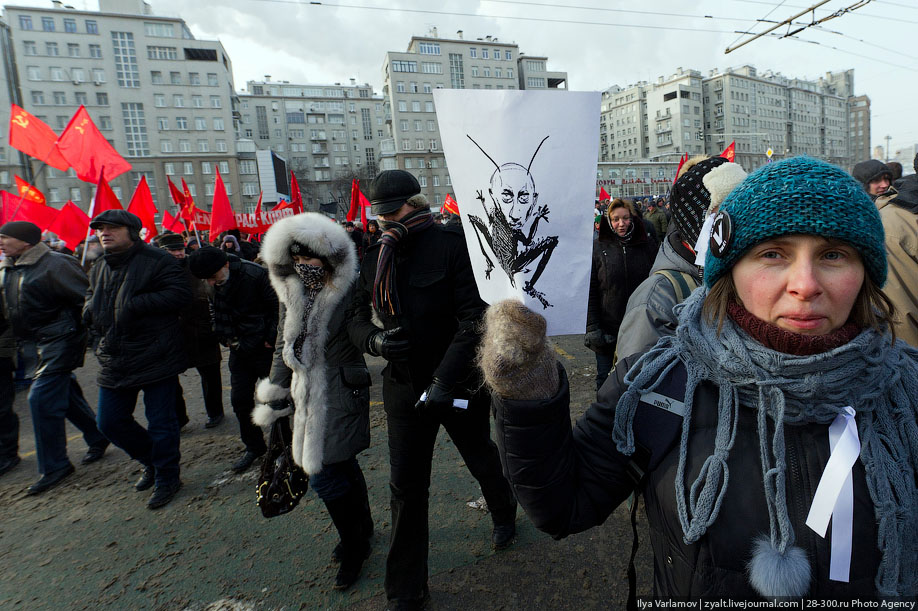
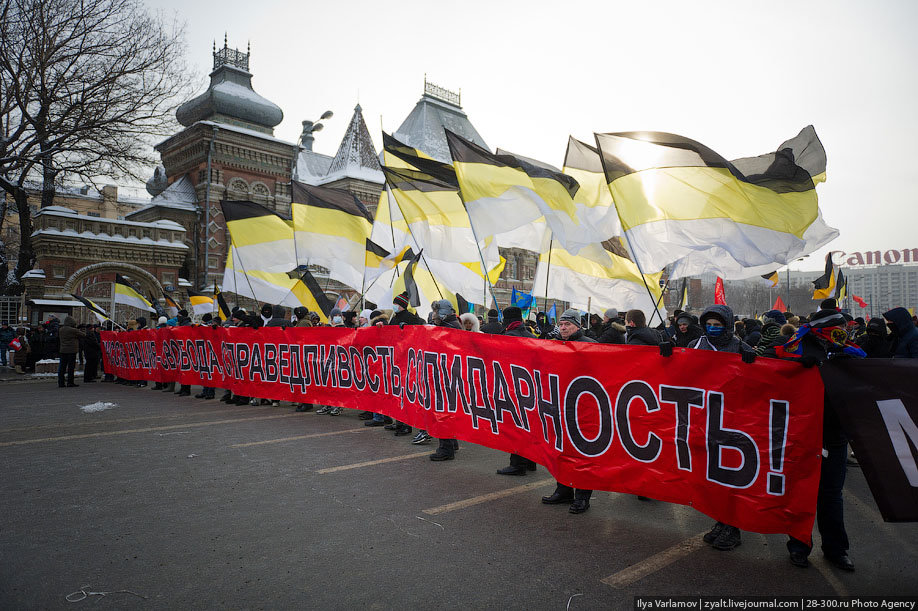
DEMONSTRATIONS. The opposition movement is losing steam. As we have seen before in post-Soviet Russia, it is one thing to agree on dislike of the present regime but quite another to agree on what comes next. An association of former ins wanting to get back in, communists, nationalists and “new young people” do not have very much in common. The two pre-eminent leaders (or actors: are there any “leaders”?) now appear to be the hard left Sergey Udaltsov and the anti-corruption (and rather nationalistic) Aleksey Navalniy. They agree on their dislike of Putin &Co and people from Central Asia and the Caucasus. Is that enough to make a match? Perhaps, nationalism and socialism have co-existed before. Meanwhile the anti-Putin demos are getting smaller and, in some cases we see a return to the provocative demos (ie no permit or breaking the permit) that characterised opposition protests in the Luzhkov days. Western reporters breathlessly write these up and diplomats huff but, really, now that it is clear that protesters can assemble in the tens of thousands so long as they do what they apply to do, what is the point of provocative demos? Udaltsov is calling for “a march of millions” for the day before Putin’s swearing in but it seems very unlikely that anything like that will turn out. It’s over for the moment: a VTsIOM poll indicates interest is waning. And, the basic premise that the Duma elections were stolen has still not produced any convincing evidence. And even less so in the case of Putin’s victory. Amusingly, some media people have set up a mock Facebook group “Journalists Against Demonstrations”. Presumably if they hold a “Demo against Demos” they won’t cover it.

NATO. Now that Pakistan is less willing to be NATO’s base for its Afghanistan operations, there is a scheme to build a transit base in Ulyanovsk. The KPRF is demanding a referendum be held first and there has been a small demo against the idea in Ulyanovsk. I remember writing lots of briefing notes in the 1990s for the higher-ups saying you can kick Russia when it’s down, but it won’t always be down.

SYRIA. The flapdoodle about Russia sending troops to Syria, first reported by RIAN and then picked up by other outlets, seems to have been rather thinly based. The official Russian line is that an auxiliary tanker is at the Russian Navy base at Tartus as part of the support for anti-piracy operations off Africa (in which the Russian Navy has been engaged for some years). The ship, although civilian-crewed, has some Armed Forces personnel on board. The Western media is in an all-Syria-all-the-time mode (strange that we don’t hear much about Libya these days. Or Kosovo) and such stories are grist for the excitement mill. For something that goes deeper than “Putin is nasty; therefore he likes nasty people”, the assumption behind so much Western coverage, I recommend reading this: Moscow has practical reasons, realpolitik, in not seeing NATO topple someone else and leave a bigger mess behind. Russian concerns about blowback are never much understood in the West: I believe it to be a major worry affecting Russian-Georgian relations.

RUSSIA’S MIGHTY ARMS BUILDUP. The Air Force is to receive the first six (6) Sukhoy Su-35 (prototype 1988) fighter jets by the end of the year. 30 Su-30SMs (prototype 1989) are expected by 2015. We hear a lot about plans to re-equip Russia’s Armed Forces but what happens is still rather small.

PUSSY RIOT. 2 members of this band were arrested last week and a third a couple of days later and charged with “hooliganism”. They performed an anti-Putin song at Christ the Saviour in Moscow. Some Western reaction here and here. Blasphemous hooliganism or political protest? Here’s the video, dear reader; you decide (PS the church is Russia’s equivalent of St Peter’s Basilica).

CORRUPTION. Last week the Deputy Chairman of Vnesheconombank was charged with large-scale fraud. Some officers of the Federal Drug Control Service were busted for theft in Vologda Oblast. On the 10th a man was arrested in Kazan and died in custody. 5 police officers suspected of torturing and killing him were arrested on the 13th; the head of the local police department was fired on the 15th and the entire police squad was disbanded, with most of the officers to be fired, on the 16th. A faster reaction than we usually see in such cases.

HISTORY. Never goes away. A Latvian court overturned the parliamentary ban on a march of Latvian veterans of Nazi forces and the march duly took place. Somehow I doubt we will see any commemoration of the Latvian Rifle Regiment: that’s not part of Latvian history as now remembered. But seriously, the populations of the Baltic countries were vacuumed up by whichever army got to them first; they have no real heroes of the war: all were on the “wrong side”.

© Patrick Armstrong Analysis, Ottawa, Canada (see http://www.russiaotherpointsofview.com/)

RUSSIAN FEDERATION SITREP 8 March 2012

ELECTION. Results here in Russian on the CEC site and in English at RIAN. Putin 63.6%, Zyuganov 17.18%, Prokhorov 7.98%, Zhirinovskiy 6.22% (fourth place for once!), Mironov 3.86%. Turnout 65.3%. Turnout in Moscow City and St Petersburg about 50%. Chechnya was a little more subdued this time: a mere 94.89% turnout with only 99.76% for Putin. Interesting from the point of view of the polls: Putin did better than FOM or VTsIOM predicted but on the low range of Levada’s 63-66%. Zyuganov did better than anyone predicted, beating the average estimate by 20%, and Zhirinovskiy did somewhat worse (but they share a sector of the electorate and their total was very close to the estimate); Prokhorov hit the average prediction but Mironov was significantly worse at only about 65% of the prediction. But, generally speaking not large variations from the predicted results and Putin’s lead over perennial runner-up Zyuganov of three and a half to one is hard to pretend was manufactured. (Which isn’t stopping people from trying with what can only be an intentional misuse of statistics).Turnout was below average but still respectable. I have the feeling that the Western connection of the protestors (and I repeat that the US Ambassador’s meeting with the opposition was a gift) induced some people to vote Putin who might not otherwise (à la Voter 2’s story). Prokhorov may have a future as the non-Communist anti-Putin (a Forbes survey rated him the second-most respected billionaire) (perhaps in the cabinet, Putin suggests). Mironov, however, may not have much of a political future.

TURNOUT. I find the low turnout in Moscow especially and in St Petersburg to a lesser degree very curious. I have three possible explanations (which could be combined in different proportions in different individuals). 1. When the moment came, they couldn’t actually bring themselves to vote for one of the others, so they stayed home. 2. Protesting is cool, voting is uncool. 3. The “new young people” have given up on politics, for now anyway, and will put their energies into something else. One would have thought, after all the excitement, that there would have been a bigger anti-Putin turnout. As it was Putin got less than 50% in Moscow City. I agree with Putin when he said the opposition will become a real political force when they are able to come up with proposals on the future development of the country and prove that their proposals are desirable”. Being against Putin, but not bothering to vote, is not that. Which is not to say that something important isn’t in motion; Russian politics are far too top-down; they badly need an infusion of bottom-up.

PROTESTS. The post election protest pulled only 10K or so (“only” – interesting writing that: last year that would have been a very large number). City Hall has authorised up to 50K on Saturday. I think the protest movement is over for now, or at least will be reduced to the usuals.

RUSSIAN ELECTORAL REALITY. Anatoly Karlin has written the best single thing I have ever seen on electoral reality in Russia. I cannot recommend it too highly – everything is in it. Here it is; read it. Much better than the rubbish in the MSM.

TYPING CLASS. Reuters’ headline and story – which make no mention at all of opinion polls – “Vladimir Putin ‘elected Russian president’, opponents allege fraud” has been re-typed by thousands of outlets. AP’s “Riot police break up anti-Putin protest in Moscow” ditto; it’s only when you read down the account that you learn that the arrests came when some tried to turn it into a sit-in (not authorised in the permit) after several thousand had protested without interference by the police. But the program has been a success – millions of people now believe that Putin’s and United Russia’s victories were fraudulent.

THE RETURN. Putin met with editors of some Western news outlets and said – they obviously weren’t listening the first two times: “I will repeat for the third time (the translation is clearly not coming across very well): he and I represent the same political force; we arranged that the presidency would be contested by whoever enjoyed the better standing and had the greater chance of winning.” So that’s the official reason. He reiterated, as he and Medvedev have done many times before, that they are carrying out the same program.

POLITKOVSKAYA MURDER. Some interesting developments. The senior police officer, who appears to have been the sub-contractor for the murder is singing. According to Kommersant he believes that Berezovskiy and Zakayev “could have been” behind it and the supplier of the murder weapon has been identified.

© Patrick Armstrong Analysis, Ottawa, Canada (see http://www.russiaotherpointsofview.com/)

RUSSIAN FEDERATION SITREP 1 March 2012

ELECTION. The last polls are published and it’s clear Putin will win on the first round. VTsIOM. FOM and Levada all agree and their numbers average out at: Putin 60-61%; Zyuganov 15%; Zhirinovskiy 8-9%; Prokhorov 7-8% and Mironov 6%. As always, any significant variation from these numbers will be cause for suspicion. I reiterate that when the final results – as the Duma ones did – correspond to long series of opinions polls from different sources then the burden of proof is on those that say the results were cooked. Really robust evidence is needed to counter the appearance of the expected. This fact ought to be apparent to the meanest intellect but for some reason is no t. I expect the customary incompetent and biased reporting from the Western media. Once again, the runners-up will not be the “liberals” so lionised by Western observers but the Communist and Zhirinovskiy nominees. The rest – however many there may be – compete for 10% to 15%. But that truth – an immutable law of Russian elections since 1991 – seems to be unable to be grasped by so many outside observers who really think that the inclusion of, say, Yavlinskiy would make some difference. Not to Putin’s vote, not to Zyuganov’s vote and not to Zhirinovskiy’s vote. Only to the runners-up in the swamp who would have had to share their small piece of the electoral pie with another. I reiterate that I believe Putin’s decision to stand as President again is a mistake, but the majority of Russians are happy enough with it. 59-61% is, of course a drop from his former results in the high 60s but that is only natural. Most Western politicians would love to get that much. Maybe things would be different if the Communists had refreshed their leadership or if Yavlinskiy ten or fifteen years ago had been willing to share the spotlight but that didn’t happen. The number to watch I think is turnout; I expect it to be down from previous presidential elections (1991-2008), but how much? Normally in the high 60s, the lowest was Putin’s second at 64.3%.

DEMONSTRATIONS. Opposition groups have held more demonstrations in the last few weeks in Moscow and St Petersburg and there have been several pro-Putin rallies as well. But the big ones were Putin’s supporters in Moscow (over 100K) and the antis a couple of days later. I have no size estimate for the latter (police say 11K and organisers 40K so we’ll split at about 25K) but it’s clear that the impetus is draining. 25-30K is very far from the million people Navalniy was boasting about in December. My feeling is that the “new young people” are not at this time going to make their presence felt in politics. At any event a protest against the results (but they haven’t even seen them yet!) is approved for the day after. In an interesting report there are apparently videos out there showing ballot stuffing dated 4 March. (I am reminded of a report some years ago that the Belarusan authorities claimed to have discovered “exit polls”, already filled out and showing an opposition victory, before the election had been held. “Exit polls” and videos are very easy to fake.)

POLITICAL REFORMS. Medvedev has produced a package of electoral changes that, for the most part, put things back to the way they were a decade ago: elected regional heads, easier registration of political parties; dropping the barrier back down to 5%. It passed first reading in the Duma on Wednesday. Two easy deductions: Putin agrees with the changes and, given that many of them have been circling around in discussions for some years, they are not a result of the protests (although the timing may be connected).

REACTION. I note with amusement and no little contempt that those who have been so ready to call Putin a dictator have not come up with any explanation for why he is “allowing” all these protests. And, don’t say he’s been forced to – as we have seen in several instances in recent months, real dictators, with lots of repressive tools, aren’t worried about a few thousand protesters. And we have never seen anything like this in Putin’s Russia. Tough to fit into the meme, so they don’t try.

RUSSIA INC. The Finance Ministry reports Russia’s external debt is down to US$35.8 billion. I remember excitement ten years ago about Russia’s ability to pay. Funny how things turn out: these days Russia is the least indebted major economy by a significant margin.

KYRGYZ REPUBLIC AIRBASES. It sounds as if Bishkek is tired of foreign airbases. President Atambayev reiterated that the US lease at Manas will not be renewed when it expires in summer 2014. A week later he said there was no need for the Russian base at Kant: it does nothing he said, but “flatter the vanity of Russian generals”. And, Moscow was not fulfilling its obligations and hadn’t even paid the rent. The Russian Defence Minister hurriedly promised immediate payment.

© Patrick Armstrong Analysis, Ottawa, Canada (see http://www.russiaotherpointsofview.com/)

RUSSIAN FEDERATION SITREP 9 February 2012

SILENT MAJORITY. United Russia is not a party to get excited about. It’s made up of apparatchiks who like power and all that it brings. No one who votes for it is proud of doing so. Its program is boring: support the Boss and more of the same. But more of the same isn’t so bad for millions of Russians who endured the lawlessness, disorder and poverty of the 1990s. Their lives are better by every measurement: more employment, better wages, longer life span, more freedom in the useable sense, higher pensions, improved medical care, more and better infrastructure, more opportunities. So millions of Russian voted for more of the same. Putin is the symbol – and for very good reason – of the measurable and real improvements in the situation of Russians. So they vote – unenthusiastically perhaps, not boasting about it, maybe even with a sense of embarrassment in front of their voluble and hip children – for more of the same. In short, not the kind of people who go out to demonstrate. The anti-Putinists are exciting – young, hip, vibrant, trendy – and they want more. They go out on demonstrations with their Iphones and the Western media fawns over them and they believe they are “making a difference”. And they are. If we remove from the recent anti-Putin demos the former ins who are out and want back in, the Communists and the super-nationalists, the remainder do represent something. That something is inchoate as yet; but it will have its moment eventually. But the silent majority struck back on Saturday. What had been planned as a rather modest pro-Putin demo – after all they got a permit for only 15,000 people – turned out to be one of the largest demos in Moscow’s history, easily dwarfing the anti-Putin protest. (See my counter to the Associated Press’s absurd/mendacious number of “no more than 20,000 people” – re-typed by hundreds of media outlets around the world.) The pro-Putin, or, as it was styled, “anti-orange”, demo pulled at least 100,000 people. There were many demonstrations that day around Russia and Kommersant (not a particularly Putin-friendly organ) produced a map that shows the pro-Putin demos pulled more people than the antis. The themes of these pro-Putin demos (perhaps anti-Orange is the more accurate term) were “if not Putin, then who?” and “no Orange revolution in Russia”. Putin himself expressed surprise at the numbers – and, remember, it was only supposed to be a 15K demo. Russia’s silent majority has spoken. What has it spoken against? The arrogance of the antis, their Western connections (in this respect the new US Ambassador’s meeting with the opposition was a gift), the lack of any program other than “anybody but Putin” (Anybody? Zyuganov and Zhirinovskiy are the perennial runners-up; do these people really think they’d be better off under either of them?). If anything, all this has strengthened Putin’s re-election chances. The “silent majority” is aroused and angry. As to those who say that the pro-Putin rallies are manufactured and therefore don’t count, where do they think the opposition gets its banners, balloons and flags? It takes a lot of organisation (and money and buses) to get tens of thousands out on the street and all lined up: demos of those magnitudes are not “spontaneous”.

STAGNANT. Russian politics are very stagnant. Putin 2.0 will be opposed, just as Yeltsin, Putin 1.0 and Medvedev were, by the ever-stale Zyuganov and Zhirinovskiy. A cynic would assign the following mottoes to the pre-eminent political forces. United Russia – We like power and always agree with the Boss. Just Russia – United Russia with a smile. Communists and Zhirinovskiy – We oppose the Establishment in public but privately do well out of it. The evanescent “liberal” parties – I am the Repository on Earth of all that is True and Good and the rest of you should bow your head to me. Not much of a choice, but at least United Russia has a record – Putin and Medvedev’s record – to stand on. But it does now seem as if the swamp is beginning to drain with the appearance on the scene of the minority “new young people” and the “silent majority”. It is an undeniable fact that both could be called “Putin’s children”. The first because of the opportunities that have appeared since his arrival and the second because of all the boring – but vital – improvements in ordinary life. Saturday’s demos show that the anti-Putinists have probably peaked and the majority has shown its teeth.

PUTIN ON DEMOCRACY. You can read the original or what The Guardian thinks you should know: it doesn’t think you should know Putin quotes Solzhenitsyn. That would spoil the meme.

SYRIA. Russia and China vetoed the UNSC draft resolution and the Russian Foreign Minister explains why. (China’s POV.) For many years Moscow has dreamed that it can use its influence to settle some large international issue. It hasn’t succeeded yet but is trying again in Syria.

© Patrick Armstrong Analysis, Ottawa, Canada (see http://www.russiaotherpointsofview.com/)

RUSSIAN FEDERATION SITREP 2 February 2012

CANDIDATES. The rules say that nominees of parties in the Duma are easily registered. So Putin (United Russia), Mironov (Just Russia), Zhirinovsky (LDPR) and Zyuganov (KPRF) were all registered early. Independents must produce two million signatures (a process that requires money and organisation). Mikhail Prokhorov (independent), who has lots of the first, passed and was officially registered The CEC rejected Yavlinskiy (Yabloko) saying that a second check of 400,000 signatures turned up 23% invalid. Yavlinskiy says he will appeal. This would mean that Yabloko members could not be elections observers but Putin and Prokhorov have said they will give them mandates to do so. The signature collection process is rife with fraud and easily-discovered technicalities.

POLLS. A number of opinion polls show that Putin&Co have recovered their position and make it likely that he will win it on the first ballot. Number two is Zyuganov and number three is Zhirinovskiy. And thus it has ever been. “Liberals” are at the margin of error. Prokhorov, who has said that he intends to be the consolidated anti-Putin candidate, has a distance to go from his current rating of 3-4% to get enough to force a run-off. Mironov maybe (maybe) could get himself up to Zhirinovskiy’s level. Another VTsIOM poll puts Putin and Medvedev as the best leaders of the last century (Brezhnev and Nikolay II third and fourth, Yeltsin and Gorbachev last).

WEBCAMS. Here’s a graphic on how webcams in voting stations will be organised.

DEMOS. Last week Moscow City approved several political demos for tomorrow and assigned real estate. The vote fraud people can have up to 50K at Bolotnaya Sq; a group headed by Konstantin Borovoy can have 30K at Sakharov Avenue (no idea what line they will be pushing); 15K at a pro-Putin demo at Poklonnaya Gora and 1.5K of Zhirinovskiy’s people at Pushkin Sq. We shall see what all this brings.

MARS PROBE. The recent Russian probe mission to Phobos failed. A government commission has blamed programming errors (and possibly counterfeit circuit boards). The formerly routine success of Russia’s space launches has stumbled a bit lately, but a Russian re-supply mission docked at the ISS last week. And a good thing too – Russia is the only operating connection these days.

CORRUPTION. According to the Interior Ministry the average bribe size in Russia more than doubled in 2011 (to about US$8000). Two deductions: still lots of corruption, but it is becoming more expensive and therefore dangerous. Fines upon conviction have been hugely increased – millions now.

RUSSIA INC. An official of the Central Bank said there are no plans to change the distribution of foreign currencies in which reserves are held. About a half trillion USD, the current breakdown is nearly half USD, 40% Euros and the remainder in other currencies (including 1% in CAD).

WEAPONRY. The Armed Forces will buy some Italian light armoured vehicles; the Bulava SLBM is declared ready to be purchased. Meanwhile they will scrap 3 million tonnes (!) of ammunition. And – at last – improve storage of the remainder.

MISSED OPPORTUNITY. Sergey Ivanov told the BBC Taliban offered Russia an anti-US alliance and was rudely rejected. Putin, at his first meeting with Bush, warned him the USA was on the target list. But instead of taking up these possibilities, we preferred to expand NATO, listen to the anti-Russia lobby and fall in love with Saakashvili.

CANADA SPY. I say nothing until I see evidence he was passing information to Russia. The Western news media is too prone to reflexively blame Russia. For example see the ridiculous Moskalenko example. (And here’s Canada’s CBC being suckered by the story).

SYRIA. Clinton said that a “Libya scenario” would not happen in Syria. Well, that promise isn’t worth much: a “Libya scenario” wasn’t planned in Libya either; it happened because the no-fly zone had little effect and NATO could not be seen to lose. Moscow no longer believes mere promises.

KACZYNSKI CRASH. And some more support for what has been the Russian line all along: the Polish Supreme Audit Office has found numerous violations in organisation of VIP flights. Hasn’t stopped the conspiracy theories though.

© Patrick Armstrong Analysis, Ottawa, Canada (see http://www.russiaotherpointsofview.com/)

RUSSIAN FEDERATION SITREP 19 January 2012

PUTIN PLATFORM. An article in Izvestiya lays out the outlines of Putin’s election platform. And perhaps we have a clue as to why he thinks he must return as President. It’s one of the most concise statements of his desire for gradual reform he has ever given us. “A recurring problem in Russian history has been the elites’ desire to achieve sudden change, a revolution rather than sustained development. Meanwhile, both Russian and global experience demonstrates how harmful these sudden historical jolts can be… This is balanced by a different trend, a diametrically opposed challenge – in the form of a certain inclination to inertia, dependency, the elites’ uncompetitiveness and high levels of corruption.” Perhaps he feels that only he has the political muscle to steer between these twin shoals. He reiterated the long list of achievements since 2000 when many “foresaw one future for Russia: bankruptcy and breakup.” In short, vote for me, you know what I’m doing, you’ve seen what I’ve done. He promises more such pieces. I was also interested to see what I believe to be his first public reference to Khattab – a figure not as well known in the West as he should be.

POLLING. A VTsIOM poll shows Putin’s numbers rising since the Duma election and the rest of the field well behind. A Levada poll a few weeks earlier showed a similar rise for Putin and comparable numbers for the rest of the field. Another VTsIOM poll finds most Russians (53%) favour gradual political reforms while 39% (but note the rise from 30% in 2008) want rapid and radical reforms. All this bodes well for Putin’s winning in the first round in March.

PROTESTS. Igor Shuvalov observed that the recent protests were a sign of Russia’s irreversible political transformation and “will not be stifled”; “When per capita GDP is approaching $15,000, a country crosses a certain line, it begins to perceive itself differently, and the political system becomes more flexible”. Putin made a similar observation in Izvestiya: “Lastly, the middle classes are people who can choose politics. As a rule, their education is such that they can take a discriminating attitude to candidates rather than ‘voting with their heart’. In short, the middle classes have begun shaping their real demands in various fields.”

CORRUPTION. The former Moscow Region 1st deputy prosecutor was detained in Poland and Moscow has begun extradition procedures: he is accused of protecting an underground casino ring. A member of the Investigative Committee says the federal budget lost US$220 million last year in crimes on government purchase contracts. A former police captain has been charged with facilitating a bribe so a company could have the case against it closed. A former policeman was sentenced to 26 years for murdering an investigator looking at his rackets.

GOVERNORS. Medvedev submitted a bill to the Duma restoring direct election of regional heads. I’ve forgotten all the twists and turns but I believe it was first by presidential appointment, then direct election, then presidential appointment with two variations and now direct election again. Well, it takes time to figure it all out.

RUSSIA INC. RosStat has announced that consumer price inflation in 2011 was 6.1%; this is the lowest in the post-Soviet period. And Putin says Russia’s GDP grew 4.2% in 2011, third among the major economies (behind China at 9.5% and India at 7.8%. USA was 1.6% and Eurozone 1.5%.) (World numbers to 3Q 2011 here). More grist for Putin’s campaign mill.

THE MIGHTY RUSSIAN ARMS BUILDUP. The Defence Ministry says the Air Force will receive over 60 modernised MiG-31 (first flight by prototype 1975) by 2020.

ROCK SPIES. Well well, eventually it comes out. The British admit to spying in the “rock case” of 2006. Maybe we will eventually learn that, as Moscow said at the time, they were surreptitiously passing money to NGOs. Not quite how the story was spun when we first heard of it: Russian “paranoia” and “campaign of pressure against Russian NGOs”.

IRAN. The Foreign Minister has said that an attack on Iran by Western powers could cause an unpredictable “chain reaction”. Russia is also trying to tone down statements and actions against Syria. Despite the prattle in Western news outlets about Russian “support” for “allies”, the real truth is that Russia is cautious about changes. And indeed, foreign meddling in this part of the world often leads to unhappiness down the line.

GAS. We are informed by Ukraine’s gas company that Russian gas prices will be about US$416 per thousand cubic metres this year. This compares with the German price in December of US$435.

© Patrick Armstrong Analysis, Ottawa, Canada (see http://www.russiaotherpointsofview.com/)

RUSSIAN FEDERATION SITREP 29 December 2011

MEDVEDEV SPEECH. He gave his annual speech to parliament last week. As is customary he started with achievements. Quite a list in fact: improvements in the economy overall, in the demographic situation, poverty reduction, military improvement. All true enough, albeit presented as positively as possible. But, in the present situation, his proposals for political reform are the most interesting. And, given the continuing existence of The Team, we may assume that these have Putin’s approval and will become law. The principal ones – and, he said, more will be coming – are the return to direct election of regional heads, the creation of a proportional voting system for districts (sounds like a return to the previous system of half individual representative and half party vote) and the reduction of the numbers of signatures required to register a party or presidential candidate. Instructions were given to the government and a bill on the last was sent to the Duma. The condition for candidates and parties to produce millions of signatures was inherently bogus and brittle. Specialists in collecting or producing the signatures appeared: the results were suspect and the authorities could always find enough fraudulent signatures to disqualify whom they wanted. So a reduction in the number required will be an improvement but better still would be to allow all registered parties to nominate a presidential candidate. Will the easier registration requirements apply in the presidential election? Not clear although one of his advisors is quoted as saying they will. If so, there could be a multitude of candidates competing for the “liberal” vote. This will have the benefit of demonstrating to Western observers infatuated with the parade of “liberals” that few of them have either support or programs.

OTHER CHANGES. Putin has ordered web cameras be established at all polling stations immediately and transparent ballot boxes will be bought and provided.

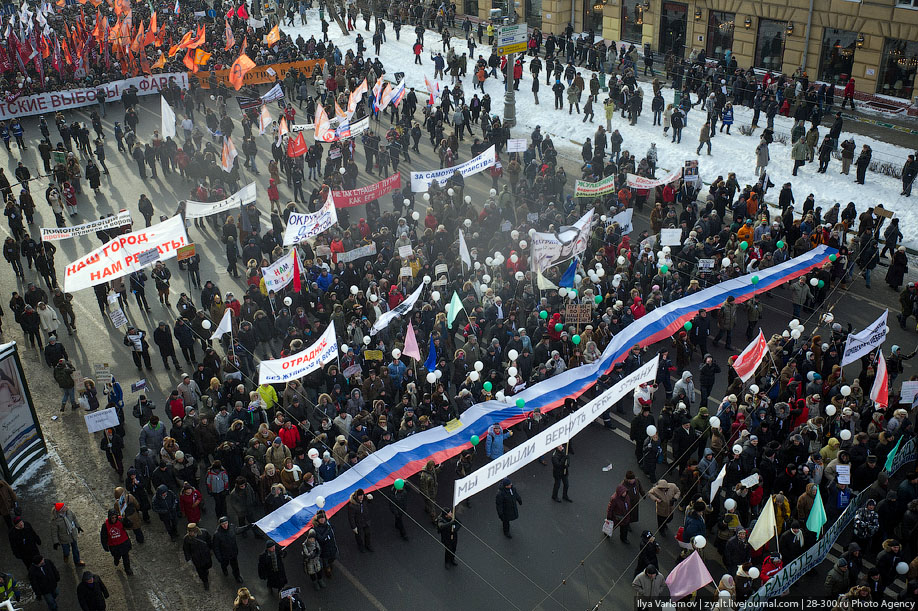
DEMONSTRATION. Another protest on Saturday; photos here, here and here. Clearly this one had a much bigger organised political party component. Two size estimates – 45K and 56K. In short, a number comparable to the Boloynaya Square protest of two weeks before. Momentum is not building: indeed Levada shows that nearly two-thirds had participated in the earlier protests. By the way, there are other opinions demonstrating these days: here is a demo on the 17th. The first photo says it all: Stalin, Putin, Aleksandr III “Yes! Single Power”.

WHO? Levada has done a survey of who was there and we can see the New Young People of whom I spoke last Sitrep (note that some questions allowed more than one answer). Men (60%), under 40 (56%), higher education (62%), self-described “liberal” or “democrat” (69%), heard of protests through the Net (89%), reasonably prosperous (68%). 20% hadn’t voted in the Duma election or had spoiled their ballot; 38% voted Yabloko, 19% Communist and 12% Just Russia. Only 37% had not protested the elections before. What were they protesting against? Falsified elections (73%) certainly but many responses show a generalised discontent with the way things are going. A solid majority want new elections, dismissal of the CEC head and punishment for fraudsters. Preferences for leaders are diffuse: about a quarter like Yabloko and Yavlinskiy but the remainder are well spread out. But there is a firm anybody-but-Putin stance. So, much as I suspected: young, educated, reasonably well-off and liberal. Putin’s children indeed but they’re tired of dad.

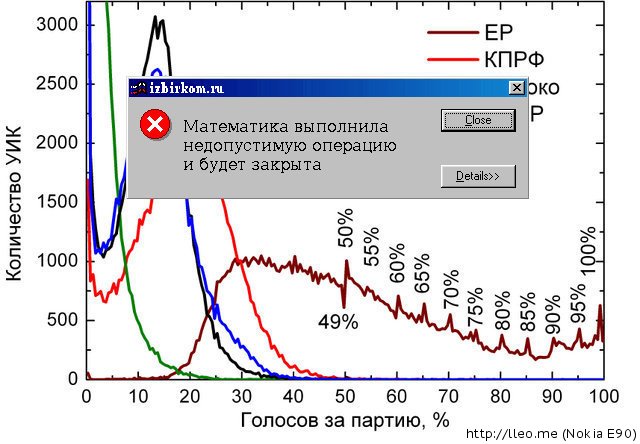
ELECTION FRAUD. Still nothing that I have seen convinces me of game-changing fraud. Vedomosti, which was looking at polling stations in Moscow it thought were the most fraudulent has given up and confesses it has not found big fraud (Google translation) and has, weakly, fallen back on anecdote. The Gaussian argument, popular in Russia, is fully discussed here and remains unconvincing. I reiterate: results in step with numerous opinion polls (in fact the ruling party did a bit worse than predicted) are strong prima facie evidence of reasonably accurate elections and need more than (partisan) anecdotes and credulous Western reports to contradict. Anatoly Karlin lists the various (and varied) opinions about the degree of fraud here.

KHODORKOVSKIY. Bet this doesn’t feature in Western coverage. The Grand Chamber of the European Court of Human Rights rejected re-examination of the 31 May judgement that “incontestable proof” to back allegations of political motivation behind his first trial “had not been presented”. A long-winded way of saying that it found no evidence that it was politically-motivated. But the meme has been established.

WTO. At last Russia is in. The overcoming of Tbilisi’s “veto” is further evidence of Saakashvili’s slippage.

© Patrick Armstrong Analysis, Ottawa, Canada (see http://www.russiaotherpointsofview.com/)

RUSSIAN FEDERATION SITREP 15 December 2011

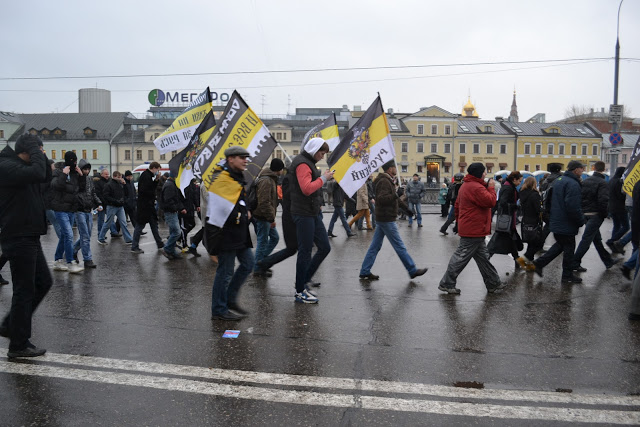
DEMONSTRATIONS. On Sunday there was a small (~500) nationalist demo, Monday saw 5-6K turn out for the authorities but the big one was Saturday’s. I am going with Alexandre Latsa’s estimates – he was there, took pictures and made a methodical estimate. He tells me he estimates about 25-30K at the maximum with many coming and going for a total over the day of maybe 50K. There were demonstrations around the country, so about 75K would be a decent estimate across Russia. Who were they? The photos show the usual oppositionists – disgruntled ex-officials, nationalists, Communists and so on – but also a lot of young middle class people who, presumably, hadn’t protested before. Latsa estimates that perhaps two-thirds were these young middle class people. For lack of a better term I will call these NYP – new young people. What generalisations can be made about them? They came to maturity in the Putin Age, have only childhood memories of the worst of the 1990s and none from the Communist period. They are, so to speak, Putin’s “children”. (Putin agrees). But children grow up and become independent. I suspect that they do not much fear change (I think many older Russians do). They are not especially representative of the population but every Russian city will have some. They are computer-savvy and linked together by the New Media: I doubt they pay much attention to TV newscasts. What were they protesting? Vote-fixing to be sure but they don’t look particularly angry in the photos. I am coming to believe that they were protesting not so much against counterfeit elections as against counterfeit politics: a protest against the Establishment; an Establishment that includes Zyuganov, Zhirinovskiy and the rest: beneficiaries of the stagnant political structure for two decades. They were saying you can’t ignore us any longer! This makes me more convinced that Putin’s decision to return was a bad one especially in the way it was done: a back-room agreement with Medvedev, announcement and servile approval from United Russia. I do not believe that the NYP have any interest in the familiar oppositionists, most of whom they would regard as tainted and – most tellingly – obsolete. I doubt that they have “leaders” (facilitators like Navalniy perhaps. By the way, there’s more to be known about him than The New Yorker tells). I believe that something new has been born but I don’t think that the NYPs or anyone else has any idea of what. I think “Putin’s Children: Flying the Nest” puts it well. It is worth noting, however, that it’s not that clear-cut – many of the people at Monday’s demo look like NYPs too.

NYP POLITICS. It seems to be agreed that the NYPs have not taken much interest in politics before. Have they started to? and if so, who will capitalise on their new interest? Not, I suspect, anyone that we have heard of. But they may continue to reject politics and make their effect felt in some other sphere. Until polling data on the phenomenon appears, no one can say. A protest has been authorised for next week and we will learn more.

ANTI-PUTIN? Is a protest against the mouldy political system – with which he has had a lot to do – a rejection of Putin the presidential candidate? At present he will be running against Zyuganov, Zhirinovskiy, Yavlinskiy – all surely more obsolete to an NYP than he is. Mironov is new to presidential elections but he’s Establishment too. Perhaps Prokhorov will be on the ballot but will NYPs rally around a plutocrat who made a fortune in the 1990s? I don’t think anyone has any idea what the NYPs will do in the presidential vote.

FRAUD. I remain unconvinced that there was game-changing fraud on the part of United Russia. Vedomosti has been doing a recount in Moscow. After examining 294 “protocols” (the document from each polling station showing its results), starting with what it expected to be the worst, it claims to have uncovered 7456 United Russia votes stolen from other parties. As 294 protocols cover 440,000 votes at about 1500 each, this is not a very high percentage. And, because its investigation is already running into diminishing returns with fewer alleged stolen votes in each new protocol examined, the total votes alleged to be stolen will not likely rise very much more. Even if we accept – and double, or triple – these numbers, the alleged theft is a fraction of one percent of Moscow’s seven million voters. The non-Gaussian argument is declared here to be bad mathematics and the author proves his point by showing similar statistical effects from the latest UK election. (I especially recommend that you read him – Google translation). As always the North Caucasus stands out but minorities are amazingly skilful at maximising their presence at the centre where the cheques are written and it is prudent for them to pretend super-loyalty; pumping 80% up to 90% or 95% is again not game-changing. Exit polls do not impress me – too easy to fake or mis-sample. And the results broadly fit previous opinion polls.

© Patrick Armstrong Analysis, Ottawa, Canada (see http://www.russiaotherpointsofview.com/)