RUSSIA HATERS THEN AND NOW

A new scientific truth does not triumph by convincing its opponents and making them see the light, but rather because its opponents eventually die, and a new generation grows up that is familiar with it.

– Max Planck

First published Strategic Culture Foundation

I’ve been at the Russia business for a while – since the days of Konstantin Chernenko in fact. As I’ve related elsewhere it was the summer of 1987 when I began to realise that things were really changing. Sometime around then I was invited to Massey College to debate with a Soviet diplomat the proposition that perestroyka meant the end of Marxism-Leninism; which, of course, it did. While I saw changes coming and was listened to seriously by my superiors in the Department of National Defence (DND) there were plenty of people who said that change was impossible. One senior guy from Foreign Affairs said his experience in Algeria showed him these regimes could never change and soon after he caused a paper to be produced that argued that the threat of nuclear war over Africa was very high. (!) The last words a local professor said to me was that change was impossible. I used to, when I gave presentations, ask the audience when they thought things were really changing in the USSR. Most of them would say when the Berlin Wall came down in 1989. Well, I would say, I realized it back then; just think how much farther along I am on the curve.

One of the half-witted theories floating around at the time was the recoil theory. The Soviets were pulling out of Eastern Europe so as to better bounce back and grab it later. Or something; never fully articulated – how could such a daft notion be? – yes, one can’t deny that they were pulling their tanks out but those cunning commies must be up to something. The idea was supported by a KGB defector who said that it was all a huge deception. There was a real outburst of excitement when a lot of tanks were moved out of the CFE area – see! They are cheating! the bounce back is beginning. This faded away when the satellite photos showed the tanks just pushed off the flatcars into the fields. The CFE Treaty requirements for cutting up a tank were very expensive; Moscow had no money so the tanks were sent out there to decay in the rain. (Which they did – one of my colleagues was an inspector and years later saw the sad rusted things). The necessity of pulling a lot of personnel out quickly meant that they were dumped wherever they could be – Norwegians, on one of our visits, worried that there were too many in the Kola Peninsula. And dumped they were – there were reports of officers and their families living in railway cars or even helicopters. Moscow wasn’t trying anything funny: the sudden withdrawals were just very difficult, especially with an economy that was collapsing. But it did what it promised it would do.

Change was happening and senior leadership at DND was open to it: I was given the chance to address the most senior group to make my pitch (1988?); I said that everything I saw indicated that Gorbachev would make a big arms reduction announcement soon. Which he did but, alas, one day too soon for publication of the paper the military intelligence people had written saying I was wrong. (Shortly before the Pentagon had put out a list of Soviet tank holdings which included a thousand or so useful T-10s; the naysayers scoffed at Gorbachev’s promise because, among other cuts, he was eliminating the now useless T-10s – an early case of damned if you do and damned if you don’t). With some opposition from Foreign Affairs, military to military talks were held (the first ever I believe) in 1989. As usual, being in the same business, the military got on well and the sole civilian lay low lest they turn on him. The talks continued and there were port visits as well.

But, there were still plenty of naysayers. For example a man who is today a player in the ludicrously titled Integrity Initiative informed us that all Russians were natural liars. In the Soviet days he’d tried to buy some scarce item, was told there was none and seen it sold to another. Liars every one! No, not liars, a shortage economy: you don’t sell a rare item to some foreigner who can’t do anything for you in return. I’ll bet he’s still telling people they’re all liars. Another now-II guy revealed to me what a complete uncoordinated balls-up NATO’s Kosovo war was; he now sings war songs on behalf of NATO. Another, quite reasonable then, turned ferocious when he lost an argument with me on JRL. Another young guy who’s part of the II slate started out balanced but is now writing Russian horror comics. Now I have some sympathy with young people starting out – I very much doubt anyone today could have the career I had either in government or academia; Russia is the enemy and if you don’t sing that tune, or pretend to, the doors will probably close in your face. But that doesn’t mean that you have to mention the “Gerasimov Doctrine” as if it were anything but obvious projection onto Russia of what NATO actually does. But it’s true: I had a career in which nobody ever told me what the “correct answer” was – other than the good advice I got in August 1991 – and I don’t think you could today. Which is just another sign of the general loss of freedom and deterioration of the intellectual climate of the West.

The August Coup attempt gave many of these a (brief) second wind – I was one of the very few in the government who said it would be a failure; over at Foreign Affairs they were all ready to recognise the junta – almost with, I think, a sense of relief that things were returning to the tried and true.

When I came back from Moscow in 1996 I was invited to one of the regular meetings our intelligence people had with our southern neighbours. One of them said that, he knew he’d been saying this for years, but finally the signs were all there of… a military coup. (In fairness, the others didn’t think much of that. By the way, has there ever been a military coup in Russia? palace coups, certainly, but no military ones). It was at that meeting when I realised that my three years there had given me a lot of on the ground experience – I’d been in grocery stores, watched the evolution of kiosks, seen the decaying Soviet Navy in Murmansk, talked to senior clergy, watched Mayor Luzhkov’s clean-up of the city, stayed in gigantic Intourist hotels in the provinces, flown, travelled by train and so on. Even met a shaman in Buryatia. A huge country and just a tiny bit seen by me but way more than most of the others. I had noticed this before on a visit to Stockholm to give a lecture. The USSR/Russia had been a far-off galaxy and, as the all-Russians-are-liars-guy showed, even some of those who’d actually visited hadn’t been very astute observers.

So the Russia-haters (Russia-fearers?) were active then too. The difference being that they didn’t have the complete influence that they now seem to have. They have persevered, over the years, shouting “Russia is the enemy!” and today they dominate. Maybe, as Planck suggests, we will just have to wait for time; they certainly can’t be argued with as this official statement shows:

Russia has generally followed international law and procedure in establishing the limits of its extended continental shelf. Russia could choose to unilaterally establish those limits if the procedures prove unfavorable and could utilize its military capabilities in an effort to deny access to disputed Arctic waters or resources. (My italics)

If forced to admit that Moscow is playing by the rules, they retort that it’s only to better break them tomorrow. They would pride themselves on having expanded NATO so as to be ready. They are the ones today who say – with no consciousness of irony – that “Russia maintains military presence close to NATO borders“.

Up to, say, 2005 nobody gave them much space because Russia was so obviously finished and dead but when Putin began to bring it back they got more attention. They joined forces with the America-first people: Russia’s contumacy could not be permitted in the post Cold War triumphalism of the New American Century. But what really put these people in the driver’s seat was the Clinton campaign’s excusing its failure by blaming Russia, the compliant corporate media’s amplification of the story and the bogus collusion story from “all 17 intelligence agencies”. You’d think that, with COVID-19 and all the dud “bombshells“, they’d be quietly dropping it, but no: they’re still trying to find that bombshell.

And it’s so easy to be one of them. Just start with the latest unproven charge – Skripal and MH17 are back in the news – then accuse them of being behind something current – BLM, gillet jaunes – throw in a selection of other unproven accusations, election interference, don’t forget a piety about the “Rules-Based International Order”; and presto! another op-ed or output from a NATO churn outfit. You could probably program a computer to do it: an anti-Russian version of the PoMo Generator. Maybe like the people at II you can strike it rich by getting the government to top up your pension in return for a little easy fantasising. The danger is that they’re training up a new generation on this easy and remunerative behaviour and Planck’s change will be postponed another generation.

But Putin turned out to be a Russia-first man, a Russian patriot, determined not to bend the knee. Not the least of the fascinations, by the way, is that the Yeltsin years are now regarded by the Russia-haters as a time when Russia was “on the right path”. Not what they were saying at the time, of course: Russia was menacing its neighbours, throwing away democracy and just generally all-round bad during the Yeltsin years too. Putin has grown and grown to monstrous proportions in these people’s minds as this selection of magazine covers shows. His “playbook” is the One Ring To Rule Them All. He controls the world with his 25¢ Facebook warriors, sowing division in a division-free paradise. Even crazier than the recoil theory!

As for my former employer, we’ve stopped talking to the Russians; we’re maintaining “security and stability” by keeping Putin out of Latvia and honouring nazis in Ukraine. The naysayers won that one too.

Ten years ago I wrote a piece arguing that, after periods of Russia being the West’s little brother and then the assertive enemy, we were coming to a time when Russia would be seen as another country with which to have normal relations. Well, that didn’t happen, The Russia-haters won the debate.

To sum up, a former head of GCHQ said at one of my presentations in the Putin era, “they just don’t share our values”. Russians would probably agree, but not in the way he meant.
THE DELUDED SUPERPOWER

The president has made clear that we have a tried and true practice here. We know how to win these races and we know how to spend the adversary into oblivion. If we have to, we will, but we sure would like to avoid it.

Marshall Billingslea, May 2020

(First published Strategic Culture Foundation

Billingslea is President Trump’s Special Presidential Envoy for Arms Control and will presumably be in charge of Washington’s team in negotiating a new START treaty.

An outstanding example of American arrogance and ignorance, to say nothing of the implication that the only actual negotiation expected will be over how loudly the negotiatees say “Yes Master”. Hardly likely to entice anyone to the table, let alone China.

The Soviet Union went down for many reasons which can be pretty well summed up under the rubric that it had exhausted its potential. Its economy was staggering, nobody believed any more, it had no real allies, it was bogged down in an endless war. Buried in there somewhere was the expense of the arms race with the USA. Billingslea evidently believes that it was that last that was the decisive blow. Believing that, he thinks that the USA can do it again.

A snappy comeback immediately pops into mind: staggering economy, loss of self confidence, allies edging away, endless wars – who’s that sound like?

But there is a bigger problem than his arrogance and that is his ignorance. Washington likes to think that its intelligence on Russia is pretty good but actually it’s pretty bad – and the proof is that it is always surprised by what Moscow does next. Intelligence is supposed to reduce surprises, not increase them.

What Billingslea is ignorant of is the difference between the Russian Federation and the Union of Soviet Socialist Republics. And he probably isn’t alone in this ignorance in Washington: yes they know it’s not communist any more – some of them do anyway – but that’s just the outward difference. The USSR was an exceptionalist state. As the 1977 USSR Constitution said:

the Soviet state, a new type of state, the basic instrument for defending the gains of the revolution and for building socialism and communism. Humanity thereby began the epoch-making turn from capitalist to socialism.


There’s a heavy cost to being an exceptionalist state – everything everywhere is your business, you are obligated to interfere all over the world, in the USSR’s case, any government that called itself socialist was entitled to assistance. The Soviet Union’s military was not just for self-defence, it was for power projection, assistance to allies and it sought full-spectrum dominance. Or, if not dominance in every imaginable sphere of warfare, at least capability. If Washington or NATO did something the USSR and the Warsaw Pact had to respond – no challenge could go unanswered. You can “spend into oblivion” a country with so expansive a self-awarded mission, especially one with a flaccid economy. And Washington tried to do so and, and I agree that the arms race made some contribution to the dissolution of the USSR and its alliance.

But Moscow has learned its lesson. Being the standard-bearer of the “bright future” brought it nothing; propping up socialist governments that deserted the moment the tanks went home brought it nothing. Exceptionalism was a bust for Russia and the Russians. It won’t do it any more. And that implies a much more modest military goal: defence. And defence is always cheaper than offence.

Moscow doesn’t have to match the US military; it just has to checkmate it.

Washington can interfere in Africa as much as it wants, Moscow doesn’t care – and if it should care, it’s demonstrated in Syria how effective a small competent and intelligently directed force can be. Washington can have all the aircraft carriers it wants; Moscow doesn’t care as long as they keep away – and if they don’t keep away, there are plenty of Kinzhals. Washington can build a space force (complete with cammo uniforms) if it wants to; Russia doesn’t have to – it just has to shoot down what attacks it. Checkmate in one defined area of the globe is much easier and much cheaper than “full spectrum dominance”.

Full spectrum dominance is the stated goal of the US military: supremacy everywhere all the time.

The cumulative effect of dominance in the air, land, maritime, and space domains and information environment, which includes cyberspace, that permits the conduct of joint operations without effective opposition or prohibitive interference.

In practice it’s unattainable; it’s like looking for the end of the rainbow: every time you get there, it’s moved somewhere else. The countermove will always be cheaper and simpler. The USA will bankrupt itself into oblivion chasing down supremacy over everything everywhere. Take, for example, China’s famous carrier killer missile. Independently manoeuvrable hypersonic powerful warhead; here’s the video. Does it exist? Does it work? Maybe it does, maybe it only works sometimes. Maybe it doesn’t work today but will tomorrow. But it certainly could work. How much would Washington have to spend to give its carrier battle groups some reasonable chance against a weapon that was fired thousands of kilometres away and is coming in at Mach 10? Certainly much less than it would cost China to fire five of them at that one carrier; only needs one hit to sink it or put it out of action. Who’s going to be spent into oblivion here?

Which brings me to the next retort to Billingslea’s silly remark. Before the US spends Russia and China into oblivion, it must first spend to catch up to them. I’ve mentioned the Chinese carrier killer, Russia also has quite a number of hypersonic weapons. Take the Kinzhal, for example. Fired from an aircraft 1500 kilometres away, it will arrive at the target in quite a bit less than 10 minutes. When will its target discover that it’s coming? If it detects it 500 kilometres out (probably pushing the Aegis way past its limits) it will have three or four minutes to react. The Russian Avangard re-entry vehicle has a speed of more than Mach 20 – that’s the distance from Moscow to Washington in well under five minutes. How do you stop that? Remember that Russia actually has these weapons whereas all the US has is a “super-duper missile“. Not forgetting the Burevestnik and Poseidon neither of which the US has, as far as is known, even in its dreams. So, Mr Billingslea, before you get the USA to the point of spending Russia and China into oblivion, you’ve got to spend a lot to catch up to where they already are today and then, when you get to where they are today, even more to get to where they will be then and still more – much more – to block anything they can dream up in all of the numerous “spectrums”. Who’s heading for oblivion now?

In conventional war the US military does not have effective air defences: this should be clear to everyone after the strikes on the Saudi oil site and the US base. US generals are always complaining about the hostile electronic warfare scene in Syria where the Russians reveal only a bit of what they can do. Russia and China have good air defence at every level and excellent EW capabilities. They do because they know that the US military depends on air attack and easy communications. They’re not going to give them these advantages in a real war, Something else for Mr Billingslea to spend a lot of money on just to get to the start state.

The US military have spent too many years bombing people who can’t shoot back, kicking in doors in the middle of the night and patrolling roads hoping there’s no IED today. Not very good practice for a real war or an arms race.

China and Russia, because they have given up exceptionalism, full spectrum dominance and all those other fantasies, only have to counter the US military and only in their home neighbourhoods. That is much cheaper and much easier. What’s really expensive, because unattainable, is chasing after the exceptionalist goal of dominance in everything, everywhere, all the time. That’s a “tried and true” road to oblivion.

They’re just laughing at him in Moscow and Beijing.

COMMENTS FROM THE LOCKED WARD

(Miscellaneous comments from pieces dealing with Russia I’ve collected. Most of them anonymous or with pseudonyms. They are chosen to illustrate either rabid hostility to everything Russian or stone-dead ignorance of present reality. I post from time to time when I have enough, spelling mistakes and all.)

Coronavirus+American liberal+Trump Derangement Syndrome=Putindunnit.

Tweet from someone self-described as “Historian. Author. Professor. Budding Curmudgeon. I study the contrast between image and reality in America, especially in politics.”

I cannot make sense of this. Is he deliberately crashing the American economy and dividing us from Europe? If so, is this Putin’s work, yet again? A final gift as Trump loses control of the country?

COMMENTS FROM THE LOCKED WARD

(Miscellaneous comments from pieces dealing with Russia I’ve collected. Most of them anonymous or with pseudonyms. They are chosen to illustrate either rabid hostility to everything Russian or stone-dead ignorance of present reality. I post from time to time when I have enough, spelling mistakes and all.)

Yup Russia isn’t a trouble maker,right ok!

What is Russia?

A failing state,built from the wreckage of a failed state and failed system

What does Russia do?

It supports failure,Syria

It supports failure, Venezuela

It supports failure,Iran

It’s oligarchy supports Putin so they can loot Russia!

Russia isn’t going anywhere its just a big lump of Forrest and oil

corrupt state enterprise outfits making crap wiz bangs

which will certainly be well worked out by Israel, and thats why Putin sucks up to Israel, because he doesn’t doesn’t want this known as its very embarrassing

Personally Putin should walk away from Syria but he’s stupid

Tweet on occasion of latest US accusation of Russian Navy dangerous driving, January 2020

RUSSIA THE ETERNAL ENEMY QUOTATIONS

1077476704

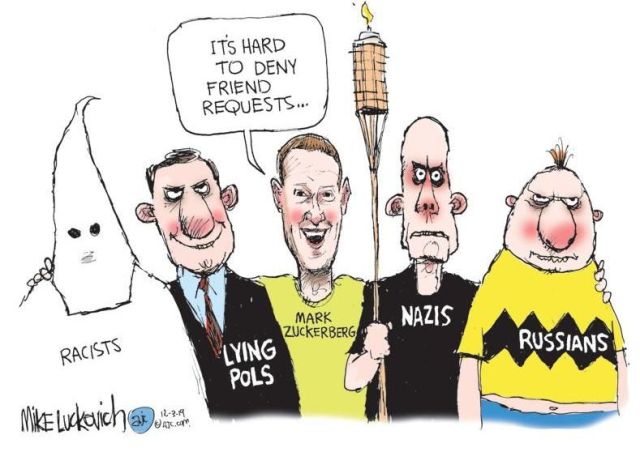
Michael Edward “Mike” Luckovich (born January 28, 1960) is an editorial cartoonist who has worked for The Atlanta Journal-Constitution since 1989. He is the 2005 winner of the Reuben, the National Cartoonists Society’s top award for cartoonist of the year, and is the recipient of two Pulitzer Prizes. He says “Normally with my cartoons I try to use humor to get across my point. After Sept. 11th, you just couldn’t use humor. The tragedy was so enormous, you couldn’t be funny. It’s almost like you have to come up with cartoons using a different part of your brain. I was just trying to come up with images that expressed the emotions that I was feeling and tried to focus in on different aspects of the tragedy that I thought were important.” (Wikipedia)

WE’RE NOT JUST TALKING TO OURSELVES – OTHERS FIND US

(First published Strategic Culture Foundation

Reasoning will never make a Man correct an ill Opinion, which by Reasoning he never acquired.

(Often rephrased as: “You cannot reason people out of something they were not reasoned into”).

– Jonathan Swift

This site (Strategic Culture Foundation) has attracted a large stable of writers; by and large, most of the time, generally speaking, we agree with each other pretty well. The point of view of most of the writers is counter Establishment. In today’s frenzied Russophobia that opens us to the charges of being Putinbots but, in truth, we write against the prevailing WaPo/NYT/Economist/Guardian view on many subjects. The fact that that commentary is now penetrated with demented fears that Putin is shaping minds and getting his stooges elected and so on, means that any denial of that delusion makes them call us Putin apologists. Just as, to take another case, Tulsi Gabbard’s condemnation of Washington’s addiction to regime change wars makes her an Assad apologist and – insanity seeks out insanity – Putin’s favourite candidate. I have never had a word changed in anything I have written, but then what I write fits the editorial model of Strategic Culture Foundation. And so does what I read there.

On the other side of the divide are the writers and readers of the WaPo/NYT/Economist/Guardian established media. They also generally agree with what they read, approve of each other’s writing and nod their heads in agreement. They are in their comfort zone.

Two solitudes – two bubbles. An agreeable agreement bubble for each: different bubbles to be sure but the same warm comfortable feeling of reassurance that they’re well-informed.

So what’s the point of writing? I already agree with you, you already agree with me. Our readers are here because they also agree. Writing becomes a mechanical operation, moving along a pre-determined course. No minds are changed, no minds are even engaged.

But there is one big and important difference between the two solitudes which leads us out of the my bubble/your bubble stalemate.

The well-informed person will be less often surprised than the poorly informed person.

There is an objective reality and people who actually do have a pretty good take on things, see that reality more clearly than those who don’t. In short, those who actually are well-informed will be less often surprised than those who aren’t. Surprise is the clue: it is both the consequence and the evidence of ignorance.

Surprise.

Here the difference between the two camps is very clear. We, over on our side of the great divide, were not surprised by what the leakers in the OPCW have to say. We were always sceptical of the proffered statements on Libya. We knew Trump’s communications were being listened to. We were not surprised that Milosevic was found not responsible. We are not surprised that the Russian economy is doing reasonably well. We already knew about Malaysia’s scepticism about the JIT. We are not surprised that protests in Moscow have pretty well fizzled out. We are not surprised that Guaidó’s coup is faltering. We comprehend the discontent in the Western World. We expect Beijing to be several steps ahead of Washington. We see through faked up colour revolutions. We weren’t surprised that Mueller found no collusion. We knew Browder was making it up.

(Of course we were surprised but in a different way: leaks from the sewn-up OPCW? The stooge ICTY makes an objective ruling? ECHR actually considers evidence? The Mueller investigation stops? But it’s a cynical – an informed – surprise.)

But the readers and writers of the WaPo/NYT/Economist/Guardian bloc were surprised. They are certain that Assad gasses his own people when there’s no reason to; they believe that Qaddafi “bombed his own people“; they laughed when Trump said he was taped; they called Milosevic the “butcher of the Balkans“; they expect the Russian economy to collapse; they’re confident that the JIT is an honest investigation; they expect the protests will weaken Putin; they believe the “world community” recognises Guaidó; they are confident the West would be happy if Putin weren’t sowing discord; they expect that the next world problem will be managing China’s decline; they know where to find democracy in Hong Kong. And, especially, they were confident that Mueller will find a bombshell to blow up Trump. They remain believers in Browder’s story.

The devotees of the establishment media bloc are almost always surprised by the way things turn out. That, by itself, shows that they are poorly informed about reality. Everybody is surprised some of the time but the poorly informed are surprised all of the time.

Another indicator of which bubble is better grounded in reality is that we know both bubbles – it’s not possible for us in the alternative media not to know what the WaPo/NYT/Economist/Guardian bloc is saying (if for no other reason than we delight in searching for examples of their errors as I just did above). They, on the other hand, have been drilled to regard us as conspiracy theorists, fringe extremists or Putin/Assad/villain-of-the-moment bots: our opinions are doubleplusungood and must be prevented and the Atlantic Council, Big Brother’s ideal fact-checker, is helping Facebook weed out crimethink. We have a very good idea of what they say; they have very little idea of what we say. In short, we’ve been there but they haven’t been here.

Which brings me to my final point and the answer to the question of why do we in the Strategic Culture Foundation stable and the many other new media sources do it. Why do we spend hours obsessing, researching and writing if all we’re doing is painting the inside of our bubble? It is very unlikely – we’ve all tried it and we’ve all failed – to reason the consumers of the establishment media out of their assumptions. These are typical responses: “How do you know these things?” “Why do you think your sources are always better than mine?” “Don’t call me stupid”. They weren’t reasoned into their complacency and they won’t be reasoned out of it. There is little chance that some conventional believer will stumble across some piece in any alternative source and change his mind.

But people do change and our audience is growing. How can that be happening if we change no minds?

Because the individual makes the first step on his own.

Phil Butler’s 2017 book Putin’s Praetorians has stories of how people came to change their views. What struck me was that, in almost every case, these people had found us, we hadn’t found them. A very common cause of the conversion of Butler’s individuals was the coverage of the Sochi Olympics three years earlier. It was so one-sided, so over-the-top, so meretricious that they couldn’t believe it and went looking for alternate points of view. For Butler’s people it was mostly Sochi; for another it was the “hysterical Russophobia of the MSM and the Democratic Party since the 2016 election” that sent him looking “for sources that would broaden and deepen my perspective. Indeed, I found an avalanche of web material that rarely makes it through the gatekeepers in the U.S.”. The triumphant success of the Russian-hosted World Cup demolished the ranting of the Establishment (“England football fans visiting Russia for the World Cup are at serious risk of homophobic, racist and anti-British attacks“); it will surely lead more to conversions.

I use the word “conversion” because it is, like religious conversion, a life-changing revelation to realise that the WaPo/NYT/Economist/Guardian bloc, when it’s not careless with the facts or mindlessly re-typing official handouts, is just out and out lying. (Paul Robinson points out a recent example from the WaPo.) To understand that a great deal if not almost all that you have been told by “trusted sources” is false; that a great deal of what is in your head is just plain wrong; that much of what you thought was true is not, is a life-changing event. It’s frightening and disturbing but, once you have absorbed that into your belly-feel, there’s no going back. This young man and his father will never again believe anything the conventional media tells them about Russia; and neither will this man – “Everything they told us about this place was a lie.” And not just everything “they” told you about Russia is a lie: the WaPo/NYT/Economist/Guardian bloc’s coverage of Iran, Syria and Ukraine is almost 100% lies, most of the coverage of China is ludicrously off-target, Venezuela is another subject of fake news, certain subjects are never mentioned, the Trump obsession is now as fact-free as the Putin obsession – indeed the two delusions merged long ago in a crescendo of craziness – watch this video from the NYT. It’s like unravelling a sweater: once you pull on one thread, it all comes apart. Apart from sports coverage or the comics, what is there left to trust in the “trusted sources”? Falsus in uno, falsus in omnibus is a fundamental legal principle for a good reason: liars lie.

So this is the reason why we write and speak and – religious allusion again – testify. People we’ve never heard of, disgusted by the strident one-sided nonsense, surprised by some unexpected reality they bump into, stop passively believing, begin to doubt, search around and find us. Our writings then show them they were right to doubt and lead them to a better appreciation of reality. We don’t persuade them, they persuade themselves; we don’t convert them, they convert themselves. But we reinforce their conversion and show them that there is more reality (less surprise) on our side. Once gained to our side, they won’t leave. It’s conversion.

It’s happening: we’re growing, they’re shrinking. How fast I don’t know but I know it’s happening. And the attempts to regulate Twitter, Facebook and the others shows that they know it’s happening too.

So, it is worth the effort, even if we seldom hear of our successes.


REALLY STUPID THINGS SAID ABOUT RUSSIA

No wonder the East Coast elites and the “interagencies” know so little about Russia: they really think tripe like this means something.

It is cheese that Russians write home about when they go abroad. “It’s my first time in Europe after all that’s happened,” the journalist and filmmaker Inna Denisova, a critic of the annexation of Crimea, wrote on her Facebook page in February. “And it’s exceedingly emotional. And of course it’s not seeing the historic churches and museums that has made me so emotional — it’s seeing cheese at the supermarket. My little Gorgonzola. My little mozzarella. My little Gruyere, chevre and Brie. I held them all in my arms — I didn’t even want to share them with the shopping cart – – and headed for the cash register.” There, Ms. Denisova wrote, she started crying. She ended her post with a sort of manifesto of Europeanness and a question: “Je suis Charlie et je suis fromage. I want my normal life back — can it be that it’s gone forever?”

Masha Gessen (who else?): What the Russians Crave: Cheese;

NYT (where else?), 4 July 2015

RUSSIA IS FINISHED QUOTATIONS

I publish this, partly for fun, but also because it gives an idea of what people expected from all the sanctions. Once again, Putin & Co thought longer and better.

Here are the first two things I could find that I wrote at the time saying Russia was surviving quite well: Sitreps 20160519 and 20160623. Another illustration of the fact that we, on our side of the divide, are less often surprised that the others are.

U.S. billionaire philanthropist George Soros has predicted that Russian President Vladimir Putin’s regime will face bankruptcy in 2017, when the nation’s economic troubles erode its leader’s domestic approval ratings, according to a column Soros published this week.

“Putin’s popularity, which remains high, rests on a social compact requiring the government to deliver financial stability and a slowly but steadily rising standard of living,” Soros wrote in his column on the Project Syndicate website on Wednesday. “Western sanctions, coupled with the sharp decline in the price of oil, will force the regime to fail on both counts.”

Moscow Times 12 February 2016

WHAT ABOUT WHATABOUTISM?

(First Published Strategic Culture Foundation Picked up by JRL,)

Vladimir Putin has made a national sport of what-abouting. In 2014, when a journalist challenged him on his annexation of Crimea, Putin brought up the U.S. annexation of Texas. The American invasion of Iraq is constantly what-abouted on state television, to excuse all kinds of Russian behavior.

– Dan Zak: “Whataboutism: The Cold War tactic, thawed by Putin, is brandished by Donald Trump“. Washington Post, 18 August 2017

“Trump Embraces One Of Russia’s Favorite Propaganda Tactics — Whataboutism”

Danielle Kurtzleben, NPR, 17 March 2017

Essentially, it’s an appeal to hypocrisy ― a logical fallacy also known as “tu quoque.” Instead of proving that your opponent’s claim is wrong on its face, whataboutism argues that it’s hypocritical of the opponent to make that claim at all.

And, the author helpfully goes on to explain: “Perhaps unsurprisingly, considering the Trump administration’s murky ties to Vladimir Putin and his associates, whataboutism is viewed by many as a Russian import.” Trumputin again! (Written, of course, before Mueller crashed.)

The author is half right: it’s hypocrisy, but it’s not an appeal to it, it’s a revelation of it.

As the quotations above show it’s a real meme: Google has thousands of hits on “trump putin whataboutism” – accusing someone of whataboutism, as apparently routinely practised by both, is supposed to be a final, complete and crushing response. Whataboutism is “a constant diversion away from actual relevant news items, facts, and arguments into constant accusations of hypocrisy” and a commonplace of Russian propaganda.

In a court of law someone who is accused of murder cannot defend himself by saying that his accuser has a dirty nose or, even, that he is himself a murderer. And neither is it accepted that the defence against an accusation of a dirty nose is saying that the accuser is a murderer. In a court of law the charge, whether dirty nose or murder, has to be proven to the satisfaction of the judge or jury; the personal behaviour of the accusing lawyer is not relevant.

But we’re not talking about a court of law here – we’re talking about an information war in which accusations are crafted to sway public opinion. In that “court” it is relevant to point out when the accusing dirty pot is calling the accused kettle black. Not to do so is a “diversion away from actual relevant facts” by changing the subject and pretending that the only subject is your crimes, not mine.

For example. Russia is routinely accused of violating the “Rules-Based International Order”. (What a great name: who wouldn’t want to live in a Rules-Based International Order and shun those who tried to overturn it?) A quick search turns up these accusations: “The Russian government wears its disdain for the rules-based international order as a badge of pride“; “What can the West do to keep Russia in check, when the country’s state policy is fundamentally at odds with the rules-based international order“; “It is Russia’s actions which threaten the international order on which we all depend“; “Today, I will set out how the Russian government under President Putin is taking steps that are weakening the rules-based order“; “Russia – a permanent member of the United Nations Security Council – has repeatedly attacked the global rulebook of normal behaviour.” Lots more examples can easily be found. Said Rules-Based International Order is praised as having kept world peace, as a “cornerstone” and other kinds of goodnesses. So, clearly, Putin & Co, by trying to overthrow it, are committing a crime.

But, actually, the accusation is only another propaganda shot at the contumacious Putin. Leaving aside the self-satisfied hype, we’re supposed to agree that this “order” is worldwide although few in, say, Africa or Asia would have happy feelings about it. But, most significantly we are required to not listen to what Putin actually says; over and over again, year after year: (this month): “Let me reiterate: truly mutually respectful, pragmatic and consequently solid relations can only built between independent and sovereign states“, or his essay in the NYT in 2013 when he said “The United Nations’ founders understood that decisions affecting war and peace should happen only by consensus”.

But enough of reality, back to whataboutism.

Many of these fulminations cite Crimea as the moment when Putin’s Russia irredeemably breached the Rules-Based International Order but the accusation was commonplace long before Putin appeared. Russia wanted “the right to do what it pleases in its own backyard” in 1994; was probably not going to be “an equal and fair player” and believed that “countries become strong only by making other countries weak” in 1996; was “subverting its neighbors’ independence” in 2006. In short “Russia is remarkably resistant to progress, material and moral“. In other words, fashions change but Russia is always the enemy: Russia wanted to dominate the energy reserves in the Caspian in 1997, but signed on to an equitable division in 2019. Never mind that accusation (and who remembers it now?) on to the next accusation! In 1997 we knew Russia wanted to trash the Rules-Based International Order, in 2019 we still know but fresh accusations replace the worn-out ones.

So, setting aside the fact that the Ukrainian constitution was nullified with the violent overthrow of the elected President, ignoring the fact that violence against Crimeans had already started, forgetting that the first action of the coup was to outlaw their language, ignorant that Crimea had the status of an autonomous republic, never mentioning there were already Russian troops legally there, pretending that the referendum was done at gunpoint, shedding crocodile tears over the suddenly discovered Crimean Tatars, carefully refusing to visit the place to see whether reality conforms to illusion and all the rest of it, let us do a little whataboutism.

If the return home of Crimea – that’s what the Crimeans call it – is to be considered a violation of the Rules-Based International Order, what was the smashing up of Yugoslavia? A popular expression of the self-determination of peoples or a foreign intervention for less shiny principles? What was the invasion of Afghanistan? Rules-Based or not? If the invasion of Afghanistan was “Rules-Based” on self-defence principles (still – 18 years later!) what was the “Rules-Base” for the invasion of Iraq? How about the destruction of Libya? By what principle of the Rules-Based International Order are US and allied troops in Syria? Especially “guarding” the oil fields? Where’s the “Rules-Base” that says Washington should care about what Maduro does in Venezuela, or is it a fundamental principle of the Rules-Based International Order that “It will make a big difference to the United States economically if we could have American oil companies really invest in and produce the oil capabilities in Venezuela“?

I reiterate that we are not in some courthouse in which, say the case of Crimea’s incorporation into the Russian Federation is being tried in Courtroom Number 1 and the NATO attack on Libya in Courtroom Number 2, the NATO presence in Syria in Courtroom Number 3 and so on. In that case the Russian defence team would not be justified in saying that the other guys are in court too; it would have to argue the case at hand (relying no doubt heavily on Article 1.2 of the UN Charter); in the other courtroom the defence would be relying on… good question.

We are in the “court of public opinion” and here it is relevant that NATO & Co accuse Russia of doing things without admitting that they do much worse. After all, in Russia’s so-called sins – Crimea, South Ossetia and Abkhazia – we can find solid majority support from the local population. NATO would have a harder time finding that support in its various post Cold War interventions. Or, to put it more plainly: Ossetia, Abkhazia and Crimea are pretty peaceful places; the Balkans, Afghanistan, Iraq, Syria, Libya etc etc are not. (To say nothing of the departure of US troops from Syria being hastened with jeers and stones.)

Occasionally Western news/propaganda outlets will confess to “the long history of the US interfering with elections elsewhere” but only to airily dismiss the issue because “the days of its worst behavior are long behind it”. (Ukraine, Venezuela, Russia and Hong Kong are not, we must assume, “interferences” and it would be “whataboutism” to suggest that they are somehow worse than the imaginary Russian intervention in the US election.)

In short, what is dismissed as “whataboutism”, and therefore unworthy of discussion, is reminder to the listener of reality; in a world of moralistic accusations that Russia has violated the sacred Rules-Based International Order it is a pointer to the West’s hypocrisy. If we are supposed to think that Russia did something bad and unlawful in Ossetia or Crimea violating the so-called Rules-Based International Order why is it wrong to point out that NATO this century has never paid a moment’s attention to the UN Charter or any other part of the, admittedly feeble, structure of international law?

The Bible advises us not to obsess about the tiny speck in the other person’s eye while ignoring the big hunk of wood in our own: “For with what judgement ye judge, ye shall be judged: and with what measure ye mete, it shall be measured to you again.”

And if that’s not “whataboutism” what is?