http://us-russia.org/310-the-end-of-usaid-in-russia-exacerbates-us-russia-tensions.html
Category: PROPAGANDA, LIES AND NONSENSE
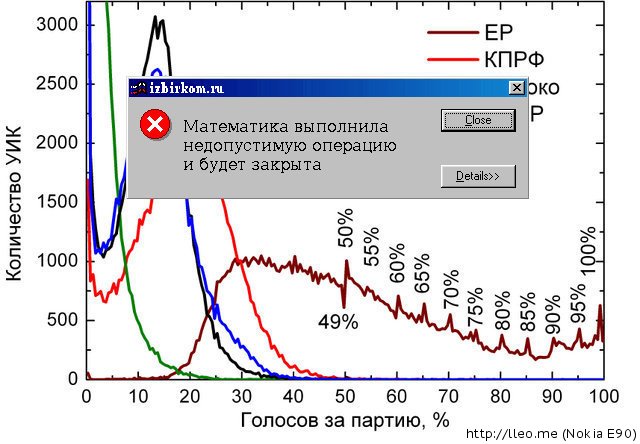
Western Interference in Russian Election
Note February 2016. These were done for the Russia Profile Weekly Experts’ Panel which I cannot find on the Net now. Many were picked up by other sources and I have given links where I can find them.
Can’t find a reference.
The Western Kommentariat finds in Putin’s remarks about Western (ie Washington’s) influence on the protests to be an “extraordinary attack” showing that he may be taking “a harder line against Russia’s opposition”. As usual there is no attempt to consider his perspective. Let’s try: here are some of the things Putin sees.
BelayaLenta.com, the supposed Russian protest group, (White Ribbon – you can’t have a coloured revolution without a colour) appears to have come into existence in October and gives its address as Bellevue, WA 98007 USA. By the way, white armbands were worn by collaborators in Nazi-Occupied USSR – not the most felicitous choice of colour.
Golos, the so-called “independent” Russian election monitor, seems to have some interesting communications with US officials with the suggestion of payment for the “correct” results. It receives funding from the USA. Independent? Only if you think Washington’s motives are the disinterested pursuit of democratic virtue.
Hillary Clinton was very quick off the mark to condemn the results, far more so many international observers who saw nothing untoward and much stronger than the official OSCE report. Almost, a cynic would say, as if she had been handed, by accident, as it were, the briefing note prepared in case United Russia claimed much more than opinion polls predicted.
The Western MSM is in full cry about how the elections were fraudulent, making up numbers where necessary to justify the preconception (“United Russia’s real vote in Moscow was 23.5%”).
What else does he see?
An election outcome, long predicted in opinion polls, in which his party lost a lot of support.
Even those who are looking for fraud aren’t finding it. Vedomosti’s recount in Moscow has turned up what it claims are 7456 votes for United Russia stolen from other parties in 294 voting stations (totalling about 440,000 votes). Given that it is finding fewer examples as it looks at more stations (it started with what it considered to be the worst cases), it is running into diminishing returns. Indeed the effort seems to have stopped – nothing has been added to the website since 14 December. Even if Vedomosti’s accusations are correct, 7500, or 15,000 or even 30,000 votes in Moscow City’s seven million voters amounts to a few tenths of one percent. Hardly the fraud the Western media is talking about.
The popular non-Gaussian argument is declared here to be bad mathematics and the author proves his point by showing similar non-Gaussian statistical effects from the latest UK election.
The North Caucasus results are suspicious but minorities are very good at maximising their presence at the centre (I commend a study of Quebec which, for more than a century, has managed to do this – even abandoning normal preferences when necessary. See the 2011 results for an especially dramatic example of a landslide of support switching).
Perhaps all this reminds Putin of other campaigns involving exit polls (very easily faked), press campaigns (easily started) and foreign funding (always present). True, the “White Revolution” is still missing a new leadership team. Could it be Zyuganov and Zhirinovskiy? After all, they took two-thirds of the seats United Russia lost and if the election was stolen, it was stolen from them.
So, his conclusion is not the wild fantasy of a diehard enemy. I see these things and wonder too.
Libya Crusade Flap
Note February 2016: A flap at the time. See, for example: “Medvedev rejects Putin ‘crusade’ remark over Libya“. In retrospect Putin was right:
What troubles me is not the fact of military intervention itself — I am concerned by the ease with which decisions to use force are taken in international affairs. “This is becoming a persistent tendency in U.S. policy,” Putin said. During the Clinton era they bombed Belgrade, Bush sent forces into Afghanistan, then under an invented, false pretext they sent forces into Iraq, liquidated the entire Iraqi leadership — even children in Saddam Hussein’s family died. Now it is Libya’s turn, under the pretext of protecting the peaceful population.” Putin said. “But in bomb strikes it is precisely the civilian population that gets killed. Where is the logic and the conscience?”
I now believe that the Libya attack was an important reason why Putin felt that he had to become President again.
The first thing that we have to ask ourselves was whether Medvedev’s comment about the inadmissibility of using the word “crusade” was actually aimed at Putin. When Medvedev (in Moscow) made his formal statement, was he aware that Putin (in the Udmurt Republic) had given his “personal opinion” four hours earlier? We don’t know. What many commentators don’t seem to realise is that the word “Crusaders” is commonly used by jihadists to describe the West and Gaddafi is now using it too. So was it a coincidence or was it a direct rebuke?
In any case Putin (in Slovenia) has denied any split saying: “We have a president in Russia who directs foreign policy and there can not be a split”. And (in Serbia) he said it again.
What this episode shows is that Putin and Medvedev have a difference of opinion on the Libya affair. Putin, probably remembering all the times he has been burned by the West, is sceptical; Medvedev is more accepting.
The second thing that it shows is that the naïve assumption that Medvedev is Putin’s puppet is – well – naïve.
Nevertheless, this incident has set off the usual speculation that the two are in some sort of struggle for the next election. Putin could have easily changed the article in the Constitution and could have been re-elected President. Why would he go through the elaborate rigmarole of putting up a puppet so he could get back into the presidency when he could, so easily, never have left office? Anyone who so speculates should be obliged, by law, to explain, before he opines on why Putin wants to be President again, why he is not today.
I maintain that Putin and Medvedev are a team, they are united on the big plan of Russia’s development, and are not likely to be diverted from this purpose by anything as trivial (in the Russian context) as actions in Libya.
Eventually there will be a serious point of disagreement, but this is not it.)
The first thing that we have to ask ourselves was whether Medvedev’s comment about the inadmissibility of using the word “crusade” was actually aimed at Putin. When Medvedev (in Moscow) made his formal statement, was he aware that Putin (in the Udmurt Republic) had given his “personal opinion” four hours earlier? We don’t know. What many commentators don’t seem to realise is that the word “Crusaders” is commonly used by jihadists to describe the West and Gaddafi is now using it too. So was it a coincidence or was it a direct rebuke?
In any case Putin (in Slovenia) has denied any split saying: “We have a president in Russia who directs foreign policy and there can not be a split”. And (in Serbia) he said it again.
What this episode shows is that Putin and Medvedev have a difference of opinion on the Libya affair. Putin, probably remembering all the times he has been burned by the West, is sceptical; Medvedev is more accepting.
The second thing that it shows is that the naïve assumption that Medvedev is Putin’s puppet is – well – naïve.
Nevertheless, this incident has set off the usual speculation that the two are in some sort of struggle for the next election. Putin could have easily changed the article in the Constitution and could have been re-elected President. Why would he go through the elaborate rigmarole of putting up a puppet so he could get back into the presidency when he could, so easily, never have left office? Anyone who so speculates should be obliged, by law, to explain, before he opines on why Putin wants to be President again, why he is not today.
I maintain that Putin and Medvedev are a team, they are united on the big plan of Russia’s development, and are not likely to be diverted from this purpose by anything as trivial (in the Russian context) as actions in Libya.
Eventually there will be a serious point of disagreement, but this is not it.
Wikileaks on the South Ossetia War
http://www.russiaotherpointsofview.com/2010/11/wiki-leaks-and-the-south-ossetia-war.html#more
Reprints
RUSSIAN http://www.inosmi.ru/caucasus/20101201/164613543.html
http://www.abkhaziagov.org/ru/president/press/inosmi/detail.php?ID=35262
ENGLISH
http://www.abkhazworld.com/headlines/600-wikileaks-and-sossetia-war-by-p-armstrong.html
http://www.sublimeoblivion.com/2010/12/24/wikileaks-and-south-ossetia-war/
http://www.sublimeoblivion.com/category/darussophile/
I have been a diplomat: I have written reports like the ones leaked and I have read many. And my conclusion is that some report writers are better informed than others. So it is with a strange sense of déjà vu that I have read the Wikileaks on US reports.
My sources for the following are the reports presented at this Website (passed to me by Metin Somnez – thank you): http://matiane.wordpress.com/2010/11/29/wikileaks-war-in-georgia/ (Direct quotations are bolded; I will not give detailed references – search the site). The reports published there are a small sample of all the communications that would have passed from the posts to Washington in August 2008. They are, in fact, low-grade reporting tels with low security classifications and only a partial set at that. Nonetheless they give the flavour of what Washington was receiving from its missions abroad. (It is inconceivable that the US Embassy in Tbilisi was reporting everything Saakashvili told it without comment in one set of reports while another said that he was lying; that’s not how it works).
One of the jobs of embassies is to inform their headquarters; in many cases, this involves passing on what they are told without comment. But passive transmission does not justify the fabulous expense of an Embassy – official statements are easy to find on the Net – informed judgement is what you are paying for. We don’t see a lot of that in these reports. What struck me immediately upon reading the reports from Tbilisi was how reliant they were on Official Tbilisi. Had they never talked to Okruashvili, or Kitsmarishvili? They could have told them that the conquest of Abkhazia and South Ossetia was always on the agenda. They actually did speak to Kitsmarishvili: he says he met with Ambassador Tefft to ask whether Washington had given Tbilisi “U.S. support to carry out the military operation” as he said the Tbilisi leadership believed it had. He says Tefft “categorically denied that”. How about former close associates of Saakashvili like Burjanadze or Zurabishvili who could have told them how trustworthy he was? (The last’s French connections may have helped insulate Paris from swallowing Saakashvili’s version whole).
The first report from Tbilisi, on 6 August, deals with Georgian reports of fighting in South Ossetia. This doesn’t mean anything in particular – sporadic outbursts have been common on the border since the war ended in 1992 – they are generally a response to the other side’s activities. What’s important about this particular outburst is that it formed the base of Saakashvili’s Justification 1.0 for his attack. We now must remind readers of his initial statement to the Georgian people when he thought it was almost over: “Georgian government troops had gone ‘on the offensive’ after South Ossetian militias responded to his peace initiative on August 7 by shelling Georgian villages.” His justification changed as what he had to explain grew more catastrophic. The US Embassy in Tbilisi comments (ie not reporting what they were told: comments are the Embassy speaking) “From evidence available to us it appears the South Ossetians started today’s fighting. The Georgians are now reacting by calling up more forces and assessing their next move. It is unclear to the Georgians, and to us, what the Russian angle is and whether they are supporting the South Ossetians or actively trying to help control the situation”. The comment sets the stage: the Ossetians started it and Moscow may be involved. There appears to be no realisation that the Ossetians are responding to some Georgian activity (itself a reaction to an Ossetian activity and so on back to 1991, when the Georgians attacked). Shouldn’t Tefft have wondered at this point why Kitsmarishvili had asked him that question a few months earlier? (Parenthetically I might observe that there is never, in any of the reports that I have seen, any consideration, however fleeting, of the Ossetian point of view. But that is the Original Sin of all of this: Stalin’s borders are sacrosanct and Ossetians are nothing but Russian proxies).
On 8 August comes what is probably the most important message that the US Embassy in Tbilisi sent to its masters in Washington: “Saakashvili has said that Georgia had no intention of getting into this fight, but was provoked by the South Ossetians and had to respond to protect Georgian citizens and territory.” The comment is: “All the evidence available to the country team supports Saakashvili’s statement that this fight was not Georgia’s original intention. Key Georgian officials who would have had responsibility for an attack on South Ossetia have been on leave, and the Georgians only began mobilizing August 7 once the attack was well underway. As late as 2230 last night Georgian MOD and MFA officials were still hopeful that the unilateral cease-fire announced by President Saakashvili would hold. Only when the South Ossetians opened up with artillery on Georgian villages, did the offensive to take Tskhinvali begin. Post has eyes on the ground at the Ministry of Interior command post in Tbilisi and will continue to provide updates..,. If the Georgians are right, and the fighting is mainly over, the real unknown is what the Russian role will be and whether there is potential for the conflict to expand.” The Embassy also reported “We understand that at this point the Georgians control 75 percent of Tskhinvali and 11 villages around it. Journalists report that Georgian forces are moving toward the Roki tunnel”. How wrong can you be? The Georgians did not control 75% of Tskhinval and they were not approaching Roki; at this time their attack had already run out of steam, stopped by the Ossetian militia.
“Saakashvili and the Georgian leadership now believe that this entire Russian military operation is all part of a grand design by Putin to take Georgia and change the regime.” Already we see that Tbilisi is preparing the ground for Justification 2.0. I refer the reader to Saakashvili’s “victory speech” made on Day 1. As I have written elsewhere, when Saakashvili saw that his war was not turning out as he expected, he changed his story. The Embassy reports the beginnings of Justification 2.0 without comment: “Saakashvili, who told the Ambassador that he was in Gori when a Russian bomb fell in the city center, confirmed that the Georgians had not decided to move ahead until the shelling intensified and the Russians were seen to be amassing forces on the northern side of the Roki Tunnel.” From the US NATO delegation we get the final version of Justification 2.0: “Crucially, part of their calculus had been information that Russian forces were already moving through the Roki tunnel into South Ossetia. Tkeshelashvili underlined that the Russian incursion could not have been a response to the Georgian thrust into South Ossetia because the Russians had begun their movements before the Georgians.” But, really – think about it – would Georgia have invaded in the hope that its forces could beat the Russians on a 60 kilometre road race into Tskhinval that the Russians had already started?
But at last we begin to see some scepticism: “It is increasingly difficult to get an accurate analysis of the military situation because of the fog of war and the fact that the Georgian command and control system has broken down.” By the 12th Georgian reports are accompanied by some caution: “Note: Post is attempting to obtain independent confirmation of these events. End note.” At last it is comparing the different stories: “Merabishvili said that 600 of his MOIA special forces, with their Kobra vehicles (armored Humvees with 40-mm guns), took Tskhinvali in six hours, against 2,000 defenders. He claimed that in the future they will use the attack to teach tactics. He returned again to the subject, noting that ‘we held Tskhinvali for four days despite the Russians’ bombing. Half of our men were wounded, but none died. These guys are heroes.’ (Comment: Post understands MOIA control of Tskhinvali was actually closer to 24 hours. End Comment.)”
Nonetheless the Embassy passively transmits: “bombed hospitals”; “Russian Cossacks are shooting local Georgians and raping women/girls”; “The Georgians suffered terrible losses (estimated in the thousands) overnight”; “Russian helicopters were dropping flares on the Borjomi national forest to start fires”; “Russia targeted civilians in Gori and Tskhinvali”; “the Backfires targeted 95 percent civilian targets”; “raping women and shooting resisters”; “stripped Georgian installations they have occupied of anything valuable, right down to the toilet seats”.
However, enough of this: it’s clear that the US Embassy in Tbilisi believed what it was told, had not in the past questioned what it was told and, for the most part, uncritically passed on what it had been told. The US Embassy reports shaped the narrative in key areas:
- Ossetians (and maybe Moscow) started it;
- The Russian forces were doing tremendous and indiscriminate damage;
- Possibly the Russians wanted to take over Georgia altogether.
Many reports deal with attempts to produce a unified statement of condemnation from NATO and show differences among the members. On the one hand, “Latvia, echoed by Estonia, Lithuania, and Poland highlighted their Presidents’ joint statement on the crisis and invited Allies to support that declaration. Each of these Allies expressed that Russian violence should ‘not serve the aggressor’s purpose’ and that NATO should respond by suspending all NRC activity with the exception of any discussion aimed at bringing an end to the conflict. Bulgaria liked the idea immediately”. But not everyone bought into Washington’s contention that Ossetia or Moscow had started it: “Hungary and Slovakia called for NATO to take into account the role Georgia played at the beginning of this recent conflict, suggesting that Georgia invaded South Ossetia without provocation.” Germany is even described as “parroting Russian points on Georgian culpability for the crisis” and described as “the standard bearer for pro-Russia camp”. Would Berlin’s scepticism have any connection with the fact that Der Spiegel was the only Western media outlet that got it right: “Saakashvili lied 100 percent to all of us, the Europeans and the Americans.”? Eventually, after a lot of back and forth, there is agreement that Moscow’s response was “disproportionate”. (But how much was that judgement affected by Tbilisi’s hysterical reports of indiscriminate bombardment, casualties in the thousands and the exaggerated reports about the destruction of Gori? To say nothing of meretricious reporting by Western media.)
The Western media – with the exception of Der Spiegel – was no better. Perhaps the best example of its slanted and incompetent coverage was passing off pictures of Tskhinval as pictures from Gori: one newspaper even tried to pass off a Georgian soldier – wearing a visible Georgian flag patch – as a Russian in “blazing” Gori. It was months before the New York Times or the BBC, for example, began to climb off their Tbilisi-fed reporting.
During the war I was interviewed by Russia Today and I said that, sitting at my computer in my basement in Ottawa, far from the centre of the world, I had a better take on what was happening than Washington did. I see nothing in these reports to change my opinion. I also said that the war would be a reality check for the West when it was understood that Moscow’s version of events was a much better fit with reality than Tbilisi’s. And so it has proved to be.
Why did I do better? Assumptions. The American diplomats assumed that Tbilisi was telling the truth (despite the strong hint from Kitmarishvili). People in Warsaw, Riga and other places assumed that Russia wanted to conquer Georgia. On the other hand, my assumption was that Tbilisi hardly ever told the truth – I had followed all the back and forth about jihadists in Pankisi or Ruslan Gelayev’s attack on Abkhazia. I knew about Saakashvili’s takeover of Imedi TV. I knew that Ossetians had reasons to fear Tbilisi years ago and more recently. I knew that they were only in Georgia because Stalin-Jughashvili had put them there and that they wanted out. I remembered the Gamsakhurdia years when all this began. I was not pre-disposed to believe Tbilisi on this, or, truth to tell, anything else. Assumptions are everything and that is what we see in these reports. Russia is assumed to be evil, Georgia assumed to be good.
But, what a change in only two years: today NATO courts Russia and Saakashvili courts Iran.
The Third Turn
Author’s note January 2016. Well, this didn’t turn out the way I expected, did it? Thanks to Washington’s machinations and especially the Ukraine coup, the “Assertive Enemy” phase remains with us, with a vengeance.
In ROPV http://www.russiaotherpointsofview.com/2010/11/the-third-turn.html
REPRINTS
ENGLISH
1. JRL/2010/216 http://www.cdi.org/russia/johnson/johnsons-russia-list-newsletter-table-contents.cfm
2. Pravda http://engforum.pravda.ru/showthread.php?300264-The-third-turn
3. http://www.flot2017.com/show/monitoring/32783
4. https://therearenosunglasses.wordpress.com/tag/russian-democracy/
5. http://vivreenrussie.1fr1.net/medias-anglophones-f28/the-third-turn-t4036.htm
7. http://arthurshall.com/forum/viewtopic.php?f=4&p=423105
8. http://www.america-russia.net/eng/
9http://slavija.proboards.com/index.cgi?board=general&action=display&thread=7621&page=1
10. http://www.network54.com/Forum/84302/thread/1290089805/last-1290095892/THE+THIRD+TURN
RUSSIAN
1. http://www.inosmi.ru/politic/20101119/164345180.html
2. http://inoforum.ru/inostrannaya_pressa/tretij_etap/
2A http://inoforum.ru/forum/index.php?showtopic=53415
The Third Turn
The hypothesis of this essay is that the conventional Western view of post-Communist Russia has passed through two cycles and is entering a third. While the first two were grounded mostly on what observers wished to see, the third is shaping up to be based more on reality.
Little Brother
As Tom Graham wisely observed some years ago: while no one will take seriously a country with a declining GDP, no one can ignore one whose GDP is rising. When the USSR fell apart in 1991, its extraordinarily centralised economy, whose links were now were blocked by new national borders, choked and died. Living standards sank, inflation exploded, the tax base collapsed, state employees went months without pay, factory employees were paid in kind, the social support system failed and the demographic decline that had begun in the Khrushchev period accelerated. All indicators worsened at once. This was the time when “free fall” was a favourite descriptor. A reminder of this period was a piece that appeared in the Atlantic Monthly in 2001, starkly entitled: “Russia is Finished.” Still available on the Net, it makes curious reading today.
The apparently unstoppable collapse of Russia led to two prevailing views in the West. The first was that Russia was a kind of “little brother” which Western expertise could educate or lead into a future in which the world had reached “the end point of mankind’s ideological evolution and the universalization of Western liberal democracy as the final form of human government”. In furtherance of this teaching mission, Russia filled with Western NGOs coming to transform its institutions. The second, and related view, was that Russia was no longer a threat but had become a danger. This was the period of “red mercury”, missing “suitcase nukes” and other nuclear weapons, crazy Russian generals in the provinces – in short, Russia’s collapse was a danger to the rest of us. This first phase might be summed up by the expression that we must help little brother lest he blow up and spatter all over us.
But Russians have a different view of the 1990s. I can think of no better illustration than a woman I know in Moscow. At the beginning of the period, she had saved up enough money – about 5000 Rubles – to buy a car. A year later that sum of money would have bought a monthly Moscow transit pass and a year later two loaves of bread. But at least she had a job. While hundreds of thousands saw their standard of living disappear, some individuals, feasting on the decaying carcass, became fabulously wealthy; the apogee of this period was Berezovskiy’s boast in 1996 that he, and five others, owned Russia. And perhaps they did: through fixed auctions and financial prestidigitation, they certainly controlled a good deal of it. Much of the so-called free press of the time was devoted to their wars as they calumniated each other in order to steal more.
Many Russians acquired bad associations with the word “democracy”. The democracy the West advocated was experienced by them as theft, corruption, poverty, crime and personal suffering. I recommend two books to readers for this first period: Janine Wedel’s Collision and Collusion and Chrystia Freeland’s Sale of the Century. Also, I recommend a consideration of the HIID scandal. In my more cynical periods, I think that the lasting effect of all the Western aid/assistance was to teach the Russians how to steal big time. Suspicious Russians, sticking to the zero-sum game, were strengthened in their suspicion that the West really wanted a weak and divided Russia.
The Assertive Enemy
But in 2000 the decline began to slow. The 1990s had been cursed, from Moscow’s perspective, by declining energy prices. Given that the overwhelming proportion of Russia’s money-earning exports came from sales of oil and gas, declining prices were a heavy blow. But they began to increase in the late 1990s giving the state budget some openings.
Enter Putin. For reasons not entirely clear even now, Yeltsin picked Putin to be his successor. He brought him from St Petersburg where he had been Mayor Anatoliy Sobchak’s deputy, to head Russia’s internal security force in 1998. He appointed him Prime Minister next year, resigned in his favour and Putin was duly elected President in 2000. Western reporters, mostly based in Moscow and having little knowledge other than in the Rolodexes inherited from their predecessors, fixated on the fact that he had begun his career in the 1st Chief Directorate of the KGB and stuck with that as their descriptor. Had they bothered to go to St Petersburg, they would have learned that he was very well known there because one of his jobs had been the City’s contact with Western businesses. But the mould was cast and Putin was forever a Chekist; his speeches and writings – especially his Russia at the turn of the new millennium – were combed for KGB-sounding entries. When he said “Russia was and will remain a great power”, it was interpreted to mean he wanted to invade Poland.
No one noticed that he also said in the document “The current dramatic economic and social situation in the country is the price which we have to pay for the economy we inherited from the Soviet Union”; that he spoke of “the outrageous price our country and its people had to pay for that Bolshevist experiment”; that he said that it would be “a mistake not to understand its historic futility It was a road to a blind alley, which is far away from the mainstream of civilisation”. A few did observe his blunt assessment that “It will take us approximately fifteen years and an annual growth of our Gross Domestic Product by 8 percent a year to reach the per capita GDP level of present-day Portugal or Spain, which are not among the world’s industrialised leaders.” Commentators especially missed this encomium to democracy: “History proves all dictatorships, all authoritarian forms of government, are transient. Only democratic systems are intransient”. The whole “Putin program”, which continues today, is laid out; read it for yourself.
Selective quotations set the style for most commentary for the next decade or so. Returning to Graham’s observation, as GDP began to grow under the “steely-eyed former K-G-B spy”, Russia gradually morphed from a danger into a threat. It became “resurgent” and “assertive”; that is to say it stopped declining. “Putin Wants a New Russian Empire” we were told.
As an illustrative example of this one-eyed coverage, “the steely-eyed former intelligence officer” told us in advance that Russia would no longer sell its precious gas to its immediate neighbours for a third or a quarter of what it could get on the world market. For fifteen years Russia subsidised all its neighbours for billions and billions. Putin warned us – but not loudly enough – that this would no longer go on. But, when Russia started re-negotiating contracts to move the price up, its neighbours cried wolf. Russia was not trying to sell one of its most important assets for as much as it could get, it was threatening Europe and its neighbours with its gas weapon.
We were now regularly warned about Putin’s new Russian empire: “only one agenda on Mr Putin’s mind: to increase his iron grip on his country and rebuild the once-mighty Russian empire”. The foundation stone in the edifice of this notion was the endlessly repeated assertion that in a 2005 speech Putin had given the game away by saying that the breakup of the USSR had been “the greatest” geopolitical catastrophe of the Twentieth Century. (In that same speech he said: “I consider the development of Russia as a free and democratic state to be our main political and ideological goal”; but, even if reporters bothered to read that, they presumably decided that it was just for show). But he did not say it was “the greatest”: the Russian is very clear. What he said was this: “Прежде всего следует признать, что крушение Советского Союза было крупнейшей геополитической катастрофой века.” (“Above all, we should acknowledge that the collapse of the Soviet Union was a major geopolitical disaster of the century.”) And he went on to say that it had been so because “Tens of millions of our co-citizens and compatriots found themselves outside Russian territory. Moreover, the epidemic of disintegration infected Russia itself.” One can argue with his opinion about how “big” this “disaster” was, but his speech was not a call for empire. Western commentators continued their practice, established when the Moscow-bound Western press had not bothered to find out what people in St Petersburg thought of their Deputy Mayor, of fitting whatever Putin said into the once-and-future-KGB mould. This misquotation, and the theoretical edifice erected upon it may be found here, here, here, here, here; the reader is invited to search for more. But it’s not what he said.
In each of these two examples – which were much made of at the time – we see the continuation of the initial prejudging: Putin had started out in the KGB, “once a Chekist always a Chekist”, therefore everything he does is a threat to his neighbours. Everything he says that can be twisted into a threat is true, everything else is false. The propensity to believe that Putin means some of the things he says but not others is the apodictic indicator of partisanship.
In the 1990s the word “democracy” had acquired distasteful attributes for Russians and it acquired another in the second period. This was the period of “coloured revolutions” in which victors immediately began to talk about NATO’s interests as if they were identical with theirs. Ukrainian President Yushchenko seemed to have little else in his program and, just before he went down to defeat this year, made it clear: “if we don’t give [a positive] answer [to the question of NATO membership] as a nation, then we will not have independence. We will lose our democracy.” NATO membership had now become the new meaning of “democracy”. For many Russians in the 1990s “democracy” had meant corruption and poverty and now geopolitics was added to its meaning: a geopolitics directed against them.
And now we come to Russia’s so-called invasion of Georgia. The desire of Ossetians and Abkhazians not to be ruled from Tbilisi was clear to those who knew the background: they fought Tbilisi when the Russian Empire collapsed; when the USSR collapsed they defeated Georgian attacks and won de facto independence. On 8 August 2008, just a few hours after President Saakashvili had said “Georgia is undertaking an immediate, unilateral cease fire”, his army invaded. The Ossetians stopped them and, when Russian troops arrived, the Georgians broke and ran, abandoning their cities and their weapons. In the end, South Ossetia and Abkhazia welcomed their Russian liberators, as they call them, and declared their independence.
The Third Turn
I believe this war marked the beginnings of a reassessment of Western views of Russia. Paris took a lead in trying to settle the war. Foreign Minister Bernard Kouchner arrived in Tbilisi on 10 August and from thence went on to Moscow. But in transit he did something quite remarkable – he visited the Ossetian refugees in Russia and spoke to them. This was remarkable because Western coverage had never considered the Ossetians: the whole story was cast in terms of Russia, Georgia, NATO and other large issues. Kouchner learned that, for the Ossetians, Russia was the saviour and Georgia the oppressor. I believe that this experience inoculated Paris against swallowing Tbilisi’s story whole.
A ceasefire was negotiated, the Russian forces pulled back to South Ossetia and Abkhazia and those two declared their independence. But there were lessons learned. The obvious one was that Moscow was no longer the weak and spiritless place it had been a decade ago. But also learned was that Saakashvili was simply not reliable: you could not believe anything he said. Even the long-delayed and feeble EU report on the war did not accept his post-bellum assertion that the Russians had moved first (his story changed several times). Once one began to think along those lines one was forced to question the whole narrative that Tbilisi had given out. It was like pulling on a thread in a poorly knitted sweater: the whole narrative of Moscow wanting to conquer Georgia and telling lies about it began to unravel.
With the end of the “Orange Revolution” another yarn unravelled: Ukrainians did not want to be pawns in some grand geopolitical game and Viktor Yanukovych was not a Russian stooge who could only win elections by cheating. In the latest gas crisis with Ukraine Moscow was smarter and more transparent: it became evident that the blockage of Russian gas going west was not in Moscow but in Kiev. This was another thread in the sweater; the narrative about the “gas weapon” had studiously avoided noticing that Moscow was putting up the price for everyone, friends and enemies alike: Armenia and Belarus also had to pay more. The sweater unravelled some more.
The “coloured revolutions” ended unhappily. President Yushchenko of Ukraine was defeated: never more than a quarter of Ukrainians had expressed support for his NATO aims and only a twentieth wanted him back. The revolt and change of government in the Kyrgyz Republic finished off the “Tulip Revolution”. The declining group of defenders of the “Rose Revolution” now have to overlook Saakashvili’s machinations to remain in power and his apparent courtship of Iran.
Another important development since 2008 is that the Putin program has proved to have legs: despite apocalyptic predictions, Russia got through the financial crisis reasonably well. Here are two small indicators: Russia’s unemployment rate is actually less than the USA’s and the IMF predicts better growth for Russia over the next five years than for any other G8 country. Russia is not about to collapse into insignificance. And, internally, Russia’s leaders enjoy overwhelming majority support.
I suggest that the West is entering a new cycle in how it perceives Russia. Gone is the patronising little brother phase and going is the Russia is the eternal enemy phase. What we are entering, I believe, is a period – perhaps the first ever – in which Russia is seen as a country much like others. A country with which its neighbours must deal but deal with in a normal fashion: neither as an idiot failure nor as an implacable enemy. An important partner in security, not the cause of insecurity.
The West has not had a very good record of seeing Russia as it is; more often it has been a palimpsest on which the visitor has written his notions. I recommend Martin Malia’s Russia Under Western Eyes which starts with Voltaire’s imaginary ideally-governed Russia or David Foglesong’s The American Mission and the ‘Evil Empire’ which details a century of American obsessions about a Russia seen as a disappointingly stubborn and backwards twin brother.
But it is certain that change there has been since August 2008. Here are some indicators.
The famous “reset” of the Obama Administration. Some of the fruits, apart from a new nuclear weapons treaty have been:
The US State Department finally put the leader, but not the organisation itself, of the Caucasus Emirate on its terrorist list (the jihadist foundations of the second war in Chechnya has been one of the West’s persistent misunderstandings).
The abandonment of strategic missile defence in Poland and the Czech Republic. Although the deployment had little support in either Poland or the Czech Republic, it was strongly supported by the political classes in each country. Another example, it seems, of democracy becoming geopolitics.
The air crash that killed Polish President Kaczynski and the open and sympathetic reaction of Russians has opened possibilities with Poland, previously one of Russia’s most implacable opponents inside NATO.
The financial crisis has hit many of the former post-USSR success stories quite hard and made them re-think relations with Russia. Latvia is a pertinent example.
Relations with NATO are changing rapidly. NATO expansion has been dealt a blow: it’s clear that Ukraine will not join and no one wants to share a table with Saakashvili. But more to the point, NATO has, after a dozen years of treating Russia with contemptuous indifference, realised that it needs Russia in Afghanistan. While the General Secretary of NATO says different things to different audiences (for example in Tbilisi saying that Georgia will be a member of NATO one day), he has also been making overtures to Moscow, calling a few weeks ago for a “true strategic partnership.” I suspect that Paris and Berlin (and perhaps now Warsaw too) are pushing him.
For several years, President Medvedev has been calling for a re-think of the European security system. At first dismissed as “an attempt to split Europe” his idea is receiving better reception.
Crying wolf – what more ridiculous example can there be than this hyperventilation: “Putin’s shadow Falls over Finland” – is losing its effect. Russia’s neighbours have not been bludgeoned into slavery by the “gas weapon”, Russian troops did not “conquer Georgia” and annex the pipelines. After these and (many) other predictive failures, new doom-filled warnings are that much less believable.
The metaphorical sweater is unravelling rapidly. If Ossetians and Abkhazians regard Russians as their protectors, one cannot believe the story Tbilisi has been telling us for years. If Yanukovych won a fair election, perhaps it was the “Orange Revolution” that was the fraud. If Armenia has had its gas prices go up as much as Ukraine, then it can’t be a “gas weapon” to reward friends and punish enemies. What was stopping Russian troops from seizing large parts of Georgia proper? perhaps Putin neither wants the empire back nor to control the pipelines. If Russia’s principal enemy in the North Caucasus is a “terrorist”, then what’s really going on there? If China and Zimbabwe are members of the WTO, why isn’t Russia?
Paris and Berlin continue to lead: at the three-way summit in Deauville, overtures were made as was clear from the press conference. President Sarkozy said “We are certain that Russia, Germany and France share common positions in many respects” and that “we live in a new world, a world of friendship between Russia and Europe.” Chancellor Merkel said “we need to put relations between Russia and NATO on a rational track. After all, we face some of the same threats in the world today.” Medvedev, for once not the suppliant, was less forthcoming but made it clear he was listening.
These are, to be sure, straws in the wind but there are now quite a few of them and more come every day. Barring some unexpected catastrophe, I expect this development to continue. Paris and Berlin (and perhaps Warsaw) are leading developments but others will join in. The coming NATO summit will move the process a step further.
The end result, for perhaps the first time in history, will be a Western view of Russia more nearly as it actually is; no longer an imagined reflection. As an important player with its own interests Russia will have to be accommodated. Not an enemy, not an opponent, not necessarily an ally, but an important player that, in fact, marches in the same direction most of the time. And when it doesn’t, disagreements can be discussed and reasonable compromises made. In short, a Russia that is seen to be “in the box”.
Flying So High You Can’t See the Ground
http://www.russiaotherpointsofview.com/2010/02/elections-in-ukraine.html#more
JRL/2010/25/31 2 Feb 10
Ukrainians will be electing a new President on Sunday and, while we do not yet know who will win, we know that neither Yanukovych nor Tymoshenko is running on an overtly anti-Russia platform. Therefore, whoever wins, relations between Kiev and Moscow will likely be calmer than they have been since the “Orange Revolution” of 2004. Stratfor sees this in apocalyptic terms: “The next few months will therefore see the de facto folding of Ukraine back into the Russian sphere of influence” and “a new era of Russian aggressiveness” now begins The author goes on to talk about the Carpathians as a defence shield for Russia, Ukraine as Russia’s “breadbasket” and so on.
But who decided that this was the question that Ukrainian voters were answering? It was the “Orange Revolution” and its outside backers that injected into Ukrainian politics the binary choice of either joining the West or becoming Russia’s appendage: at no point was there support among the majority of Ukrainians for such a choice. And there is absolutely no reason to treat the recent election as having made such a choice. While Yushchenko was indeed the binary candidate: “either this pro-Kremlin couple and pro-Kremlin policy wins, or the pro-European policy does”, he and his view have been brutally rejected by the voters. No surprise, of course, to those who have been watching opinion polls in Ukraine.
Typical of such stratospheric analyses, there is nothing in the Stratfor piece about the Ukrainians themselves. The fundamental assumption of the authors is that either Ukraine is a member of the free Western alliance or it is a subject of Moscow. There is no in-between. But there is absolutely no reason to suppose that Ukrainians voted to reject Yushchenko and his “Orange Revolution” so that they could be under Moscow. Polls like this one, indicate that Ukrainians want good relations with Russia yes, but also with the EU. The voters reject the either-or option. Ukrainians spurned Yushchenko and his program because his term in office was a black hole into which every hope disappeared: according to a Gallup poll last summer, Ukrainians’ support for their government is “the lowest in the world”. The economy is not noticeably better; indeed it may even be worse. Corruption is as bad as ever. Ever since the “Orange Revolution” the government system has hardly functioned at all. The hope (and the hype) of the “Orange Revolution” has evaporated leaving disgust. There is nothing in these results to suggest that Ukrainians want Moscow to be their puppet masters. The fact that Moscow may be happier with this turn of events, does not mean that Moscow orchestrated it; to assume so is a ludicrous example of the petitio principii fallacy.
This is what stratospheric analysts miss: they are so lost in their perception of a chess game high in the sky that they fail even to see the actual decision makers.
A similar blindness is found in two recent books on the Ossetia war of August 2008. Cornell’s book does not include a chapter discussing the Ossetian point of view. Judging from the reviews, Asmus’ book also ignores the Ossetians. It too is full of stratospheric analysis in which the war was “really” between Moscow and the West and the Ossetians (and the Georgians too, come to think of it) were mere pawns moved around by the chess players in the sky. But, why don’t these books, which claim to be contributions to the discussion, discuss the Ossetians? After all the real casus belli, for 90 years now, is the desire of the Ossetians not to be part of Georgia. They fought Georgians at the end of the Russian Empire, at the end of the Soviet Union and they did so again in August 2008. They stopped the Georgians in the streets of Tskhinvali and then welcomed the Russian troops as liberators. There is no anti-Russia liberation war in Ossetia. That, in itself, ought to be an important indication of reality.
Any serious examination of the background to the war must start in 1918 when the Democratic Republic of Georgia attempted to add South Ossetia by force; carry through with Stalin-Jughashvili’s decision to cut Ossetia in two and give the southern half to the Georgian SSR; mention Ossetian demands to retain the rights they had had in the Soviet system (as an “Autonomous Oblast”); refer to Tbilisi’s rejection of that; describe the Georgian attack in 1991. A perceptive account would reflect on the “hosts and guests theory” prevalent in Georgia in the late 1980s and what non-Kartevelians thought about it. There should be recognition of the truth that the Ossetians are actors, not marionettes and that they have shown, by plebiscites and by fighting, that they do not want to be part of Georgia.
But, as soon as these actors are taken into account, the beautiful simplicity of stratospheric analysis becomes impossible to sustain. Rather than the machinations of omniscient chess players in the sky, we have their fumbling reactions to events they did not plan. But it is simply easier to maunder on about Carpathian barriers, bread-baskets, Russia’s sphere of influence and other high-falutin but vague phrases: how boring to study Ukrainian opinion polling or actually to talk to an Ossetian.
It’s nonsense; it’s an example of the logical fallacy of assuming your conclusions; after twenty years of this, it’s time to stop giving it house room. Ukrainians and Ossetians (and Georgians) have their interests: they’re not pawns in the East-West chess game and its sloppy, and silly, to write up everything at such a stratospheric level that nothing remains but initial assumptions fleshed out with claptrap. The Ukrainians have just shown that the “Orange Revolution” was based on false premises and a futile – and damaging – interference in Ukraine’s affairs by ignorant outsiders. The Georgians will soon show the same about the “wilting petals” of the “Rose Revolution” (the same Gallup poll shows support for the government there at only 21%).
And, as to Stratfor’s assertion that “Ukraine is the Russian Empire’s breadbasket”, in the latest figures available (2003/2004), Russia exported 35 times as much wheat as Ukraine did.
The EU Report: Little and Late
http://www.russiaotherpointsofview.com/2009/10/the-eu-report-little-and-late.html#more
Reprinted
JRL/2009/187/32
http://www.republicofsouthossetia.org/
http://www.therepublicofabkhazia.org/
http://www.abkhazworld.com/headlines/320-the-eu-report-little-and-late-by-patrick-armstrong.html
http://circassianworld.blogspot.com/2009/10/eu-report-little-and-late.html
The long-delayed Report of the Independent International Fact-Finding Mission on the Conflict in Georgia was finally issued on 30 September, 13 months after the war. It is to be found here: Vol I (Introductory); Vol II (Report); Vol III (Submitted material). In what follows quotations are from the BBC-supplied version (which is somewhat faster loading). Generally speaking, I regard it as rather little, rather late, naïve and incomplete. It is also excruciatingly delicate – even precious – in what it says and what it avoids saying. It concludes with a number of unexceptionable, but rather vague, recommendations.
It is incomplete because it, evidently seeing the conflict as one between Georgia and Russia as other commentators have, leaves the Ossetians out. While the authors feel it useful to give some historical background on Georgia, going back to the Treaty of Georgievsk in 1783, there is no equivalent discussion of the Ossetian (or Abkhazian) point of view. But, if asked, Ossetians would certainly speak of their unwillingness to be part of Georgia and refer to earlier Georgian attacks in 1920 and 1991. Their arguments for independent status (here is Abkhazia’s) should be heard out even if they are to be refuted. Tendentious perhaps but a significant factor in Ossetian (and Abkhazian) perceptions. The fact is that the Ossetians, rightly or wrongly, do not want to be part of Georgia, fought for their independence when the Russian Empire collapsed, were placed in the Georgian SSR by Stalin-Jughashvili, tried to be excluded from it when the USSR collapsed, fought another independence war and, very probably, stopped the Georgian attack before the Russian forces got there (some Tskhinvali combat footage at 7:50). To leave their point of view out of the Report is to be incomplete. Added to which, the discussion about their citizenship (the authors assert that they were Georgian citizens) is to altogether ignore their contention that, while they were certainly Soviet citizens in 1991, they never agreed to becoming Georgian citizens. Indeed the world recognised Georgia, in the borders that Stalin gave it, while the disputes in South Ossetia and Abkhazia were actually going on.
The Report is legalistic: “According to the overwhelmingly accepted uti possidetis principle, only former constituent republics such as Georgia but not territorial sub-units such as South Ossetia or Abkhazia are granted independence in case of dismemberment of a larger entity such as the former Soviet Union. Hence, South Ossetia did not have a right to secede from Georgia, and the same holds true for Abkhazia for much of the same reasons.” This may well be true from a narrow legal perspective but by dismissing the Ossetians’ wishes it hardly points to a solution of the problem. Nor should it mean that South Ossetia and Abkhazia should lose the status they had had under the Soviet system just because Tbilisi says they should. It is not Moscow’s fishing in Georgian waters, but Tbilisi’s refusal under Gamsakhurdia in the 1990s to entertain the possibility of South Ossetia and Abkhazia retaining the quasi-autonomy they had had in the Georgian SSR that is where and when this latest round in the conflict began. The world recognised Stalin’s Georgia without consideration of this problem (just as it did with Azerbaijan and Karabakh and Moldova and Transdnestr. And Russia and Chechnya). In retrospect, it would have been better had we all made recognition conditional on a civilised compromise (as, for example, Ukraine’s government negotiated with Crimea).
The Report is incomplete because it fails even to mention two important pieces of evidence. One from the former Georgian Defence Minister, Irakly Okruashvili: “But Okruashvili, a close Saakashvili ally who served as defence minister from 2004 to 2006, said he and the president worked together on military plans to invade South Ossetia and a second breakaway region on the Black Sea coast, Abkhazia.” The second, from Georgia’s former Ambassador to Russia in 2008 Erosi Kitsmarishvili who said in his November testimony in Tbilisi:
- first that an attack was considered in 2004 (“During that meeting, President Saakashvili asked the question whether to launch a military assault on Tskhinvali or not?… We were very close to taking a decision in favor of the operation, because Okruashvili, who was in favor of the military operation, was at that time very close associate to President Saakashvili”);
- second that there was a plan to attack Abkhazia earlier in the year that was put off (“The military operation should have been undertaken in direction of Abkhazia; military instructors from Israel were brought here in order to prepare that military operation; Kezerashvili also said at that meeting that the operation should have started in early May, or at least before the snow melted on the mountain passes; This decision was not materialized);
- and third that Saakashvili thought that he had Washington’s approval for the attack on South Ossetia (“In the second half of April, 2008, I have learnt from the President’s inner circle that they have received a green light from the western partner to carry out a military operation; When asked to specify “the western partner” Kitsmarishvili said: after a meeting with the U.S. President George W. Bush [the meeting between Bush and Saakashvili took place in Washington on March 19], our leadership was saying that they had the U.S. support to carry out the military operation; In order to double-check this information, I have met with John Tefft, the U.S. ambassador in Tbilisi and asked him whether it was true or not; he categorically denied that;”).
Thus, these two men, close to Saakashvili and to decision-making in Tbilisi, attest there was always a war plan and that there had been several close calls. This is a very important part of the background to the August war: one can assume that Moscow and Tskhinvali had knowledge of this. To leave testimony from such sources out of the Report altogether is to seriously distort the discussion of the immediate background.
The Report is naïve in its discussion of the ceasefire. In one part the authors say “On 10 August, the Georgian Government declared a unilateral ceasefire and its intention to withdraw Georgian forces from South Ossetia. This ceasefire, however, was not followed by the opposite side”. Why would Moscow believe Saakashvili? He preceded the attack on Tskhinvali with a ceasefire declaration. It is naïve of the authors to expect Moscow – or anyone – to trust Saakashvili’s declarations after that. But at another place they write: “After five days of fighting, a ceasefire agreement was negotiated on 12 August 2008 between Russian President Dmitry Medvedev, Georgian President Mikheil Saakashvili and French President Nicolas Sarkozy”. But did Saakashvili sign it? A French Report says that he did but another report suggests that he only signed on the 15th. There was also some confusion over just what he signed. Then the Report refers to an implementation agreement on 8 September. The Report charges “However, the Russian and South Ossetian forces reportedly continued their advances for some days after the August ceasefire was declared”. My question is which “August ceasefire?” the 10th, the 12th or the 15th? At one point the authors write “Furthermore, all South Ossetian military actions directed against Georgian armed forces after the ceasefire agreement of 12 August 2008 had come into effect were illegal as well.” Ah, but when did it “come into effect”? It is naïve to think that there is any such thing as a unilateral ceasefire and it is naïve to expect forces in contact to stop shooting immediately.
The Report is incomplete in its charge that “Russian armed forces, covered by air strikes and by elements of its Black Sea fleet, penetrated deep into Georgia” going “far beyond the reasonable limits of defence”. Georgia is not a very large country, to be sure, and “deep” there does not mean the same distance as it would in a larger country. But of the list of towns mentioned in the Report – Gori, Zugdidi, Senaki and Poti – Senaki, at about 40 kilometres from the Abkhazian border, is the deepest. I would not have used the word “deep” here, but that is a matter of opinion. What is more important, showing both naïvety and incompleteness, is that no reason for the Russian “penetration” is entertained. But the fleeing Georgian forces, still in contact, with no mutually agreed ceasefire, abandoned significant amounts of weapons, armoured vehicles, ammunition and fuel in the army bases at Senaki and Gori (at least a battle group’s worth in the latter). In the case of Gori, certainly and probably also Senaki, all local authorities, from the mayor to the police, had fled with the retreating army. Should Russian forces have just left these weapons unguarded? One can imagine what the authors of the Report would have said had the Russian commanders shrugged their shoulders and left these tanks, APCs and artillery pieces, fuelled and armed, to the first group of Ossetians or Abkhazians bent on revenge. Poti was a naval base for warships that had fired at Russian ships and Zugdidi is on the way to Senaki. War has its logic and part of that logic is that forces, once set in motion, seek out the enemy and destroy his resources. Until there is a ceasefire, and as we have seen, the authors of the Report fudge the issue of just when there was a mutual ceasefire, that military logic holds. Therefore this charge is weak, naïve and, its use of “deep” is rather questionable.
The Report several times charges the Russian forces with “massive and extended military action ranging from the bombing of the upper Kodori Valley to the deployment of armoured units to reach extensive parts of Georgia, to the setting up of military positions in and nearby major Georgian towns as well as to control major highways, and to the deployment of navy units on the Black Sea.” More naïvety: just because an artillery piece, or air base firing on Russian forces is not actually located in South Ossetia does not give it immunity. Russian forces attacked Georgian air assets until they stopped action; it attacked artillery units until they stopped action. It occupied key positions until there was a solid ceasefire and then it left them. That is war and, it is to be recalled, Saakashvili chose war. At least the Report avoids the fatuous expression “disproportionate”. The Russian reaction was in fact quite “proportionate”. If one wishes to see what a “disproportionate” use of force would be, one may consider the case of Novy Sad which was bombed many times by NATO aircraft in 1999: every single bridge over the Danube was destroyed, the oil refinery was destroyed, the TV station was destroyed and its water and electrical supplies were knocked out. Novy Sad is over 200 kilometres from Kosovo. Nothing like that happened to Georgia.
Many refugees were created (“far more than 100 000 civilians who fled their homes. Around 35 000 still have not been able to return to their homes”). And, given the way the war turned out, most of them are Georgians who have left (or been pushed out) from South Ossetia and Abkhazia. The Report spends much time discussing them, and rightly. But it fails to take into consideration what would have happened had the outcome been different. Which is naïve. There is some reason to suspect that the Georgian aim, by bombarding the population of Tskhinvali just after Saakashvili had secured surprise by saying “I have been proposing and I am proposing Russia act as a guarantor of South Ossetian autonomy within Georgia”, was to force as many Ossetians to flee north as possible. The Report ought to at least entertain the alternative possibility. But, throughout, it refuses to speculate on Tbilisi’s intentions. Which is remarkable given that the authors accept that Tbilisi fired first. What was Tbilisi trying to do? The authors are quite incurious.
On the other hand, the authors are clear that Tbilisi fired first and that its action was unjustifiable: “There is the question of whether the use of force by Georgia in South Ossetia, beginning with the shelling of Tskhinvali during the night of 7/8 August 2008, was justifiable under international law. It was not…. It is not possible to accept that the shelling of Tskhinvali during much of the night with GRAD multiple rocket launchers (MRLS) and heavy artillery would satisfy the requirements of having been necessary and proportionate in order to defend those villages.” The authors of the Report judge the action, but they do not understand it because they fail to ask the key question: “What war did Saakashvili think he was starting?” Certainly not the war he got. This failure is probably the most naïve and unreflective part of the Report. The authors treat the events of August and September 2008 as if they were disconnected: Russia is justified to do this but not that; Georgia that but not this (“In a matter of a very few days, the pattern of legitimate and illegitimate military action had thus turned around between the two main actors Georgia and Russia”). When Saakashvili ordered the opening of fire, he took an irrevocable step and transformed a long crisis into something else. The Ossetians fought back, the Russians intervened, the Georgians collapsed and fled leaving their weapons and the population they were supposed to defend behind, a period of confusion ensued in Tbilisi and elsewhere, revenge for the devastation of Tskhinvali was taken, soldiers secured themselves against danger, eventually an agreed settlement appeared and it stopped. It is a continuous flow of actions and reactions; it cannot be packaged into discrete segments and judged independently. The weakness of the legalistic approach taken by the authors of the Report is precisely this lack of context and understanding of the connectedness of events. Especially as concerning wars which are easy to start but difficult to finish. The authors seem to assume that everyone had perfect knowledge and perfect control.
But at least the Report got who started the war right and most of the headlines have concentrated on that point. It is amusing to see Tbilisi’s apologists now pretending that the bombardment didn’t really matter: “Tagliavini’s Report does state that Georgia started the war. That should not be confused with the question of responsibility. Indeed, the Report acknowledges that firing the first shot does not necessarily mean bearing responsibility for the conflict”. This is to burke the essence of what happened: Saakashvili claimed that Ossetians were Georgian citizens, and after professing his “love” for them – indeed the timing means that he must have already given the preparatory orders – ordered what the Report calls “a sustained Georgian artillery attack” on the town of Tskhinvali. Curious indeed to pretend that this action, from which there could be no turning back, is not “responsibility”.
The Report is dismissive of Moscow’s claimed justifications for action. To prevent “genocide”: well, it’s true that there were no mass deaths in Tskhinvali but the Report does not take into consideration the excited reports of casualties at the time, the thousands of refugees fleeing north or what might have happened had Tbilisi won. This is consistent with its inexplicable lack of curiosity over what Tbilisi’s plans and intentions were. It spurns Moscow’s rationale of protecting Russian citizens by decreeing that the South Ossetians were not Russian citizens at all, dismissing the issue of whether, in the conditions of the collapse of the USSR and the skirmishing already happening there (and in Abkhazia), it is really correct to say that they were Georgian citizens, given that to have accepted Georgian passports would have been to concede their whole argument and desire. It dismisses the “humanitarian intervention” justification in what seems to me to be a rather confused paragraph, (“Could the use of force by Russia then possibly be justified as a “humanitarian intervention”, in order to protect South Ossetian civilians? To begin with, it is a highly controversial issue among legal experts whether there is any justification or not for humanitarian intervention. It might be assumed, however, that humanitarian intervention to prevent human rights violations abroad is allowed only under very limited circumstances, if at all. Among major powers, Russia in particular has consistently and persistently objected to any justification of the NATO Kosovo intervention as a humanitarian intervention. It can therefore not rely on this putative title to justify its own intervention on Georgian territory. And as a directly neighbouring state, Russia has important political and other interests of its own in South Ossetia and the region. In such a constellation, a humanitarian intervention is not recognised at all”.)
But, to be sure, there was plenty of hypocrisy on Moscow’s side. In August 2008 Moscow posed as a humanitarian hero – a quality in short supply in the Chechen wars, especially the first – and a defender of self-determination, ditto. But NATO’s position (and the EU’s) was equally hypocritical: they took their stance on the principle of territorial integrity – something that apparently didn’t apply in Kosovo – and Russia’s supposedly “disproportionate” response, despite their actions in Kosovo. Moscow’s real concern, in my opinion, was the fear that Georgia’s war with South Ossetia and Abkhazia would, as it did in the 1990s, attract fighters from the North Caucasus and spread back into Russia. But, it is certain, Moscow cannot be unhappy with Saakashvili’s discomfiture and the likely end of Georgia’s entry into NATO.
Saakashvili’s story changed several times. Initially, in his “victory speech” on the 8th when he believed Georgian forces controlled “most of South Ossetia”, he made no reference to Russian forces entering South Ossetia before the Georgian attack. It was later, on the 23rd when he had a catastrophic defeat to explain away, that his story became “Russia then started its land invasion in the early hours of Aug. 7”. (No matter how preposterous the idea was that, having giving the Russian forces an 18-hour head start on a 55 kilometre road race, he would order the attack anyway). It is evident that the later charge was false – had he had evidence that the Russians had invaded, he would certainly have mentioned it on the 8th. The Report is coy in its assessment of this obvious falsehood: “The Mission is not in a position to consider as sufficiently substantiated the Georgian claim concerning a large-scale Russian military incursion into South Ossetia before 8 August 2008.” Not “sufficiently substantiated” – does that mean it’s not true? Tergiversations like this justify the adjective “little”.
As to Abkhazia; of course it seized its chance to clear Georgian forces out of the last corner of the former Abkhazian ASSR – and Tbilisi should count itself fortunate that Svanetia, Javakhetia and Ajaria did not: perhaps they would have had the war lasted longer. But, as Kitsmarishvili’s testimony shows, Abkhazia had reason to fear it would be next on the list.
This sentence caught my eye: “The military aid [from Washington to Tbilisi] was at first designed to assist Georgia in regaining full control over the Pankisi Valley in the Caucasus where Chechen fighters had allegedly sought refuge, as Russia had claimed.” “Allegedly” “as Russia claimed”? More tergiversation: was Russia correct in so claiming? A very confused sentence altogether. In fact, Moscow was correct in so claiming, as Georgian officials finally admitted in 2003 and the earlier denials by the Georgian government helped to form Moscow’s opinions about Tbilisi’s veracity and reliability.
This Report is late because all of its conclusions, thirteen months afterwards, were knowable at the time. There is nothing in the Report from Tbilisi’s starting the shooting, to the falseness of Saakashvili’s claims, to the hypocrisy of Russia’s stated war aims that I (and many others) did not see.
Thus the Report is little, late, naïve and incomplete.
And finally, I don’t pretend to any kind of knowledge of international law but, according to Wikipedia, uti possidetis is defined as “a principle in international law that territory and other property remains with its possessor at the end of a conflict, unless provided for by treaty. Originating in Roman law, this principle enables a belligerent party to claim territory that it has acquired by war. The term has historically been used to legally formalize territorial conquests, such as the annexation of Alsace-Lorraine by the German Empire in 1871”. Does that mean that South Ossetia and Abkhazia were independent in 2008 by virtue of having won their independence wars against Georgia in the early 1990s? The Report is clearly referring to this meaning of the term, but one can ask. Certainly the so-called international community has to come up with a better answer to long-held grievances than the mantra of “territorial integrity”. Especially when the territory in question was designed by someone like Stalin.
Unguided Missiles
http://www.russiaotherpointsofview.com/2009/09/unguided-missiles.html#more
For some years Washington has been planning a missile defence network with a radar in the Czech Republic and ten interceptor missiles in Poland ostensibly to counter possible intercontinental ballistic missiles from Iran. Last week the plan was dropped. At a briefing at the Pentagon, Defense Secretary Gates provided the rational: there had been, he said, two changes since 2006 when he had recommended the Polish and Czech bases: “The intelligence community now assesses that the threat from Iran’s short- and medium-range ballistic missiles… is developing more rapidly than previously projected” while “the threat of potential Iranian intercontinental ballistic missile capabilities has been slower to develop than was estimated in 2006”. Thus a different defence against a different threat is planned.
Immediate Polish and Czech official reaction was that Washington had abandoned them: “we are not firmly anchored”; “losing a strategic alliance with Washington”; “the Americans are not interested in this territory”; “defeat primarily of American long-distance thinking”. It should be emphasised that the idea was never especially popular in either country and a Polish poll immediately after the announcement shows approval. Here, as in other places, the leadership is not in line with the population.
Abandoned to whom? Why to Russia of course: the decision “may embolden Russian hawks”; it was an “appalling appeasement of Russian aggression”; it “advances Russia’s goal” and “betrays” allies; it resembles Chamberlain’s appeasement of Hitler; it rewards “bad Russian behaviour”. Little talk of Iranian ICBMs here.
From the beginning, Moscow had objections. Regarding the threat of Iranian ICBMs as overblown, military planners assessed that the locations of the bases suggested that Russia was, or could be, the real target. These concerns were ridiculed and dismissed: “Technically speaking and militarily speaking, this is not a threat to Russia: the geography is not right”. Others, however, saw justification in the Russian position.
Moscow’s concerns were caricatured: “The idea that somehow 10 interceptors and a few radars in eastern Europe are going to threaten the Soviet strategic deterrent is purely ludicrous and everybody knows it” said US Secretary of State Rice in 2007 (Imagine saying “Soviet” while implying that Moscow was “grounded somehow in the 1980s”!). But Moscow was worried about future possibilities: as Medvedev said last November, it was the constant step-by step “construction of a global missile defence system, the installation of military bases around Russia, the unbridled expansion of NATO and other similar ‘presents’ for Russia” that made it nervous. What would be next?
As to Washington’s assurances that the sites were only looking at Iran, Moscow no longer believes mere promises. And why should it? Jack Matlock, US Ambassador to the USSR from 1987 to 1991, and present at many of the discussions, has many times stated that a condition of Moscow’s acquiescence to German reunification was the “clear understanding (though not a legal obligation) that NATO’s jurisdiction would not be moved further eastward”. Or, perhaps, these numerous assurances led to a “misunderstanding” in which Moscow was foolish enough to think that an undertaking not to expand NATO’s “jurisdiction” precluded expansion. “The whole history of Russia’s relations with NATO is a history of broken promises, guarantees and obligations”. Mere verbal promises have lost the force in Moscow that they might once have had.
Moscow’s concern was, notwithstanding promises today, that tomorrow the ten might become twenty, then forty, then sixty…. As Medvedev said in November 2008: “we must take this into account in defence expenditures” and announced some counter-measures including deployment of missiles in Kaliningrad. The first mention of this obviously conditional reaction was, typically, interpreted as a threat of nuclear attack on Poland; a “military threat to the West” or, said NATO, a threat to arms control agreements (although, puzzlingly, the US missiles were not). Here we see a certain cock-eyed logic at work: NATO insists that some action – missiles, new members – does not “threaten” Russia; Moscow says that it feels threatened and may take counter-action; the counter-action is called a “threat” by NATO; and so NATO must counter-threaten Russia.
But Medvedev’s statement was not Moscow’s first reaction; it was its last. At the 2007 G8 meeting, then-President Putin offered the leased Russian radar station at Qabala Azerbaijan (having first secured Baku’s agreement) as a part of the system and later the newly-opened Armavir radar. That offer went nowhere. Then Moscow asked whether Russian officers could be stationed onsite in order to observe that the radars were really only looking at Iran. That too went nowhere. Naturally the arguments of those who claimed that the locations were – or easily could be – aimed at Russia were strengthened; the Kaliningrad deployment was a last attempt to point out that there would be consequences.
Now it appears that Moscow was right all along. The Pentagon agrees that the threat of intercontinental missiles (as opposed to shorter range missiles) from Iran was overblown; leaders in Poland and the Czech Republic agree that the missiles had more to do with Russia than with Iran.
What of the future? Moscow has already cancelled the Kaliningrad deployment – but that was always conditional. Many think that Washington’s decision is part of something larger and, indeed, there are hints in Obama’s speech (“In confronting that threat, we welcome Russians’ cooperation to bring its missile defense capabilities into a broader defense”), Gates’ speech (“Their Armavir radar in the southern part of Russia could be integrated into this network and could be very effective in helping us”); Medvedev’s response (“we agreed that the United States and Russia will strive to work together to assess the risks of missile proliferation in the world”); and the NATO Secretary General’s speech (“This brings me to another area where Russia and NATO can and should work together, which is missile defence”).
We will see what comes next. It’s a common problem, after all.
Airbrushing History
http://www.russiaotherpointsofview.com/2009/05/airbrushing-history.html#more
“Other countries could blame Russia for their lost decades; Russia, having no one to blame, couldn’t face its history” This piece of rhetorical puffery appeared about two years ago as an explanation for Russia’s alleged “de-democratization”. Not only does it ignore such things as the abortive trial of the CPSU in May 1992 and the Butovo Memorial, but it has a serious blind spot: the former communist countries have not come to terms with the fact that many of their people eagerly participated in the Bolshevik experiment and that they have a share of responsibility in the disaster. Bolshevism was not a purely “Russian” phenomenon.
A Latvian government commission has been working away to produce a monetary figure to put on the losses suffered by Latvia as a result of its incorporation into the USSR from 1940 to 1990. It has not finished its calculations yet, and may never, but the numbers that are bruited about are in the many billions. When it completes its work, the final number will be as accurate or as inaccurate as such numbers will always be.
But it seems to be expected that, when the commission arrives at a number, Latvia will present a bill to the Russian Federation. But why should Russia be expected to pay? Bolshevism was not especially “Russian.” Determining ethnicity in a multi-national state like Russia is always somewhat a matter of opinion and Russian has two words to distinguish between ethnic Russians (русский “russkiy”) and citizens of the state (российский “rossiyskiy”). Thus, while all members of the Bolshevik Central Committee which plotted and executed the seizure of power in Petrograd in 1917 had been born into the Russian Empire, only two were ethnic Russians (Lenin and Bubnov); the remainder were Jews – certainly not considered “Russians” at the time – (Zinoviev, Kamenev-Rosenfeld, Sokolnikov-Brillyant, Trotskiy-Bronshteyn) and Lenin’s “miraculous Georgian”, Stalin-Jughashvili. But the true leadership can be gauged from Lenin’s famous “testament” of 24 December 1922 in which he criticises his likely successors: Stalin, Trotskiy, Kamenev, Zinoviev, Pyatakov and Bukharin – the last the only “Russian.” The leadership of the Bolshevik Party cannot be said to have been especially “Russian” and Volkogonov’s biography many times shows Lenin’s contempt for all things Russian. “Russians” alone did not make the Bolshevik Revolution; the Bolsheviks were, as they always claimed to be, “internationalists.”
Where did the Bolsheviks get the force that allowed them to seize power? The most reliable and potent military force that the Bolsheviks controlled was the Latvian Rifles: this force supplied the bayonets in the Petrograd coup and the dismissal of the Constituent Assembly. Without the power of these disciplined troops the Bolshevik coup might not have happened at all. The other force behind Bolshevik rule was the Cheka, the political police. Its first leader was the Pole Feliks Dzherzhinskiy-Dzierzynski and, when he briefly resigned after the assassination attempt on Lenin in 1918, his principal deputy, the Latvian Jekabs Peters-Peterss, served as head, ably assisted by another Latvian, Martins Latsis-Lacis.
So, given the essential role of Latvians in the coup itself and the creation of the Red Terror, perhaps Latvia should ask for compensation from itself.
The actual takeover of Latvia in 1940 was the decision of Stalin-Jughashvili (who ruled the USSR for nearly half its existence) assisted by his political police chief Lavrenti Beria (a Mingrelian or, in today’s parlance, another Georgian). This was hardly a “Russian” decision: as Donald Rayfield says in Stalin and his Hangmen (p 356): “In 1939 the whole of the USSR could be said to be controlled by Georgians and Mingrelians”.
Therefore, perhaps Latvia should apply to Georgia for compensation.
Or, perhaps, Russia should demand compensation from Latvia or Georgia. It is pointless to argue about which nationality suffered most but Russians also suffered greatly: as then-President Putin said at the Butovo memorial: “This is a particular tragedy for Russia because it took place on such a large scale. Those who were executed, sent to camps, shot and tortured number in the thousands and millions of people. Along with this, as a rule these were people with their own opinions. These were people who were not afraid to speak their mind. They were the most capable people. They are the pride of the nation.” The communists killed millions: they did not distinguish among nationalities: They were “internationalist” and their murders and their murderers were too. The fact that Beria was from Georgia did not prevent him from wiping out the Georgian intelligentsia. As Latsis said, perfectly defining the Red Terror: “The first question you must ask is: what class does he belong to, what education, upbringing, origin or profession does he have? These questions must determine the accused’s fate. This is the sense and essence of red terror.” There is nothing to suggest he excluded Latvians.
Several of the post-communist states are engaged in an exercise of re-writing their history. Native communists and their involvement in Bolshevism are airbrushed out of the picture. Gone from the new picture are Latsis and Peters, Derzhinskiy and Orjonikidze; gone are Kossior and Zhdanov; Sultan-Galiyev, Narimanov and Vakhitov are airbrushed out; Vares and Snieckus are gone. In their place is erected a narrative of Russians imposing Russian-invented communism on innocent nations. Perhaps the most preposterous example of this reconstruction of reality was the proposal that the still-existing museum in Gori to its favourite son, Ioseb Bissarionis-dze Jughashvili, be re-named the museum of the Russian occupation of Georgia. Perhaps Russia should create a museum of the Georgian occupation of Russia: given the effect on Russian mortality of Stalin, Beria, Orjonikidze, Goglidze and Gvishiani, that would have more historical credibility. Some people in Ukraine want to paint the great famine of 1932-33 that killed so many Ukrainians as an act of Russian genocide. In fact the famine was caused by the drive to export wheat to obtain the capital to fuel Stalin’s ambitious industrialisation plans: the whole black earth zone of the USSR was targeted; people starved in the Kuban, as well as in Ukraine and Kazakhstan. It is simply otiose to say that because the Russian Federation assumed responsibility for the USSR’s debts, left-over troops, nuclear weapons and Security Council seat (to the approbation and relief of the West, be it understood), it also assumed responsibility for the doings of Stalin or Peters.
The view that Bolshevism and the USSR was “all-Russian” has persisted over some time, usually as an unstated background assumption in some piece about Moscow’s desire to re-occupy post-Soviet space. But it’s false history and false history is an impediment to reality.
As for one country claiming reparations from another, there is no one to present the bill to: those truly responsible are long dead, they were not products of their countries and all peoples of the USSR were equally ruined.
Russia Profile Weekly Experts Panel: Eastern Europe in Danger?
http://neftegaz.ru/en/press/view/5698
When NATO expansion was light-heartedly (George Kennan’s expression) begun by the Clinton administration its proponents sold the idea (I well remember earnest Americans patiently explaining this when I was a diplomat in Moscow) as a means of improving European security. And, had there been any serious intention to include Russia, perhaps it would have been. But wiser people, like Jack Matlock, foresaw that the exclusion of Russia would make things rather less stable.
And so it has proved to be. Even proponents of NATO expansion can see the connection with Tbilisi’s attack on South Ossetia last August and are fond of claiming that Russia puts up gas prices in order to weaken Ukraine (ignoring the fact that Russia has put up prices for everyone – even Armenia and Belarus which have no intention of joining NATO). NATO expansion has steadily crept east, from Poland to Latvia and now to Ukraine and Georgia (although their accession looks less likely today). Now the argument seems to be little more than because Moscow does not want these countries in NATO, they must be admitted (and, above all, we must not give Moscow a “veto”). A thin reason indeed.
NATO now has members that have re-painted their history under communist rule: gone are the home-grown communists like Wladyslaw Gomulka or Martin Latsis and in their place is a picture of Russian imperialism and native resistance. These countries are a lobby pushing NATO into a reflexive anti-Russian stance. They do not need actual evidence of Russian hostility: Russian imperialism is the very foundation stone of their new historical mythology. Perhaps the most preposterous example of this reconstruction of reality was the proposal that the still-existing museum in Gori Georgia to its favourite son, Iosef Bissarion-dze Jughashvili, be re-named the museum of the Russian occupation of Georgia. Perhaps Russia should create a museum of the Georgian occupation of Russia: given the importance to Russian history of Stalin, Beria, Orjonikidze, Golglidze and Gvishiani, this would have more historical credibility. “In 1939 the whole of the USSR could be said to be controlled by Georgians and Mingrelians” says Donald Rayfield in Stalin and his Hangmen. But these people have been painted out of the portraits – de-communisation was often more airbrushing than an honest recognition of the reality of enthusiastic native participants. And now they’re selling these paintings to NATO. As Matlock saw ten years ago: “it creates greater polarization of attitudes as the line moves east”. Kennan called it “a tragic mistake”.
The actual problems of the post-communist countries are all similar: corruption, out-dated industry, bad work habits, decaying infrastructure, crashing demographics and fragile economies. Countries that had the full 70-year dose of communism are worse off than those who received the 40-year dose to be sure, but the problems are shared. NATO is not the answer to any of them.
There is no better illustration of this truth than the parlous state of Ukraine today. The post “Orange Revolution” obsession with NATO has only exacerbated the political division in the country.
And finally, why would Russia, which is surviving the financial storm better than most – if not all – of its neighbours, want to acquire these countries anyway? Much more trouble (and expense) than they’re worth. After all, there wasn’t much stopping Russia from seizing most of Georgia last August if it had wanted to.