HISTORY IN NATOLAND

In what was no doubt intended to strike his listeners dumb with awe, the current NATO GenSek said today:

NATO is the most powerful defense alliance in world history. Even more powerful than the Roman Empire. And more powerful than the Napoleon Empire. We are the most powerful defence alliance in world history…

First “defensive”. Do you think Hispania, Britannia, Gallia, Germania, Aegyptus would agree? But, more to the point, most of the times you hear the Roman Empire mentioned these days, it’s in a sentence like this “the Roman Empire fell because it was doing what (insert name of country, or alliance.) is doing now.”

Not, perhaps, the most felicitous comparison.

But the other is even worse. As to defensive, see above. But has he forgotten a certain decision Napoleon made in 1812 that led to the Russian Army entering Paris two years later and inventing the bistro? And this while he’s ginning up a fear of Russia? Who briefs these guys: Alfred E Newman? (NOTE: You’d think that a guy who had wasted his youth reading Mad magazine would know it was spelled Neuman, wouldn’t you? Thanks to a reader)

My advice to the GenSek is that in his pleading for more money at the end of the month, he add that a Directorate of Scary Historical Analogies will be established that is actually competent.

ANTI-RUSSIA THROUGH THE YEARS

One of the things I’ve often heard and seen Russians say is that the West has always hated Russia and always will. When it needs Russia it will pretend friendship but when the emergency is over it’s back to the same. Britain is often named as the chief hater. I’ve filed this away as something Russians believe to be true but may be exaggerated; after all, every nation is the innocent hero of its own stories. And as Palmerston (of whom more below) said “Nations have no permanent friends or allies, they only have permanent interests“. Take Britain for example. At the moment London is the principal actor in the anti-Russia/pro-Ukraine camp; before that Cold War opponent; then ally against Hitler; then variable; then ally against Germany; then opponent in the Great Game; then enemy in the Crimean War; then ally against Napoleon and back and forth we go until the first and reasonably amicable trade contacts in Elizabeth’s time. From one to the other as interests dictated.

But a month ago I read something that made me wonder if maybe the Russians had a point. It was Orlando Figes’ book on the Crimean War and I was astounded to see the same anti-Russia tropes that we see today. (All page numbers from Kindle edition)

  • The first difficulty for the Allied propagandists in this very ostentatiously Christian age was to justify going to war against a Christian country in support of a Muslim country. For a French newspaper, it was about stopping “the Greek heresy [from being] imposed by Cossack arms on all of us”. (209) In Britain by the assertion that Christians in the Ottoman Empire were perfectly safe (with the British and French overlooking) while Russian dominance would see “their places of prayer either demolished, or converted into temples of a faith as impure, demoralizing, and intolerant, as Popery itself. What British Christian can hesitate as to the course proper for such a country as ours, in such a case as this? (223) Whew! Russia, “blessed by inhuman Priests” (368), isn’t really Christian after all. (But what an image! Cossack sotnyas galloping through Barsetshire to sabre Archdeacon Grantley!)
  • And they were as loathsome as their religion. The war was “the crusade of civilization against barbarism” (209) “The defence of mankind” against a “hopeless and degenerate people” bent upon the conquest of the world, a “religious war”. (224) “For the cause of right against injustice”. (223) Against “a country which makes no advances in any intellectual or industrial pursuits, and wholly omits to render her influence beneficial to the world”. (449) Insolence, arrogance and pride; a “bully”. (554) “A Holy War” against the Russians, “heathens”, “infidels” and “savages”. (650) An Anglican clergyman thundered that Russia’s offensive against Turkey was an attack “on the most sacred rights of our common humanity; an outrage standing in the same category as the slave trade, and scarcely inferior to it in crime”. (223)
  • These horrid people were unrelentingly expansionist. A popular pamphlet dating from 1828, On the Designs of Russia, written by a future Crimean War general, projected a desire to conquer all of Asia Minor and effect the collapse of British trade with India. (73) The foundation of this was the forged Testament of Peter the Great (102) which set out a plan to conquer Europe; it was widely quoted for years.
  • To return to Lord Palmerston. Tremendously influential for decades and Prime Minister for the last year of the Crimean War, he was very anti-Russian. As far as he was concerned, “The main and real object of the war was to curb the aggressive ambition of Russia.” (267) The fighting in the Crimea was just the start and his desired result was put forth in his memorandum to the British Cabinet in March 1854. The Crimea and Caucasus to the Ottoman Empire; Finland to Sweden, the Baltics to Prussia, Bessarabia to Austria, Poland independent. (540) Liberation movements against tsarist rule to be supported. (443) (Britain had already been providing weapons to Imam Shamyl’s forces in the long-running Caucasus war. (453)) Poland enthusiastically supported the idea (449) It was generally expected that the fall of Sevastopol would bring Russia to its knees and the Western powers could impose their conditions on the Russians. (269) But, when it finally fell in September 1855, Russia didn’t. Now what? France, which had done the heaviest fighting, was not sympathetic to Palmerston’s desires for more war in the Balkans or the Baltic. The Allies certainly weren’t about to commit the forces required to hold Sevastopol. And so they departed six months later. As the Emperor himself said “Sevastopol is not Moscow. The Crimea is not Russia. Two years after the burning of Moscow, our victorious troops were in Paris”. (535) And he was right: at the end the map hadn’t changed much.
  • And, of course, people who objected to this were “pro-Russian” and therefore “un-English” (204)

**************************************

Back then Russia was an autocracy ruled by a man ruling by Divine Right (and the Brits happily allied with the last of the series in 1914); then it became “the world’s first socialist state” (and the Brits happily allied with that in 1941 – earlier if Churchill had got his way) and now it’s Russia again but without a hereditary ruler and an all-encompassing ideology. None of these changes, apparently, have made a bit of difference: still expansionist, all round nasty, contributing nothing good to the world, contumacious, better broken up but very unstable and soon to collapse. Our side, of course, from its morally immaculate position, is ever in defence of the Right. If you disagree, you’re “pro-Russian” and therefore “un-English/American/Canadian/European/everything good”.

We dealing with something here that doesn’t seem to be very fact-based. Maybe the Russians do have a point.

VICTORY DAY 80

A couple of days ago I read a rather distressing discussion on X about US lend-lease to the USSR. Distressing because of the combination of impenetrable ignorance and unshakeable conviction. One side yelling that US lend-lease made no difference at all and you’re an idiot; the other yelling that it made all the difference and you’re the idiot. Like a bunch of drunks arguing about something in the Star Wars movies.

More ignorance on the Western side than on the Russian? Not sure actually in what I read although we have to agree that Trump just set the American bar pretty high. And it soon degenerated into who Hitler’s best friends were. Each was certain that he had all the facts and the other side had none.

Would the Soviets have beaten the nazis without US (and British and Canadian) aid? I’m inclined to think so although certainly at a greater cost and more years of struggle. Did the aid make a difference? Of course it did; in food and trucks especially. But you can make the argument that the Germans had lost their best chance after the Battle of Moscow in 1941 and after Stalingrad there was no chance. David Glantz has put it quite neatly I think: the Germans won the summers of 1941 and 1942 but the Soviets won the other summers and all the winters. Lend-lease took some time to build up and didn’t really peak until 1943 so less of an effect in those vital years of 1941 and 1942. (Years ago I was surprised to see a Canadian-made Valentine tank in a Berlin battle film. Apparently the Soviets liked the tank because it was well-armoured and easy to maintain, but I can’t think the 2-pounder gun was much use in 1945.)

Who won the war? The Allies did. But you can’t forget the 80/20 division. Who suffered the most? The Soviets undeniably. Where were the most important Axis defeats? On the Eastern Front, no question. (Except for the Battle of Britain.)

Who started the war? Well we all had a responsibility: Stalin spent six years trying to organise an anti-Hitler coalition but failed for various reasons and then became the last man to do a deal with Hitler. (It was infuriating in those X rants and counter-rants when some ignoramus threw out the Ribbentrop-Molotov agreement as if that were the final word. The certainty of facts without context.)

Probably the most noticeable thing on the Western side was the incomprehension of the gigantic scale of the fighting on the Eastern Front. I remember remarking when I first read Liddell-Hart’s history 40-50 years ago on the disproportionate space given to the North African fighting versus the Eastern Front. I have some sympathy for him because the Soviets weren’t telling us much then but still. And that disproportion persists in the West although there’s no excuse any more. And so does the view that the Soviets had no skill: on the contrary, once they got going, they beat the Germans strategically and operationally and surprised them almost every time. These people should be required to read at least one book by Glantz before they’re allowed to open their months again. And listen to the lecture by Jonathan House about the three German alibis.

And from the Russian side the tiresome conviction that D-Day only happened because the Western allies saw that the Soviets were winning and felt they’d better jump in. No, D-Day happened as soon as it could. I don’t think the Soviets had any idea of how difficult a seaborne invasion is against a defended coast. And how would they? Have the Russians or Soviets ever done one?

The Europeans secretly supported Hitler. Yes, many did, but they lost that argument in 1939.

Or Allen Dulles fooling around in Switzerland. He did but it was a personal initiative by a guy whose whole career was based on the assumption that the rules were whatever he said they were. Unconditional surrender was primarily Roosevelt’s initiative and he and Churchill agreed to it in January 1943. That, not Dulles’ fantasies, was and remained official policy.

Operation Unthinkable. Well, maybe the name gives you a clue.

But over the years much has been forgotten. The clearest example is that opinion poll record that shows the French in 1945 knowing the Soviets had played the biggest part (80/20) but these days believing the USA had.

As for Trump’s recent assertion, I have a horrible feeling that most of my neighbours, few of whom have ever heard of Canada’s Hundred Days, would agree with him.

********************************

I was there for the 50th. A different time. The Western Allies showed up to do honour. In those far-off days we knew the difference between Stepan Bandera and Lyudmilla Pavlichenko and which side which was on. Today the Canadian Parliament and British VE-Day ceremony organisers have forgotten.

Which, of course, feeds into the conviction many Russians already have that Marshal Zhukov got it right when he (reportedly) said “We have saved Europe from fascism and they will never forgive us for it”. (Did he actually say that? Certainly lots of Russians seem to think he did.)

THE NEWS THAT WAS FIT TO PRINT YESTERDAY DOESN’T FIT TODAY

Remember this from 2023? “Neither NATO nor NATO Allies are party to the conflict.” Or this? “In response, U.S. Defense Secretary Lloyd Austin emphasized Thursday that U.S. is not at war with Russia”. How about this from 2024? “NATO is not at war with Russia and is not party to the war Russia is waging on Ukraine.” How many times did you hear “NATO is not a party to the conflict”? Hundreds. Why NATO itself officially told us that to say “NATO is at war with Russia in Ukraine” was “Russian disinformation”.

Well, fuhgeddaboudit it! While you were sleeping, disinformation became information and there’s a new Party Line now. And here it is. “Key Takeaways From America’s Secret Military Partnership With Ukraine: An investigation by The New York Times has revealed that America was woven into the war far more than previously known.

Of course, as Larry Johnson has pointed out, the real purpose of this propaganda shift is the underbussing of the Ukraine disaster.

I can summarize the massive story in one sentence — Ukraine would have destroyed the weak, incompetent Russians if only the Ukrainian generals had followed the guidance from the US military. If you’re looking for a signal that the war in Ukraine is on its last legs, this article is it. This is a ridiculous attempt to burnish the image of the Pentagon and US European Command as strategic and tactical geniuses who could have beaten the Russians if only those damn Ukrainians had followed their advice.

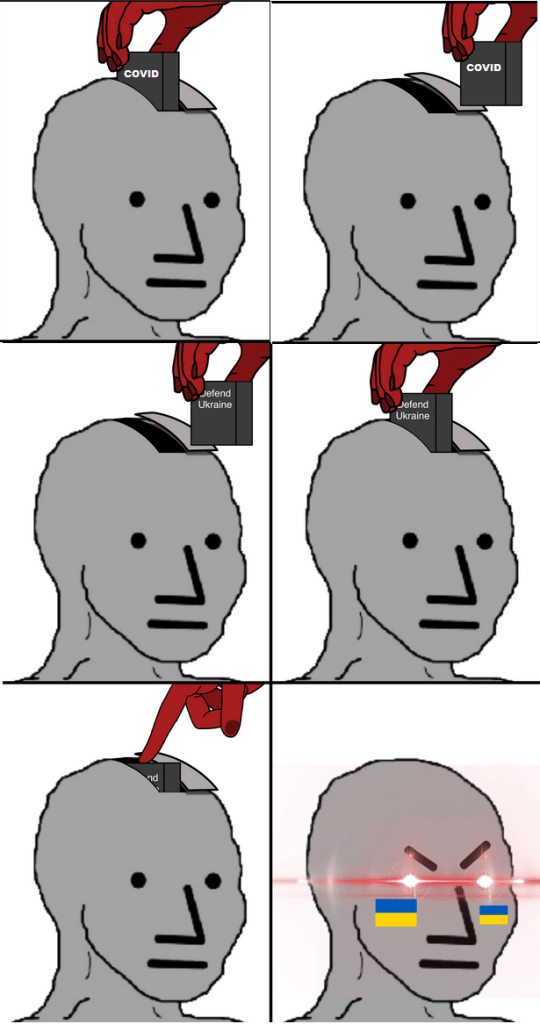
It’s the signal for the sheep to start bleating a new tune (remember the scene in Nineteen Eighty-Four when, right in the middle of Hate Week, the Enemy becomes the Ally? Creepy how much Orwell foresaw, isn’t it?) As “Simplicius” remarks: “Of course, most of it is news only to the NPCs who’ve subsisted on main courses of MSM consumption.”

The real news is not what they say; it’s

that they say it.

I didn’t bother to read the whole thing but I saw enough to recognise a familiar tune. One of the principal themes of my writings in this site is that Washington and the West generally have very poor knowledge of Russia (here I am in 2018). Most of it is based on unexamined assumptions complacently adhered to. And here we see it again. Let’s start a short, victorious war. And we know that it will be short and victorious because Russia’s economy is weak and sanctions will collapse it in a couple of months; Putin’s underbosses will whack him out if we can make them hurt; their weapons are ancient junk; their generals are unimaginative clods; their tactics are inept; their soldiers are poorly trained dregs. We. on the other hand, are the greatest warriors with the best generals and the best weapons ever.

My very favourite example of this ill-informed self-satisfied overconfidence all in one go from a British source from 2023 just before the big offensive:

As a former tank commander, I can say one thing for certain: Putin’s demoralised conscripts are utterly unprepared for the shock action now hitting their lines. Ukrainian armoured formations are beginning to meet Russian forces in battle, and they are going to pulverise Russia’s defensive lines. I am confident for one simple reason: Ukraine will follow the Western ideology of manoeuvre warfare in a combined arms context, while the Russians will follow Soviet doctrine, relying on attrition and numbers. The Russians will find that the armour of Western tanks is far more resilient than flesh and bone, they will die in great numbers, and they will lose.

Whatever else it may be, war is the ultimate reality test and, when the confident assurance fades, step by step, the sunk cost fallacy will drag the West deeper into the bog. Babbling about Russia’s dependence on refrigerators is replaced by they’re out-producing us four-to-one. The years roll by and it’s suddenly time to get out however you can. Just like Vietnam, Iraq and Afghanistan. And, like those, no lessons will be learned because we won or at least we would have if only the wind hadn’t blown so hard or our allies weren’t so useless or something else beyond our control. (Do they read Clausewitz at West Point? Ever heard of the Correlation of Forces? How about Sun Tzu’s famous quotation about knowledge?)

Nothing short of genius can account for losing so consistently given the enormous resources available to American forces. In light of this very low level of military competence, maybe wars are not our best choice of hobby.

As the toilers at MiniTrue re-write and the Memory Hole burns, we wait for the next Russian disinformation to suddenly turn into information. Lots of NATO troops in Ukraine? “The Revolution of Dignity” was Made in America? NATO provoked the war? Every chance to settle the problem peacefully was torpedoed by Washington or London? Ukraine is full of Galician nazis actually making the big decisions? Bucha was a fake? So was the maternity hospital?

*************************************

(By the way, as most of you already knew, because propaganda is about impressions not details, there’s no penalty for failed predictions and the British guy quoted above is still at it: “Whisper it, but the tide might just be turning against Putin:The American president has lost patience with the Russian leader – so has his own people… within Russia’s top brass, the knives are out for their leader”. Evidence? A mis-interpretation, two false “facts” and the usual inflated casualty figures.)

COMMENTS FROM THE LOCKED WARD

(Miscellaneous comments from pieces dealing with Russia I’ve collected. Most of them anonymous or with pseudonyms. They are chosen to illustrate either rabid hostility to everything Russian or stone-dead ignorance of present reality. I post from time to time when I have enough, spelling mistakes and all.)

European nation need to start enriching Uranium and building nuclear weapons NOW!

Because once we are in a confrontation with russia it will be too late.

Because the moment putin’s spies tell him a European nation is producing fissile materials he will nuke European cities.

This (posted yesterday) from one of my favourite pro-Ukraine accounts on X. What I particularly enjoy is that he has pinned (ie the first thing you see on his X account home page) that Russia has already lost the war in Ukraine and that Putin is doomed and he knows it. This dated three years ago.

Think about what he’s saying above: Europeans have to start building nukes to protect themselves from Russia and, as soon as they do, Russia will nuke them.

ANOTHER ANNIVERSARY DOWN THE MEMORY HOLE.

On 26 January 1934, 91 years ago, Hitler was four days away from his first year as Chancellor. The Enabling Act of 23 March 1933 had given him and his National Socialist party virtual dictatorial powers but he wouldn’t become Supreme Leader for another eight months. But you’d have to be pretty dull not to realise in January 1934 what was happening in Germany and who and what Hitler was. (It’s one of the most tedious books ever written but it had been out there for nearly a decade and the author, then an imprisoned nobody, has actually made it to the top of the power pyramid. So anybody within range of Germany should read it and take what it says seriously.)

We’ve all heard of the “Hitler-Stalin Pact” of 1939 when these two BFFs got together to eat Poland and kick off the Second World War, haven’t we? Only a real monster like Stalin could do a deal with another real monster like Hitler, right?

That’s what we’re told today but, actually, the facts aren’t there. In my last few entries on this site I’ve mentioned Michael Jabara Carley’s research on Soviet efforts to form an anti-Hitler coalition, mentioned the ludicrously late and low-level British-French military mission to Moscow well past the eleventh hour on the countdown to war, the Anglo-German Naval Treaty of Hitler Year 2 and other things that have gone down the Memory Hole.

No, the truth is that Stalin was not the first guy to do a deal with Hitler. He was the last guy.

This is the first guy.

And, according to the standard Western narrative, the last one whom you’d expect.

Check it out on Wikipedia.

**************************

My point is this. A lot of the foundation for explaining what’s going on today that we’re presented with is very selective. Those who don’t know the history are easily gulled into swallowing this syllogism: Hitler was a monster; no one would have anything to do with him except that other monster Stalin; Putin is Stalin’s successor; therefore he is a monster; we must resist Putin otherwise it’s 1939 all over again.

Far from being a ‘liberator,’ the Soviet Union was a facilitator of Nazi Germany and a perpetrator of crimes of its own“; this five years ago to justify not inviting Russia to the anniversary of the liberation of Auschwitz. “Aggression of 17 September 1939 ‒ the historical lie of the current policy of the Kremlin”. These are, of course, attempts by Warsaw to cover up what you have just learned because mentioning the Hitler-Poland Pact would spoil the story.

But not only Poles want to replace reality with a constructed narrative; here’s the BBC six years ago:

President Putin argued that Stalin had tried to forge an anti-Hitler alliance with Britain, France and Poland, but that the Munich Agreement in 1938 – dooming Czechoslovakia – had scuppered that plan. Stalin then had to reach a deal with Hitler, feeling betrayed by the West, he argued. However, Western historians point out that the Nazi-Soviet Non-Aggression Pact meant Hitler did not have to fear a clash with the USSR if he invaded Poland, so giving him the assurance he needed.

While each statement is true, the second is not the answer to the first, as the writer is trying to pretend. Another (British) masterpiece of elision is this so-called “deep dive”:

The Rapallo Era ended nine months after Hitler assumed power in 1933 and, at his orders, the secret facilities closed one by one. While mistrust pervaded Soviet-German relations over the next six years, ties were never completely severed, Johnson writes. In spring 1939, both Stalin and Hitler proved open to renewing cooperation and in August, the country’s two foreign ministers signed a treaty of nonaggression, known as the Molotov-Ribbentrop Pact.

Selective indeed: yes Germany and the USSR cooperated in the 1920s, yes that cooperation was a big help to the German military. But leave out the Soviet attempt to stop Hitler because it will spoil the story; just jump over six years as if they didn’t exist. And so we have the WSJ in 2020 accusing Putin of having “rewritten history for political ends” when it’s actually the other way round.

But Memory Holes are not as all-efficient as in Orwell’s novel and the Internet remembers a lot: “Stalin ‘planned to send a million troops to stop Hitler if Britain and France agreed pact‘”; “But the British and French side – briefed by their governments to talk, but not authorised to commit to binding deals – did not respond to the Soviet offer, made on August 15, 1939”. Very rare that, but it dates from 2008 well before MiniTrue took the present line on Russia. (There’s even a preserved video of the Anglo-French mission setting off. By ship!)

It’s history written backwards so that today these partial and selective narratives can be used to reinforce contemporary positions. Disinformation they call it.

Today is the anniversary of one of the things left out.

Did it make you doubt the received version, Dear Reader? What else is Memory Holed?

**************************

How about this? Maybe Poland wasn’t the first foreign entity to think it could do a deal with Hitler. You’ll find this one, from 25 August 1933, even more surprising. Check it out on Wikipedia.

Real history, in contrast with carefully pruned afterwards “history”, shows that almost everybody tried to do a deal with Hitler.

ANOTHER ANNIVERSARY NOBODY REMEMBERS

On this day, 18 June, in 1935, the Anglo-German Naval Agreement was signed. The two sides agreed that the German Navy’s total tonnage would be fixed at 35% of the Royal Navy’s tonnage. Not, when you think about it, a very intelligent agreement from London’s perspective. One of the causes of the First World War had been British concerns about the size of the German Navy and yet where did they think this one-third-as-big navy would be based? Obviously in the North Sea; the British, with their world-wide empire, would have most of their ships elsewhere, In short, London was agreeing that the Germans could have near-parity in the waters closest to it.

But worse. The agreement was the first violation by a great power of the Versailles conditions and had been done without consultation with any of Britain’s allies. It was the first, and therefore legitimating, agreement made by a great power with Hitler’s Germany.

(Unless you count Poland as a “great power” as the Polish government certainly did. It had signed a non-aggression pact with Hitler’s Germany eighteen months before. A French diplomat remarked that he saw a repetition of a pattern of Polish history: overestimate your power, step too far, be divided up by your neighbours.)

Soon after Hitler’s takeover in Germany, Moscow (which is to say Stalin) understood four things: 1) there was no possibility of returning to the previous good relations (Rapallo) 2) Hitler was a threat to all around him 3) Hitler would break any agreement as soon as he felt strong enough to 4) the only possible response was an alliance/coalition/agreement of Germany’s neighbours to block him. This became the Soviet Union’s principal foreign policy; as a Soviet diplomat put it to a French colleague, Soviet policy was very simple: “It is dictated by the fact that all that reinforces Germany we are against, and all that reinforces France, we are for”. Soviet diplomats were dismayed when they told their interlocutors that Hitler had plainly stated his intentions in Mein Kampf and received flippant answers like that’s just a ten-year old book and nobody ever does what he said he would when he gets in power. A ten-year old book given to every newlywed couple and soldier; definitely not something to ignore.

Many agreed with Stalin – President Roosevelt for example, in conversations with Litvinov, even proposed a US-Soviet non-aggression pact. In the UK in particular, the affable Soviet Ambassador, Ivan Mayskiy had found agreement on these four points with Robert Vansittart, the senior civil servant in the Foreign office, with Lord Beaverbrook, the powerful press baron, and even with the arch anti-Bolshevik Winston Churchill. Mayskiy discussed the world situation with the three many times, agreeing that the biggest threats to peace were Germany in Europe and Japan in Asia and that the coalition proposed by Moscow was the only hope of avoiding another great war. But Vansittart did not make policy, Beaverbrook could only push the line in his newspapers and Churchill was very far from power. Similar attempts in France failed, despite the support of General Weygand and other important officials, because of the instability of French politics and the effective opposition of Pierre Laval. And Poland was a constant worry: how close to Hitler was it getting? The smaller countries weren’t going to move without France or Britain. But many people in many countries agreed with Stalin and were working towards an anti-Hitler coalition.

The Anglo-German agreement was a shock to these hopes. London had given recognition to Hitler’s coup d’etat, made a bad agreement with him, ignored its allies and tossed Versailles overboard. Encouraging to Hitler and dismaying to his opponents.

Following his policy of pushing another step while professing eternal peace, Hitler re-occupied the Rhineland, demilitarised by Versailles, in March 1936. London and Paris did nothing and, once again, Hitler’s assessment proved out. How much did the naval agreement make him think he had the measure of London’s firmness of purpose? Do you think he would have done it had there been a USSR-France-UK plus Romania and Czechoslovakia alliance?

And, just as Stalin predicted, Hitler repudiated the naval agreement in spring 1939 along with the 1938 Munich agreement on Czechoslovakia and the 1934 pact with Poland. Moscow continued with its efforts to create an anti-Hitler force but with less and less hope. The final flicker was the abortive Anglo-French-Soviet military talks in late 1939. Giving up, Stalin accepted Hitler’s offer, signed a pact with him and the overconfident Poland was again eaten by its neighbours. (“‘We do not fear, [Józef Beck, Polish Foreign Minister] was reported to have said, [in 1934] ‘attacks on the part of Germany’.”)

The stock Western story remembers to forget this. Instead the story is 1) Munich (and for the neocons the time is always September 1938 and the place is always Munich) and 2) Hitler and his soulmate Stalin allying. Even so, every now and again the corporate media forgets to forget it: “Stalin ‘planned to send a million troops to stop Hitler if Britain and France agreed pact'”. And here we have a perfect example of the customary “forgetfulness”: for this historian the Soviet-German clock stopped in early 1933 and started up again in late 1939 :

The Rapallo Era ended nine months after Hitler assumed power in 1933 and, at his orders, the secret facilities closed one by one. While mistrust pervaded Soviet-German relations over the next six years, ties were never completely severed, Johnson writes. In spring 1939, both Stalin and Hitler proved open to renewing cooperation and in August, the country’s two foreign ministers signed a treaty of nonaggression, known as the Molotov-Ribbentrop Pact.

Evidently we’re supposed to believe that absolutely nothing (well, a teensy-tiny bit of “mistrust” if you insist) happened in Soviet-German relations over nearly seven years. (But to fill in the gap would spoil the simple story of Hitler, Munich, Stalin-Hitler wouldn’t it?)

History is indeed little more than the register of the crimes, follies, and misfortunes of mankind.” Hitler could have been stopped.

Once again I am indebted to Michael Jabara Carley’s work. I have just read his Stalin’s Gamble. This, the first in a trilogy, details the dismal story from Hitler’s coup until early 1936. Because of his three decades of labours in the archives of the principal countries, he has seen the notes taken by everyone of every meeting and diplomatic event; he can therefore tell us all sides of the issue It’s a dismal story because, hard as it may be for many in the West to accept, Stalin’s take was completely accurate. All his four points, which he had formulated by the end of 1933, came true. And the tragedy is that the foreign officials who agreed with him could never quite push their countries over the finish line. And so the alliance that could have deterred him never happened and only in the disaster of a great war did it eventually form.
“LISTEN TO WHAT HE’S SAYING”

I’m fond of quoting the Duke of Wellington on intelligence:

All the business of war, and indeed all the business of life, is to endeavour to find out what you don’t know by what you do; that’s what I called ‘guessing what was at the other side of the hill.’

Find out what you don’t know by what you do“. It’s not easy, it’s not necessarily pleasant but it’s what you have to do in order to minimise your surprise when whatever it is actually comes over the hill at you.

Here’s former British Ambassador to Russia Laurie Bristow saying the same thing:

My advice to all young diplomats and analysts [is that] if you want to understand Mr Putin’s foreign policy, listen to what he’s saying. You won’t like it, but you need to understand it, you need to listen to it. The place to start is the Munich speech in 2007.

Listen to what he says”. It’s quite easy to. Putin has said a lot and most of it appears on the Presidential website in English as well as the original Russian. Never read what the Western reporters say he says – they almost always distort it – read the original. I’m sure that both Wellington and Bristow would agree.

And that’s what intelligence is all about. Try and understand how the other guy sees things. I have spent the last four decades trying to figure out what’s going on in Russia. I do that by reading what they say and watching what they do and trying to connect the two. Of course you should listen carefully to Putin and other officials, but there’s lot’s more you have to do. A country with a space program like Russia’s probably doesn’t need to steal washing machines for their chips. The West outsourced its manufacturing, Russia didn’t; so Russia can probably make lots of weapons if it has to. Putin has very high levels of support; outsiders probably can’t weaken it. The Russian economy is very self sufficient; sanctions might not have much effect. Russia’s making lots of new infrastructure; it’s not some poor country struggling along. Check these videos out: they’re Google street views of Russian towns ten years apart; the Western media certainly gives you a different impression about life in the Russian boondocks, doesn’t it? Look, listen, think. I’m sure that both Wellington and Bristow would agree.

If you don’t bother, if you blither on about “your values”, the “Rules-Based International Order” and your power and excellence, all you’re doing is looking in the mirror and seeing a slim muscled figure in place of your flabby overweight body. And, sooner or later, you’ll be very sorry because reality will bite you.

I have written many times on this site about bad Western intelligence and the unending stream of nonsense spewed in the West about Putin. Indeed, if there is one big theme of my website it’s that the Western view of Russia and Putin is almost completely false. In a word, Russia is much much stronger, in every way, than the Western establishments thought it was.

This is all being revealed in Ukraine right now: the Western “experts” were all wrong. March’s A total Russian collapse is surprisingly close puffs itself up to May’s Putin is terrified of Ukraine’s counteroffensive; then the bubble bursts and the very same “expert” declares Ukraine is losing, but the UK must stand by it. Their false expertise has cost thousands and thousands of lives. More and more witnesses have appeared to say that Kiev and Moscow had almost reached an agreement that would have stopped the fighting when the West encouraged Kiev to keep fighting. The reflection in their mirror told them that Western “game changer” weapons would terrify Putin’s unmotivated, poorly trained conscripts and their junk weapons. Here’s RAND, a year ago, solemnly pronouncing Russia’s failure:

Also, over the longer term, Russia does not have the capacity for a long war in the face of economic sanctions. Although Russia can continue to generate revenue from oil and gas exports, it does not have the ability to manufacture advanced weapons or even sufficient materiel to keep the Russian army fielded.

Then reality bit. The Western spinmeisters now redefine success, decide that victory doesn’t involve keeping territory and strengthen resiliance.

The bargaining stage of Kubler-Ross’ five stages.