The current dramatic economic and social situation in the country is the price, which we have to pay for the economy we inherited from the Soviet Union.
Vladimir Putin “Russia at the turn of the millennium”, 1999
The current dramatic economic and social situation in the country is the price, which we have to pay for the economy we inherited from the Soviet Union.
Vladimir Putin “Russia at the turn of the millennium”, 1999
It is not possible to have a strong state without respect for human rights and freedoms. (Между тем сильное государство немыслимо без уважения к правам и свободам человека.)
Putin address to Federal Assembly, 8 July 2000
Only a strong – effective, in case someone does not like the word strong – effective democratic state is able to protect civil, political and economic freedoms and to create the conditions for a good life for the people and the prospering of our native land. (только сильное, эффективное, если кому-то не нравится слово “сильное”, скажем эффективное государство и демократическое государство в состоянии защитить гражданские, политические, экономические свободы, способно создать условия для благополучной жизни людей и для процветания нашей Родины.)
Putin address to Federal Assembly, 8 July 2000
They [the oligarchs] see the mass media as their chief instrument of influence over the state. They have all become accustomed, especially recently, to getting everything they want from the state and using it as they want. They don’t want to live in accordance with the law, and I don’t think that’s right.
Putin interview in Globe and Mail, Geoffrey York and Chrystia Freeland, “We are not looking for enemies”, 14 Dec 2000
http://russia-insider.com/en/i-wasnt-really-wrong-when-i-said-putin-would-retire/ri10223
I did not expect Putin to return for a third term and on August 2011 I said he would not. In September (that’s fast!!) I had to eat my words. But I wasn’t happy to: while I thought Putin was a pretty effective leader – maybe the best Russia has ever had, in the last thousand years, anyway – every leader (and everything else) has a “best before” date. There’s a time when a leader runs out of ideas and creativity, a time when the sycophants figure out what buttons to push (“I know you don’t like flattery boss; that’s one of the things I admire about you”), a time when subordinates start plotting, a time when the Old Guy’s past it and it’s time to think about our futures and so on. Putin’s not there by a long shot, but it will come one day. Better to leave at the top of your game.
And, I have to admit, there was some personal embarrassment on my part – a US Congressman was ranting to me about how Putin was just power-hungry and I stopped him by saying: then why isn’t he president right now? Well, the last laugh’s on me, isn’t it? He’s president again and maybe he never really stopped being the real boss.
So why did he come back? Why does he risk becoming the Turkmenbashi of Russia?
I prefer to think that he’s not just the power-crazed dictator that the US Congressman thinks he is. And so fearlessly risking another episode of logophagy, I offer another theory which allows me to preserve my August 2011 idea and pretend to have been right all along while actually having been wrong. (A bit like being an op-ed writer, in fact. It’s nice to have a rolling memory that forgets when you were wrong. Take, for example, Der Spiegel, which now blames Merkel for the whole sorry mess in Ukraine without ever admitting its own responsibility for whipping up the hysteria. But I, unlike Official Journalists©, know that the Internet Never Forgets.)
So, why did Putin not take my advice and return to the presidency?
Libya, in a word. Consumers of Western media outlets who can still remember the dim, distant days of March 2011 will recall that Qaddafi “was bombing his own people”. First appearing, I think, on Al Jazeera, the story spread everywhere and was amplified by the West’s pet “human rights” N”G”Os. There doesn’t appear to have been any evidence that he was – and a later report concluded that he wasn’t – but this was the mantra. And, it’s important to remember, “humanitarian bombing” episodes are always preceded by unanimity in the media; we’ve seen it in Kosovo and Syria and more recently in Ukraine – every news outlet saying exactly the same thing at exactly the same time.
“Bombing your own people” is a terrible, terrible thing and “something must be done”. (or, rather, it was then: not so important today in Ukraine). The US and its allies went to the UN and secured a resolution to create a “no fly zone” so as to stop Libyan government aircraft from “bombing his own people”. Russia (and China) abstained rather than veto.
To make a long story short, NATO paid no attention to the text of the resolution. They bombed everything, then they supplied weapons, then special forces trainers, then forward air controllers. At the end, after seven (seven!) months, Qaddafi was run to ground and brutally killed. Hillary Clinton’s cackle should not be forgotten.
All appearances suggest that Washington and those NATO members who participated lied from start to finish: they never meant the “no fly zone” stuff and they always intended to overthrow Qaddafi. They played Moscow and Beijing for suckers.
Well, my guess is that Putin is tired of Russia being played for a sucker, tired of Washington & Co bombing everyone it wants to whatever pretext it invents (is Russia on the list?). My guess is that President Xi agrees with him (could China be on the list?) In fact he/they is/are thinking some unthinkable thoughts. I suspect they may be entertaining the notions that, under present management:
There is no honour, no consistency, nothing to be trusted in Washington. And, worst of all, pace Palmerston, they don’t even know their own interests (Stupidity is very frightening when combined with Washington’s military power).
Washington is, and will be, Russia’s (and China’s) enemy.
And that is why I think he came back. He foresaw, thanks to the US/NATO deception on Libya, that hard times were coming for Russia. Only he had the necessary muscle to both over-awe the contending factions in Russia and, at the same time, stand tough against the threats.
And the Ukraine nightmare has shown he was right. In the eleven month period from delaying the EU agreement (v2013) to delaying the EU agreement (v2014), Russia has been ceaselessly calumniated and provoked. Putin, leading and controlling his team, has proved cooler, calmer and cleverer than his enemies.
There is nothing about US actions in Syria that will make him think differently.
What did we hear in his 2014 address to the Russian parliament? – a speech, you may be sure, in which every word is tried out, tested and tasted.
Could anything be plainer than that? We tried, they rejected us; we tried again, they spat again. One last attempt… That’s it. It’s over. He’s come to the end, past the end, of the rope. So, altogether, Putin read the tea leaves and I did not.
http://us-russia.org/941-is-russias-anti-corruption-drive-the-real-thing.html
http://english.ruvr.ru/experts13/
(Other discussion http://globaldiscussion.net/index.php?%2Ftopic%2F112-is-russia%E2%80%99s-anti-corruption-drive-the-real-thing%2F
JRL/2013/31
Vlad Sobell mentioned two theories: Putin might be seriously attacking corruption or it’s only inter-clan fighting.
“Clannology” has been a popular notion for years. In the early Putin years I remember an intelligence agency proudly presenting its typology. Three clans were fighting: “Family”, “Siloviki” and St Petersburg? – I can’t recall now. Unimpressed, I asked: What have we learned from this? What is explained? What is predicted? “Clannology” has nothing to offer: it has Popper’s fatal sin of not being falsifiable. Whatever happens will be fitted into the theory: Putin and Medvedev fall out, different clans; they don’t, same clan. A theory that explains everything, explains nothing.
So we must (Popper again) make a falsifiable hypothesis that Putin really is making a serious attack on big scale corruption and ask what would be the evidence that he is. Let us consider three hypothetical corruption examples. A hospital exists, but the staff demand bribes to do their jobs. The hospital exists, but the money for many items was stolen. No hospital exists because the money was stolen before anything happened. Arresting the bribe-taking staff is not evidence of a serious anti-corruption drive: they’re little guys and easy to catch. Arresting the locals who divert some of the money is better but the real effort must be getting the big thieves – the connected people who can make money disappear before it appears. Big Russian corruption – vide the OboronServis case – resembles the third example: money allocated for some public purpose is diverted to private benefit by people at the top of the money flow. This is much more serious than some traffic cop scoring a free lunch: more money is stolen, further up the power chain and it therefore corrupts the body politic more. Putin has to bite into this layer to reverse behaviour and send the message to the big thieves who think they are immune.
In short, someone high up must be arrested; otherwise thieves just learn that it’s better to steal big than steal small. No such arrest has yet been made although the dismissal of Serdyukov has put us within sight of one. (And, pace the clannologists, Serdyukov, appointed and retained by Putin in a very important ministry, would surely have been considered a member of Putin’s clan). Former Moscow Mayor Luzhkov’s fate, or his wife’s, while they are a few orbits away from the inner ring, is also something to watch. Talk about their malfeasances has quieted but the Prosecutor General’s Office moves slowly. And investigations must be done properly, with evidence, otherwise it’s not a real campaign.
Can we put a time limit on this? I would suggest, given that Putin recently described corruption as “the biggest threat to our development”, that we should see someone in the inner ring, or an orbit away from it, charged before the end of Putin’s current term. (Unless they are all pure. Which no one believes.)
But it’s possible Putin will try but fail: in 2007 he was asked “How can you control corruption?”, “Unsuccessfully” said he, “We are addressing this issue unsuccessfully.” It won’t be easy to take a bite out of people who have been stealing for years.
Medvedev recently said that there were about 50,000 corruption cases being investigated. If half of these go nowhere and 90% of the rest are small fry, that still leaves several hundred potentially big cases that we may hear about. I believe that an effort is indeed being made, but it has not yet passed the test of one of the inner ring being punished.
http://us-russia.org/392-how-will-history-judge-putin.html
I believe that “history” will judge Putin as one of the best leaders Russia has had in its thousand year history.
Or would have so judged him had he retired.
When he came to power, according to his “Russia in the New Millennium”, he set himself four tasks: to reverse the economic collapse, to reverse the decay of central power, to improve Russia’s status in the world and to institute a rule of law, or at least a rule of rules. On his watch these goals were achieved to a considerable extent (the last, less, to be sure). Most leaders are lucky if they can attain even a few of their goals, partially. Putin did much better.
But he missed one thing: to set an example to his successors that two terms are enough for any mortal.
If he built a system that can’t work without him, then it doesn’t work.
He runs the risk of “history” judging him the Turkmenbashi of Russia.
http://www.expat.ru/analitics.php?item=1124
Note February 2016. These were done for the Russia Profile Weekly Experts’ Panel which I cannot find on the Net now. Many were picked up by other sources and I have given links where I can find them.
As that great Russianologist, Sherlock Holmes, observed: “It is a capital mistake to theorise before one has data. Insensibly one begins to twist facts to suit theories instead of theories to suit facts.”
I’ve never had much use for Kremlinology, either in The Day or now. It is founded on two fatally weak conjectures. The first is the reductionist notion that Russia (or, in The Day, the USSR) can be explained by the relationship between a small group of individuals. Where is the evidence for that? But most absurdly, it imagines that we outsiders can understand what those relationships are. Do we, after all this time, understand the relationship between Lenin and Stalin? Or Stalin and Voroshilov? Or Stalin and Beria? Why should anyone think we understand the relationship between Putin and Medvedev and how they make decisions? We don’t even know what goes on inside our own governments’ offices. Kremlinology’s predictive record is negligible.
A decade or so ago, Neo-Kremlinologists spent their time categorising people into groups: the Family, the Siloviki and I can’t now remember the third; but, for some reason, these airy constructions always had three groups. Then I recall a period of speculation that Putin had created a “politburo” in the Security Council to sideline the government. I’m sure I’ve forgotten many other weighty thinkpieces that came and went scrying the future through imagined personal relationships. None of these efforts ever produced much that was either predictive or explanatory.
Furthermore, it ought to be pretty clear, after more than a decade’s observation, that Russia has a remarkably collegial, discreet and effective management team. While a few former insiders have gone over the opposition (Kasyanov, Illarionov and presumably Kudrin) it is striking how well the Team has held together. The second thing a decade’s worth of observation tells us is that Putin is loathe to kick someone into the darkness and so we see today that old ministers have been “kicked upstairs” to advisory positions in order to preserve their dignity and make way for new people in the government. (Perhaps Putin has learned from Lyndon Johnson: “It’s better to have some one inside the tent…”).
Thus, there is no second or parallel government: there is a Team. The same team that has been running the place for 12 years. Any disagreements are kept inside the box.
It is much better to regard Russia’s governing structure as a “black box”: observe what is said and what happens rather than speculate about the unseen gears inside the box.
Note February 2016. These were done for the Russia Profile Weekly Experts’ Panel which I cannot find on the Net now. Many were picked up by other sources and I have given links where I can find them.
Can’t find a reference.
The Western Kommentariat finds in Putin’s remarks about Western (ie Washington’s) influence on the protests to be an “extraordinary attack” showing that he may be taking “a harder line against Russia’s opposition”. As usual there is no attempt to consider his perspective. Let’s try: here are some of the things Putin sees.
BelayaLenta.com, the supposed Russian protest group, (White Ribbon – you can’t have a coloured revolution without a colour) appears to have come into existence in October and gives its address as Bellevue, WA 98007 USA. By the way, white armbands were worn by collaborators in Nazi-Occupied USSR – not the most felicitous choice of colour.
Golos, the so-called “independent” Russian election monitor, seems to have some interesting communications with US officials with the suggestion of payment for the “correct” results. It receives funding from the USA. Independent? Only if you think Washington’s motives are the disinterested pursuit of democratic virtue.
Hillary Clinton was very quick off the mark to condemn the results, far more so many international observers who saw nothing untoward and much stronger than the official OSCE report. Almost, a cynic would say, as if she had been handed, by accident, as it were, the briefing note prepared in case United Russia claimed much more than opinion polls predicted.
The Western MSM is in full cry about how the elections were fraudulent, making up numbers where necessary to justify the preconception (“United Russia’s real vote in Moscow was 23.5%”).
What else does he see?
An election outcome, long predicted in opinion polls, in which his party lost a lot of support.
Even those who are looking for fraud aren’t finding it. Vedomosti’s recount in Moscow has turned up what it claims are 7456 votes for United Russia stolen from other parties in 294 voting stations (totalling about 440,000 votes). Given that it is finding fewer examples as it looks at more stations (it started with what it considered to be the worst cases), it is running into diminishing returns. Indeed the effort seems to have stopped – nothing has been added to the website since 14 December. Even if Vedomosti’s accusations are correct, 7500, or 15,000 or even 30,000 votes in Moscow City’s seven million voters amounts to a few tenths of one percent. Hardly the fraud the Western media is talking about.
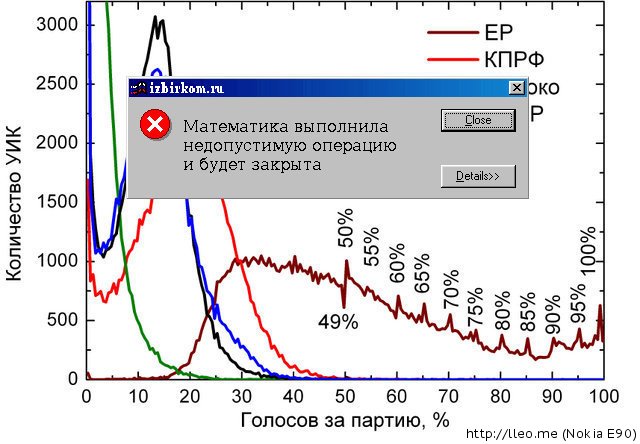
The popular non-Gaussian argument is declared here to be bad mathematics and the author proves his point by showing similar non-Gaussian statistical effects from the latest UK election.
The North Caucasus results are suspicious but minorities are very good at maximising their presence at the centre (I commend a study of Quebec which, for more than a century, has managed to do this – even abandoning normal preferences when necessary. See the 2011 results for an especially dramatic example of a landslide of support switching).
Perhaps all this reminds Putin of other campaigns involving exit polls (very easily faked), press campaigns (easily started) and foreign funding (always present). True, the “White Revolution” is still missing a new leadership team. Could it be Zyuganov and Zhirinovskiy? After all, they took two-thirds of the seats United Russia lost and if the election was stolen, it was stolen from them.
So, his conclusion is not the wild fantasy of a diehard enemy. I see these things and wonder too.
Note February 2016. These were done for the Russia Profile Weekly Experts’ Panel which I cannot find on the Net now. Many were picked up by other sources and I have given links where I can find them.
https://wikileaks.org/gifiles/docs/60/60513_-os-2011-222-johnson-s-russia-list-.html
JRL/2011/222/21
The preliminary results show United Russia down about 14 points, the Communists and Zhirinovskiy (who, to some degree, share an electorate) up about 10 points (to their combined level of the 1999 election, thereby reversing a gentle decline in their total since the high in 1993 when they totalled 35%). Just Russia is up about 6 points and the other three parties remain in the weeds, failing to cross the 7% entry barrier (or the coming 5% for that matter). Turnout is down about three and a half points. Given the way the calculations work, therefore, United Russia will have about 225 seats, well down from its 315 the last time around. It would seem therefore, that of the now-disgruntled former United Russia voters, some stayed home, some voted Communist or Zhirinovskiy and some voted for Just Russia. In any case, Yabloko and Right Cause – the “liberal” parties – did not profit.
Putin & Co are victims of their own success. Yeltsin’s team tried to create “pedestal parties” to support him in the Duma – Russia’s Choice, Our Home Russia – but they were feeble attempts: hurriedly assembled, indifferent performers and soon forgotten. United Russia has proved to be more enduring and more successful. But it has the weakness of being only a pedestal for the Boss to stand on: its ideas are the Boss’; its members are the powerful and their hangers-on; its notion of creativity is waiting for the phone to ring. All deficiencies that Putin and Medvedev have complained about many times. This is not inspiring and it is clear that the population is tiring of it. Although it is worth pointing out that in any parliamentary system, 50% would be regarded as a major victory. But nonetheless a fall from two-thirds to one-half is not a vote of confidence.
Putin and Medvedev are taking it calmly. Indeed, since the result accords well with opinion polls from many sources over some months, they must have known it was coming.
Which raises, to my mind, the principal lesson that should be clear to everybody: Russian elections do, reasonably accurately, represent the state of feeling in the country. Of course there is fiddling at the edges, pressure is brought to bear and all the rest. But no country can afford to preach because no country runs a stainless system. But, as I and others have maintained for years, Russian elections do give, grosso modo, the state of the nation. In short, they are sufficiently free and fair.
The anti-Russia league, for whom it is and always has been an unshakeable article of faith that Russian elections are phoney, will have great difficulty in continuing to claim that Russian elections are manipulated, decided-in-advance, shams created by the Kremlin to fool the simple-minded. Efficient dictatorships run efficient elections; even if they have to throw out the ballots and replace them with the “correct ones”. It is inconceivable that the cunning and evil master manipulator that they believe Putin to be would have manipulated the results so that his party lost 90 seats and its command of parliament.
But I’m sure that they will try to save their theory, no matter how they have to twist reality. I look forward with amusement to watch them.
 Russia Observer